All species › Waders, gulls and terns › Plovers and lapwings › Pacific Golden Plover
Pacific Golden Plover | Pluvialis fulva
Aziatische goudplevier | Chorlito dorado del pacífico
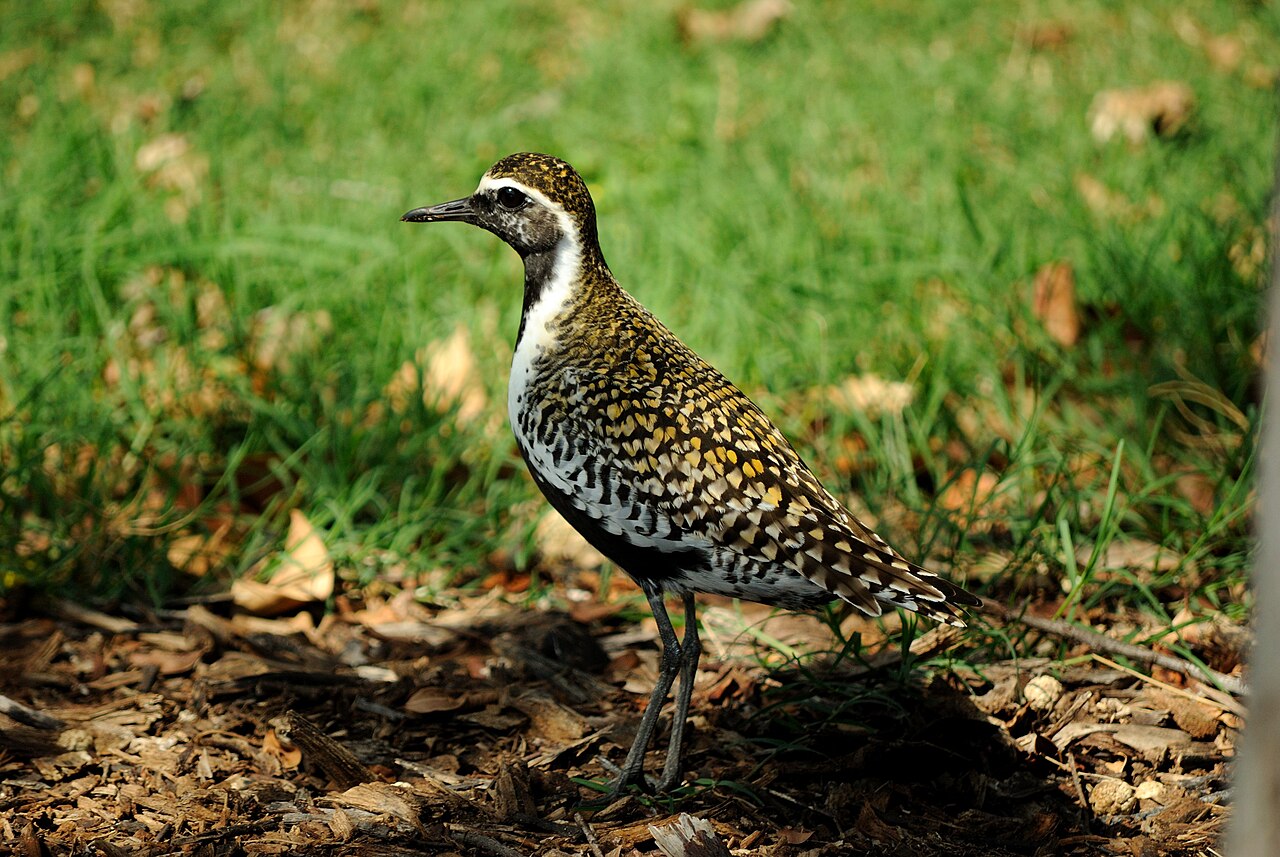
The Pacific Golden Plover breeds on the tundra of Alaska and northeastern Siberia and winters here: from September to April it stands on Australian and New Zealand saltmarsh, playing fields and tidal edges. It is the slimmer of the two golden plovers of this region and owes its name to the golden spangling on back and crown.
Voice
The flight call is a clear, melodious two-syllable whistle, tlu-ee, rising at the end and carrying the length of an estuary; alongside it comes a shorter chu-wit. In March and April, as flocks gather to leave, snatches of song are sometimes heard: slow, slurred whistles with pauses between them.
No freely licensed recording has been found for this species yet; what to listen for is described below.
Identification
A slim, upright plover of twenty-three to twenty-six centimetres with a rounded head, a short fine dark bill and long dark legs that project well past the tail in flight. In non-breeding plumage it is gold-spangled brown above, with a marked pale eyebrow and a buff-apricot wash with dark speckling across the breast. In breeding plumage, taken on in March and April, face, throat, belly and flanks are black inside a white border, and crown, nape and upperparts are densely spangled with gold, black and white. In flight there is no obvious wingbar, no white rump and a uniformly grey underwing.
Confusion species
Grey Plover (Pluvialis squatarola) is the case that matters and often stands in the same flock: bulkier and larger-headed, with a heavier bill, shorter legs, grey rather than golden upperparts, and in flight a white rump, a white wingbar and above all black axillaries. If the armpit is black it is a Grey Plover; if the underwing is uniformly grey, a Pacific Golden Plover. On short inland grass it sometimes stands beside Oriental Plover (Anarhynchus veredus), but that bird has pale yellow legs, plain sandy-olive upperparts and no golden spangling. Asleep in a mixed roost it can suggest a Double-banded Plover (Anarhynchus bicinctus), but that is smaller and shorter-legged.
Habitat
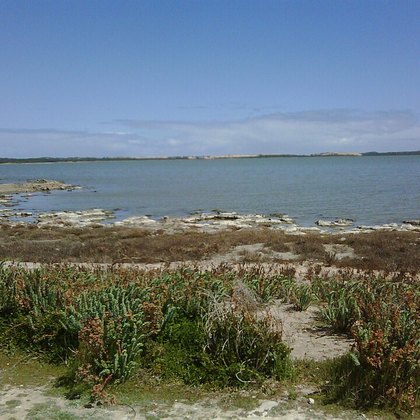
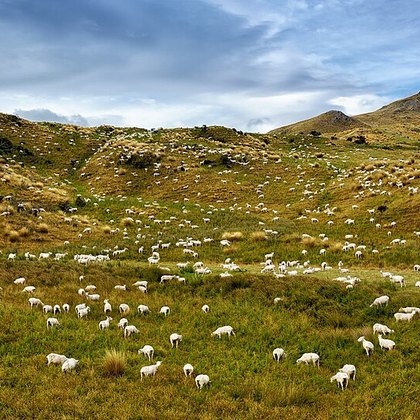
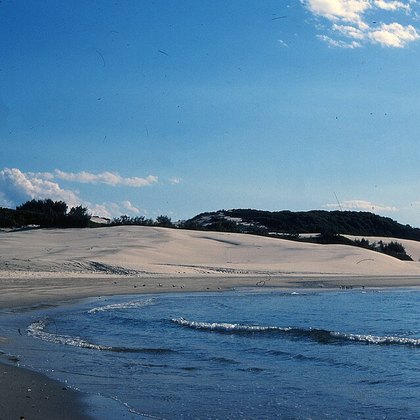
Far wider than the mudflat alone: saltmarsh and the highest levels of the intertidal plain, but equally closely grazed grassland, ploughed paddocks, airfields, golf courses and playing fields, coral platforms and the margins of brackish lagoons. It feeds in short runs and quick stabs, spacing itself out across the ground; at high water it gathers in the communal roost on saltmarsh or ploughed field.
Where the bird is most often found, arranged by main group and formation.


Range and movements
Along almost the whole Australian coastline, with the largest numbers in the north and east, plus scattered flocks inland; on Norfolk Island it is a common and conspicuous winter visitor to the grass plains. In New Zealand the numbers are three hundred to twelve hundred birds a year, with regular sites at Parengarenga, the Kaipara and Manukau harbours, the Bay of Plenty, the Manawatu estuary and the Southland estuaries, and on the Chatham and Kermadec Islands as well. It arrives from September to November and leaves in late March and early April; some immatures stay through the southern winter.
- Resident
- Breeding (summer)
- dark = core range, pale = thinly spread
Where and when to look
Do not look only on the flat: walk a coastal golf course, an airfield margin or a freshly mown playing field, because it often stands closer there than out on the tide. With every bird that lifts, check the underwing — uniformly grey in this species, with a black armpit in Grey Plover — and listen for the call, because the two-syllable tlu-ee decides and is given almost every time it takes off.
Conservation
Least Concern (LC), but with a declining trend across almost the whole East Asian–Australasian Flyway. The loss of the tidal flats of the Yellow Sea weighs heaviest, since the birds must refuel there both going north and coming south; beyond that count the changing tundra under a warming climate and disturbance of roosts along the Australian coast. For a bird that covers twenty-five to twenty-seven thousand kilometres a year, every staging ground lost is one too many.
Scientific name
Pluvialis fulva | (Gmelin, 1789)
Gmelin described the species in 1789 as Charadrius fulvus in the thirteenth edition of the Systema Naturae; because it now sits in another genus, author and year stand in parentheses. fulvus is Latin for 'tawny' or 'golden brown', after the spangling of the upperparts. The genus Pluvialis was introduced by Brisson in 1760, after Latin pluvia, 'rain': the plover was held to announce rain. The type locality is Tahiti, where the bird was collected as a winter visitor on one of Cook's voyages — a fitting place for a species that uses very nearly the whole Pacific as its wintering range.