All species › Passerines › Woodswallows, bellmagpies and allies › Silver-backed Butcherbird
Silver-backed Butcherbird | Cracticus argenteus
Zilverrugorgelvogel | Verdugo plateado
The Silver-backed Butcherbird is the butcherbird of the tropical north-west: a black-and-white hunter with a heavy blue-grey hooked bill and a pale, silvery-grey back, from the Kimberley to Arnhem Land. It was long regarded as a northern form of the Grey Butcherbird; this guide treats it as a species again, which makes it an endemic of Australia's north.
Voice
The song is rich and piping, with clear, organ-like notes and rolling phrases, and as in Grey Butcherbird it is often given in duet by a pair, most of all around sunrise. As far as has been described, the voice differs little from that species. There is also a harsh rattling scold, above all at the nest, where the birds will dive at people and dogs as well.
Recording: Nigel Young — CC BY-NC-SA 4.0 · Banyan Caravan Park, Rum Jungle, Coomalie Shire, Northern Territory, Australia · xeno-canto
Identification
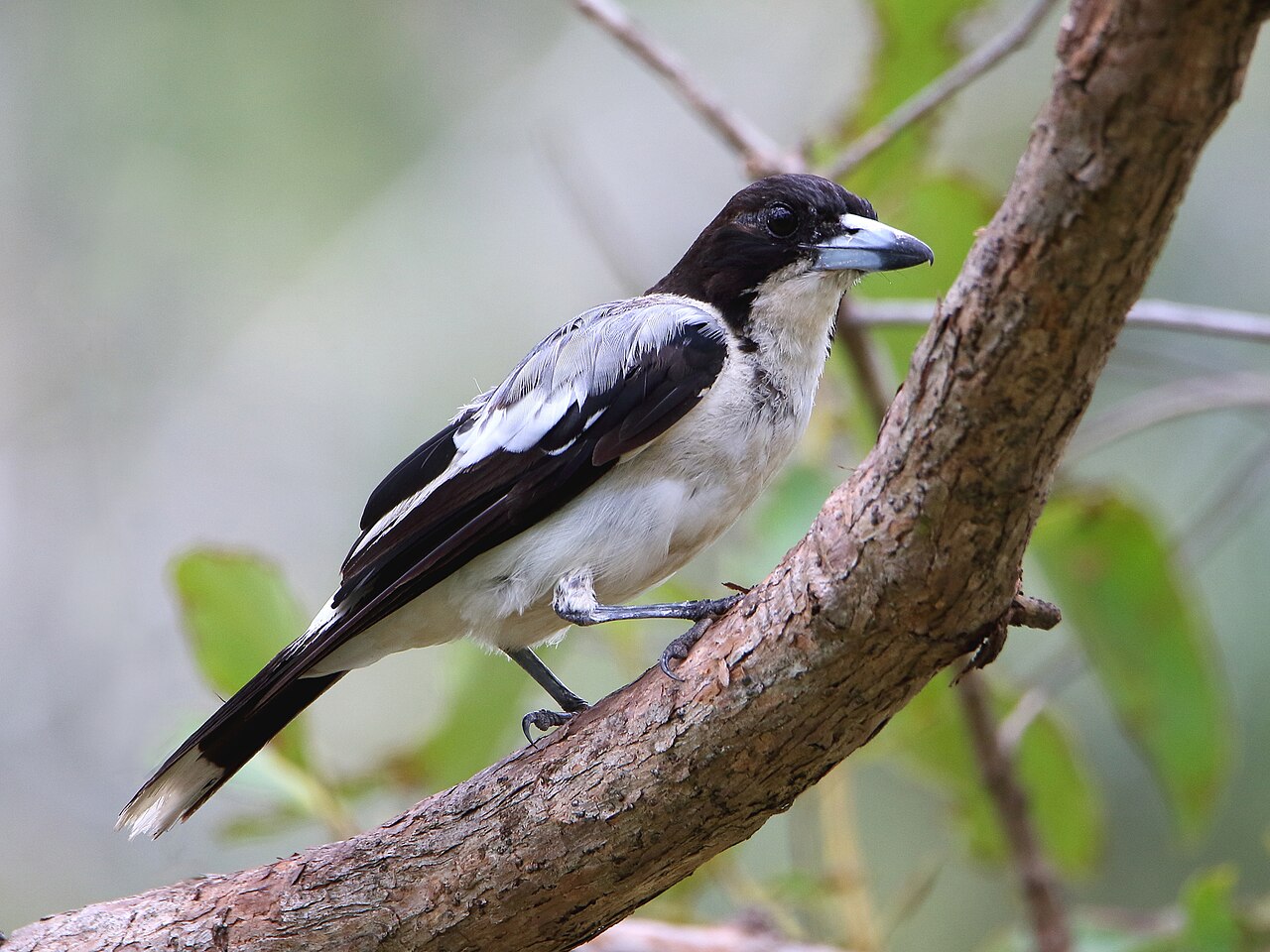
A compact butcherbird of about 24 to 30 centimetres with a large head and a heavy blue-grey bill with a black hooked tip. Head and face are black, the throat white, and a white collar separates the cap from the back. That back is pale silvery grey, lighter than in Grey Butcherbird, and contrasts sharply with the black wings and their long white stripe; the underparts are clean white, the tail black with white tips. Young birds are browner, with an olive-brown rather than black cap, and are not fully adult until towards the end of their second year.
Confusion species
Grey Butcherbird (Cracticus torquatus) is almost the same but has a darker grey back; the two meet in the north and barely overlap, so range is the best handle: a grey-backed butcherbird in the northern Kimberley or the Top End is this species. Pied Butcherbird (C. nigrogularis), common in the same country, is larger, with a black bib onto the breast and a black mantle. Black Butcherbird (Melloria quoyi) of mangrove and monsoon forest is entirely black.
Habitat
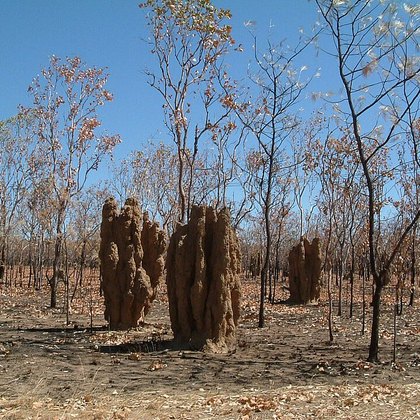
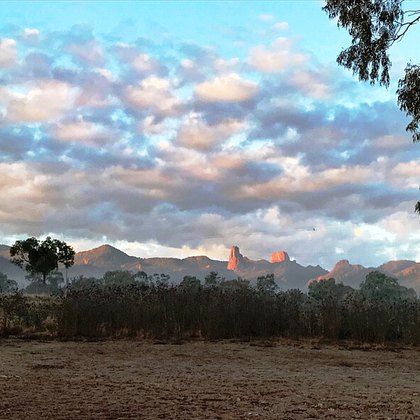
Open eucalypt savanna with a grassy understorey, dry open woodland and the edges of monsoon forest and vine thicket. Like all butcherbirds it needs a lookout above open ground, from which it drops onto insects, skinks, mice and small birds; small birds it sometimes takes in flight as well. In Darwin and other towns in the north it also uses gardens and parks with large trees.
Where the bird is most often found, arranged by main group and formation.


Range and movements
Only northern Australia, from the Kimberley in the north of Western Australia to the Top End and Arnhem Land in the Northern Territory; not in New Zealand. Two subspecies are recognised, argenteus and colletti. Further south Grey Butcherbird takes over. Sedentary: pairs hold their territory all year. Because many observers still report the species as Grey Butcherbird, the map shows the range only in part.
- Resident
- dark = core range, pale = thinly spread
Where and when to look
In Darwin, in Kakadu and around Kununurra this is the everyday butcherbird of campgrounds, parks and woodland edges. Listen at first light for the duet, then find the bird on a bare branch or post with a clear view. Watch the back: silvery grey, almost white in bright light, between the black cap and the black wings. Keep your distance from a nest, as the parents dive at intruders fiercely.
Conservation
Least Concern (LC). The species is widespread and locally common within its range, in and around towns as well, and there is no sign of a decline. The savanna woodland of the north is still largely intact; changing fire regimes, with large, hot fires late in the dry season, are the factor most closely watched for the birds of this landscape.
Scientific name
Cracticus argenteus | Gould, 1841
Gould described the species in 1841 as Cracticus argenteus, in the genus where it still stands, so author and year carry no parentheses. It was later long treated as a subspecies of Grey Butcherbird, until it was recognised as a species again. The genus Cracticus was introduced by Vieillot in 1816, from Greek kraktikos, 'noisy'; argenteus is Latin for 'silvery', after the back. The type locality reads 'north-west coast of Australia', with the type from Port Essington on the Cobourg Peninsula. The English, Dutch and Spanish names all pick out the silver back.