All species › Passerines › Rhabdornis, starlings and mynas › Singing Starling
Singing Starling | Aplonis cantoroides
Orpheuspurperspreeuw | Estornino cantor
The Singing Starling is a compact, glossy black tropical starling with a fiery red eye, at home in New Guinea and the islands around it. Within Australian territory it is a rarity of the far north: a few islands in Torres Strait, right off the New Guinea coast, and a handful of records on mainland Cape York. It lives in noisy flocks around villages, coconut palms and dead trees, and owes its name to a strikingly musical voice.

Voice
For a starling it is unusually musical: a high, clear run of whistles and squeaks, with pure rising and falling notes that carry over the general racket of a flock. That very quality gave the species its English name. Alongside it comes the ordinary starling repertoire of scraping, rattling and clicking notes, especially at the nest and at roosts, where dozens of birds hold forth at once. A colony in a dead tree above a village can be heard from a long way off.
No freely licensed recording has been found for this species yet; what to listen for is described below.
Identification
A compact starling of nineteen or twenty centimetres, entirely black with a greenish to blue-black metallic gloss that shows only in good light; under cloud the bird simply looks jet black. The eye is bright orange-red and glows out of the dark face — the most conspicuous feature of the species. Bill and legs are black, the bill straight and sturdy. The tail is short and square-ended, which makes for a stocky outline, with a fairly large head and a short neck. The sexes look alike. The juvenile is quite different: dull brown-black above and dirty white below, with heavy dark streaking from throat to belly, and it already has the red eye. It flies fast and straight on stiff, rapid beats, usually in small parties.
Confusion species
Metallic Starling (Aplonis metallica), the only other member of the genus to reach Australia and common in north-eastern Queensland, is the species it is confused with: that bird is slightly larger and has a long, tapering tail with pointed central feathers, where this species has a short square tail — in flight that difference in outline settles it. The gloss of Metallic Starling is also more pronouncedly purple and green. Juveniles of both are heavily streaked below and are then separable on tail shape alone. Common Starling (Sturnus vulgaris), introduced in Australia, is spotted rather than plain, has a pale eye and in the breeding season a yellow bill. Common Myna (Acridotheres tristis) is brown with a black head, a yellow face and white wing patches. Neither introduced species, as it happens, occurs on the islands where this bird is found.
Habitat
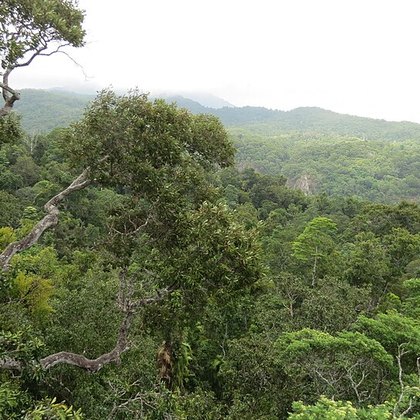
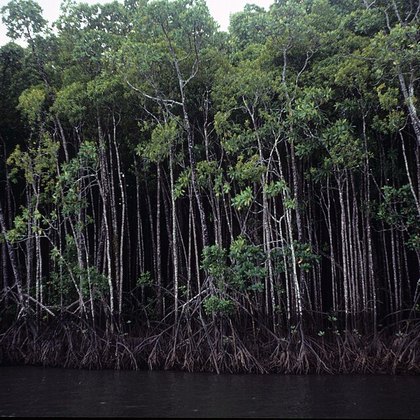
Edges and clearings of tropical forest, monsoon forest and vine thicket, coastal woodland and mangrove, but above all ground opened up by people: villages, coconut plantings, gardens, roadsides and the dead trees left standing after clearing. It is a thoroughly colonial bird, nesting in holes and crevices in dead trunks, palm stumps and sometimes buildings, dozens of pairs together. It feeds mainly in fruiting trees — figs, palm fruit and papaya — with insects added.
Where the bird is most often found, arranged by main group and formation.


Range and movements
Widespread and common across New Guinea, the Aru Islands, the Bismarck Archipelago and the Solomon Islands, where it is one of the commonest birds of villages and coastal lowland. Within Australian territory it is confined to the far north-west of Torres Strait — the islands just off the Papuan coast, Boigu and Saibai being the best known — and to a small number of records in northern Cape York. In this guide the species therefore stands as a vagrant; what happens on those islands is an outlier of the New Guinea range rather than an Australian population.
- Breeding (summer)
- dark = core range, pale = thinly spread
Where and when to look
Anyone wanting to see it in Australia must go to the northern Torres Strait islands, and there the rule is: do not search the forest, search the village. Scan the dead trees and coconut palms around buildings for parties of glossy black birds, and watch the tail — short and square makes it this species, long and pointed makes it Metallic Starling. The red eye is obvious through binoculars at close range and rules out any introduced starling.
Conservation
Least Concern (LC): the species is widespread and numerous across New Guinea and the Melanesian islands, and belongs to the small set of forest birds that actually benefit from human clearing, because open ground with dead trees is exactly what provides its nest sites. For Australia there is no conservation question, since only a handful of birds at the extreme edge of the range is involved. The species is, though, a good example of the avifauna that runs from New Guinea into Australia across Torres Strait, a boundary that for such birds is administrative rather than biological.
Scientific name
Aplonis cantoroides | (Gray, 1862)
Gray described the bird in 1862 as Calornis cantoroides, from material taken on the island of Misool off the west coast of New Guinea; because the species has moved to another genus, author and year stand in parentheses. The genus Aplonis was set up by Gould in 1836 and is formed on Greek haploos, simple or plain, and ornis, bird — after the unmarked, uniform plumage. The specific name joins Latin cantor, singer, to the suffix -oides, 'resembling', and refers to its likeness to an Asian glossy starling described earlier as cantor. The genus holds some twenty-five species, the metallic starlings of the Indo-Pacific islands; of all of them only two reach Australian territory, this one and Metallic Starling.