All species › Passerines › Rhabdornis, starlings and mynas › Metallic Starling
Metallic Starling | Aplonis metallica
Violette purperspreeuw | Estornino lustroso
The Metallic Starling is the only starling that breeds in Australia as a native, and it does so in the most conspicuous way imaginable: hundreds of hanging nests, up to four hundred, in a single tall tree, over ground white with droppings and a din audible a street away. It arrives from New Guinea in winter, breeds right through the summer and leaves again in February or March.
Voice
A colony produces a sustained high twittering and chattering that is deafening close up and never stops while the light lasts. Single birds give a clear, faintly metallic tsee-oo, and in flight a short sharp squawk. When a goshawk or a snake enters the colony tree the chatter turns into a wave of harsh alarm that runs through the whole tree and then dies away as abruptly.
No freely licensed recording has been found for this species yet; what to listen for is described below.
Identification
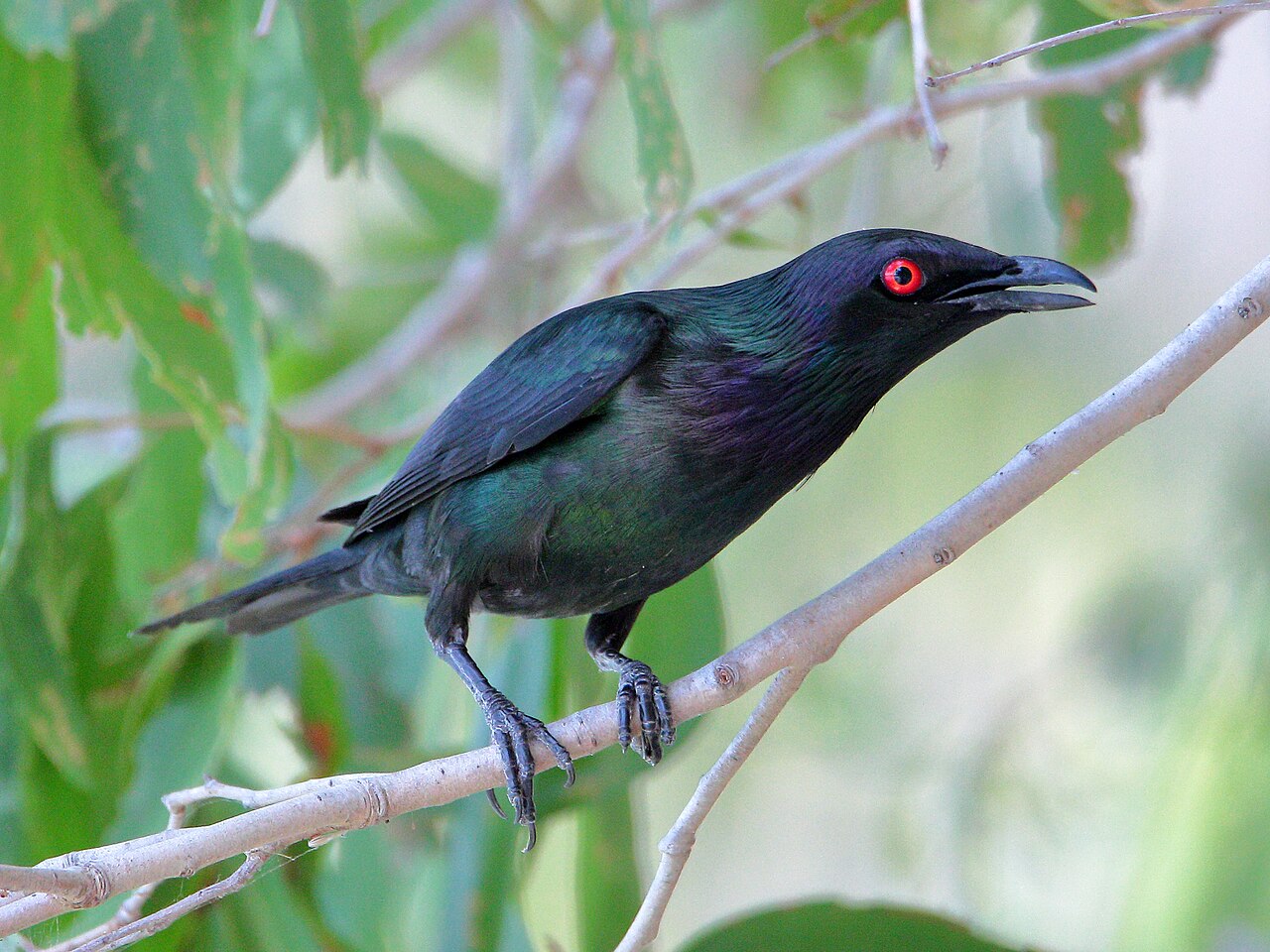
A slim starling of twenty-two to twenty-four centimetres, wholly black with a green and purple sheen that only fires in full light, with a long tapering, slightly forked tail and a burning red eye. The sexes are alike. Young birds look nothing like them: white to dirty white below with sharp black streaks, dark brown above, and they carry the red eye too. Adults and juveniles often perch on the same branch, which makes the difference plain at once.
Confusion species
Singing Starling (Aplonis cantoroides) from New Guinea reaches the Torres Strait islands: smaller, with a short square-cut tail instead of the long tapering point. Common Starling (Sturnus vulgaris) is introduced, shorter-tailed, spotted in winter, and keeps to open country and buildings rather than rainforest. A juvenile Metallic Starling, streaked below, resembles nothing else in the wet tropical forest.
Habitat
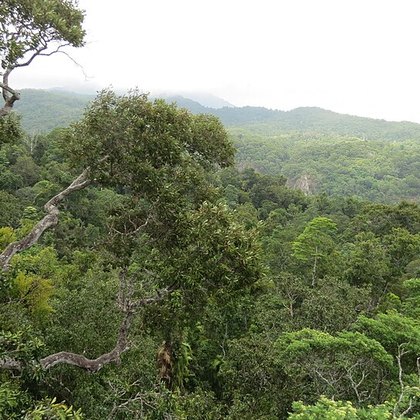
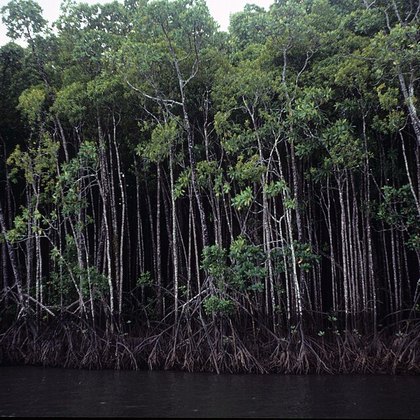
Tropical rainforest and its edges, monsoon forest and vine thicket, mangrove, and the gardens and street trees of the coastal towns between Cairns and Mackay. The colony tree is almost always a tall free-standing emergent — often a milky pine, a fig or an imported palm — with open air around it. It feeds in fruiting trees, above all native nutmeg, figs and palm fruit.
Where the bird is most often found, arranged by main group and formation.


Range and movements
In Australia only along the coast and adjacent lowlands of northeastern Queensland, from northern Cape York south to the Mackay district. It is a summer bird: the first arrive over Torres Strait in July and August, the colonies fill from August to January, and in February and March almost all of them go back to New Guinea and its islands. A few linger in the far north.
- Resident
- dark = core range, pale = thinly spread
Where and when to look
Look for the tree rather than the bird: a colony tree shows from a distance by the dozens of brown pear-shaped nests hanging like fruit from the outer branches. Stand under one early on a December or January morning and look up against the sky, because that is when the light catches the green gloss. Stay out of the droppings and mind where you put your binoculars down.
Conservation
Least Concern (LC). The species is numerous in New Guinea and the Australian share of the population is stable. The vulnerability lies in the concentration: one felled colony tree costs hundreds of nests at a stroke. Colonies in and around Cairns have been removed over noise and droppings, and that now requires a permit; the bird is protected under Queensland nature conservation law.
Scientific name
Aplonis metallica | (Temminck, 1824)
Temminck described the bird in 1824 as Lamprotornis metallicus; because it later moved to another genus, author and year stand in parentheses. The genus Aplonis was introduced by Gould in 1836, from Greek haploos, 'simple', and ornis, 'bird' — a name aimed at the plain, unmarked plumages of the group. metallica is Latin for 'metallic', after the gloss. The type locality is Ambon in the Moluccas.