All species › Passerines › Rhabdornis, starlings and mynas › Common Starling
Common Starling | Sturnus vulgaris
Spreeuw | Estornino pinto
The Common Starling is an introduced bird here, released in the nineteenth century by acclimatisation societies who expected it to clear the insects off the paddocks. It has taken southeastern Australia, Tasmania and the whole of New Zealand and become one of the commonest birds of both countries. Only Western Australia still keeps it out, with a border watch that has been running for more than half a century.
Voice
A long, unmusical run of wheezy whistles, clicks, scratching notes and a rising whine, delivered from a roof edge, an aerial or a post with the wings shivering. Through it the bird mimics other species, and in town car alarms and telephones as well; in Australia it readily picks up the calls of paddock birds. A roost of thousands gives a swelling, gurgling rush at dusk.
Recording: Philippe_Grange — CC0 · Arrondissement de la Roche-sur-Yon (near La Roche-sur-Yon), Vendée, Pays de la Loire, France · xeno-canto
Identification
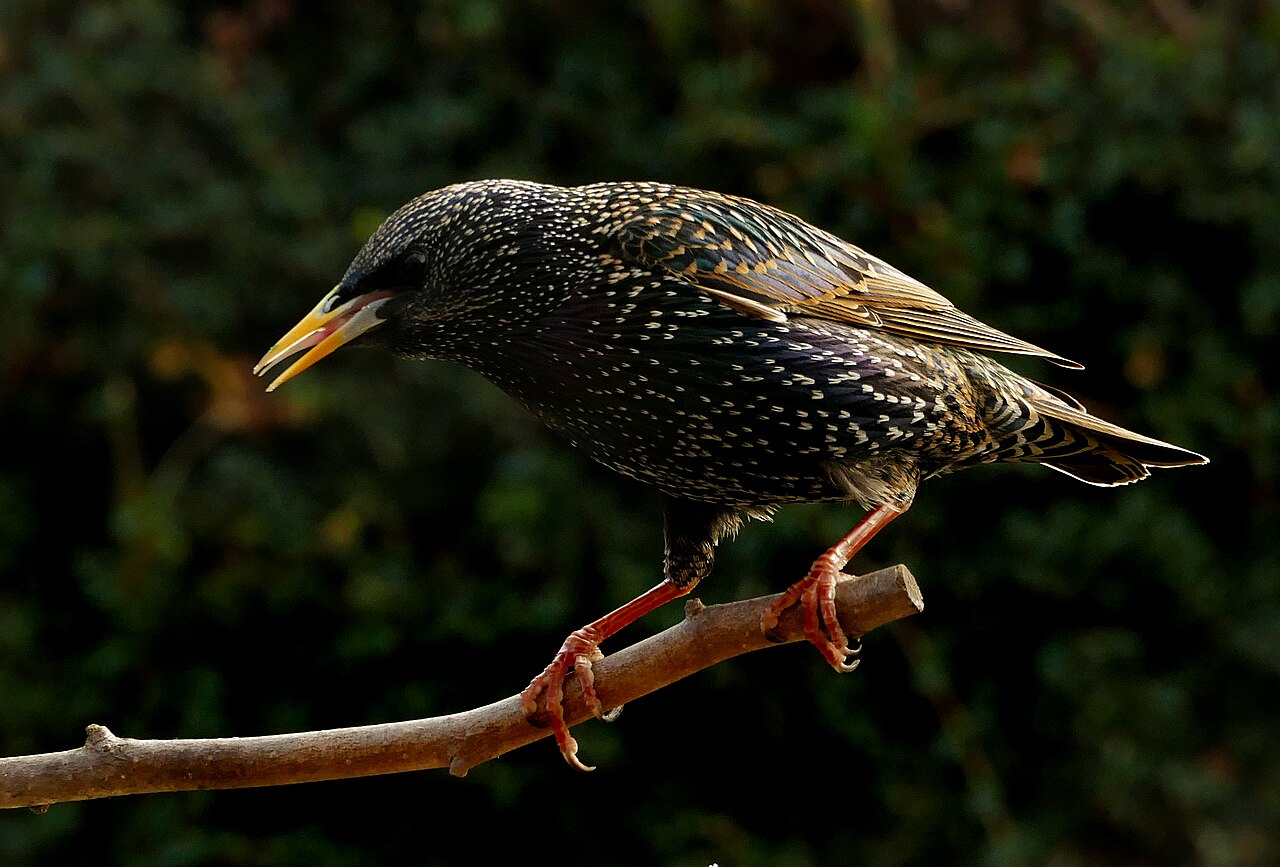
A compact, short-tailed black bird of twenty to twenty-two centimetres with a triangular wing and a fast direct flight. In fresh March and April plumage it is thickly set with white feather tips and has a dark bill and brown legs; by the August breeding season the tips have worn away and the bird is glossy black with purple and green sheen and a yellow bill. Young birds are plain grey-brown with a pale throat. On the ground it walks, it does not hop.
Confusion species
Common Myna (Acridotheres tristis) shares the town with it but is brown with a black head, yellow bill, yellow legs and a large white wing patch. Noisy Miner (Manorina melanocephala) is native, grey, and also has a yellow bill and yellow skin around the eye. Metallic Starling (Aplonis metallica) of the Wet Tropics has a long tapering tail and a red eye. A juvenile starling is grey-brown and confusingly dull; then go by the stocky build and the short tail.
Habitat
Town and village, pasture and grazed rangeland, grain paddocks, orchards and vineyards, gardens and parks. It needs two things: short grass or bare ground to probe in, and a cavity to nest in — a tree hollow, a roof tile, a wall cavity or a road sign. It avoids closed native forest, though it will nest at the edge.
Where the bird is most often found, arranged by main group and formation.



Range and movements
In Australia from South Australia through Victoria, Tasmania and New South Wales into southern and central Queensland, running inland along settlement. In New Zealand everywhere, from sea level to fifteen hundred metres, on both main islands and on countless islands around them, and on Norfolk as well. Western Australia is the gap: every bird that comes in along the Nullarbor is tracked down and removed.
- Resident
- dark = core range, pale = thinly spread
Where and when to look
Stand by a row of plane trees in a city centre at winter dusk and watch the roost: the flocks come in low and wheel before they drop. To see the plumage at its best, find a bird on a shed roof in April, when the white tips are at their sharpest. In August the yellow bill of a singing male marks the breeding season.
Conservation
Least Concern (LC), and here the question is not its survival but its damage. It evicts native hollow-nesters — rosellas, parrots, pardalotes — from their nest sites, fouls stock sheds and eats its fill of grapes, cherries and soft fruit. Western Australia has run an eradication programme since 1971 that keeps the state clear; in New Zealand it counts as naturalised and is locally valued for taking grass grubs.
Scientific name
Sturnus vulgaris | Linnaeus, 1758
Linnaeus described the bird in 1758 already as Sturnus vulgaris, and in that genus it has stayed, so author and year carry no parentheses. Sturnus is simply the Latin word for starling, which Linnaeus introduced as the genus name in the same year. vulgaris means 'common' or 'ordinary'. The type locality is Sweden; it is therefore the European bird that was put ashore here in the nineteenth century.