All species › Passerines › Thrushes and allies › Common Blackbird
Common Blackbird | Turdus merula
Merel | Mirlo
The Common Blackbird is an introduced bird here, released at Melbourne in the 1850s and 1860s and in New Zealand from 1862. In both countries it has become an ordinary garden bird, but it has not stayed in the garden: it forages in native forest and spreads there the seeds of blackberry, hawthorn and other exotic shrubs that change that forest.
Voice
The song is an unhurried, full series of fluted phrases with short pauses, each phrase different and never repeated, from a roof edge, a chimney or a high branch. In the southern hemisphere it runs from July to January, that is from winter to past midsummer. Beyond it there is a hard short tchook repeated endlessly as the bird goes to roost, a sharp rattle at a cat, and a thin high seee when a hawk passes over.
Recording: craig wilson — CC BY 4.0 · Granity, Buller District, West Coast, New Zealand · xeno-canto
Identification
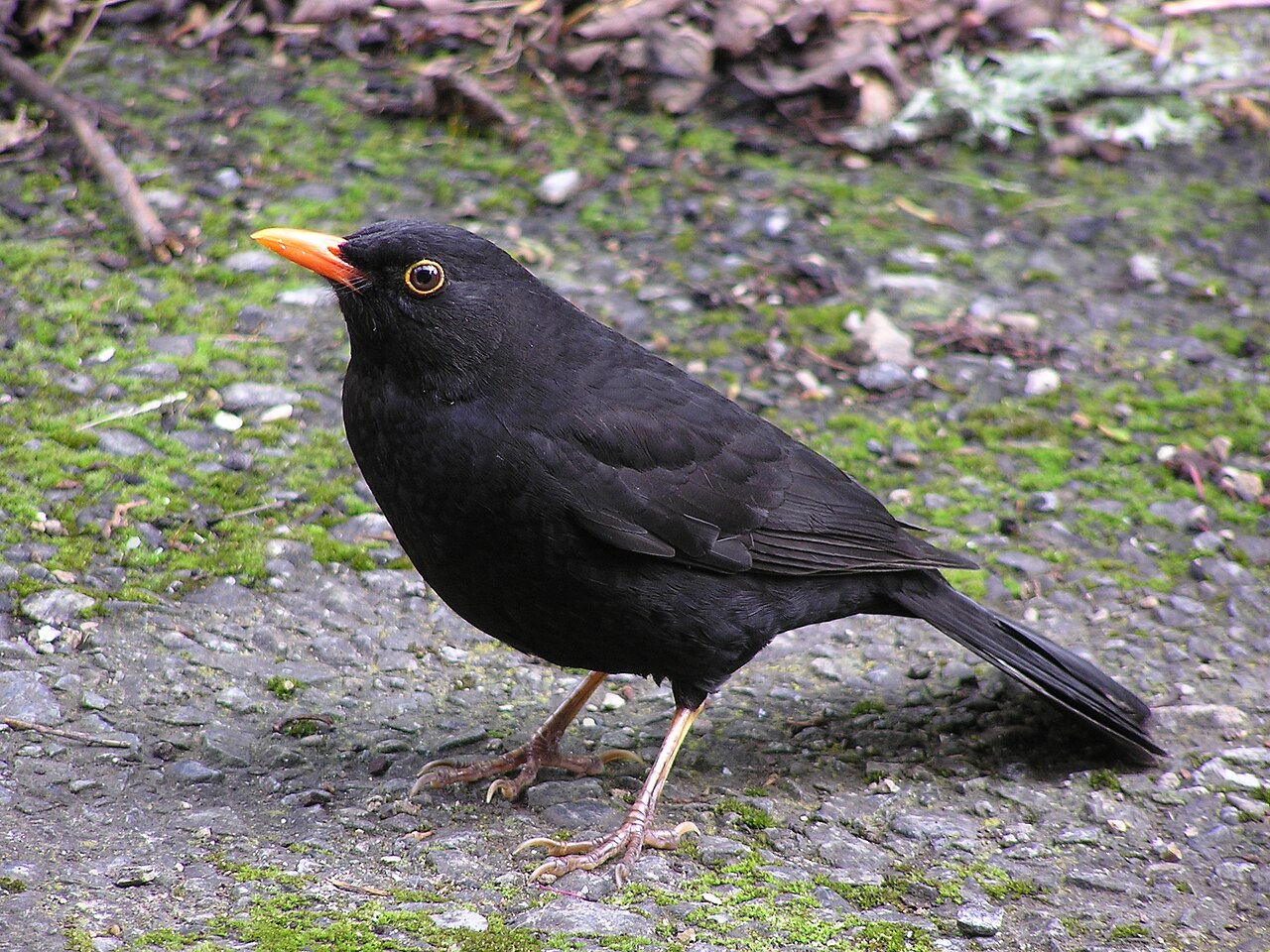
A slim thrush of twenty-five to twenty-eight centimetres with a long tail. The male is wholly black with an orange-yellow bill and a narrow yellow eye-ring; the legs are dark. The female is dark brown, paler and somewhat mottled on throat and breast, with a brown bill. Young birds resemble the female but are rustier with pale streaks. On the ground it hops with the tail raised, stops abruptly and cocks its head before striking.
Confusion species
Song Thrush (Turdus philomelos) came with it and is mainly in New Zealand and Victoria: smaller, warm brown, with a breast full of sharp black spots instead of an even brown or black ground. Bassian Thrush (Zoothera lunulata) is larger, scalloped, and keeps to closed forest. A black male blackbird can suggest a starling at range, but that bird is stocky, short-tailed and spotted.
Habitat
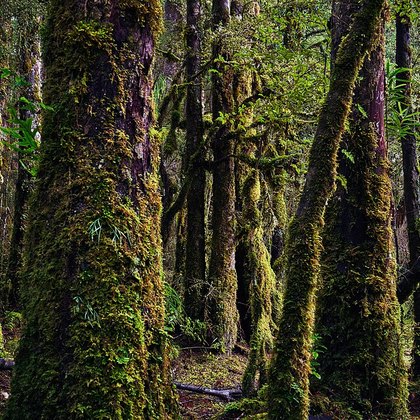
Gardens and parks, town and village, orchards and vineyards, roadsides and hedges, and in New Zealand podocarp-broadleaf forest and native scrub down into the lowlands and along the forest edges above. In Australia it has pushed out of settlement into damp forest and gullies. It needs soft ground it can pull worms from.
Where the bird is most often found, arranged by main group and formation.


Range and movements
In Australia across the southeast: from Adelaide through Victoria and Tasmania and the Bass Strait islands to Sydney, on the coast and inland. Western Australia is clear and means to stay clear; the occasional bird in Perth is removed. In New Zealand it is everywhere, from sea level to about fifteen hundred metres, out to the Kermadecs, Stewart Island, the Chathams, the Snares, the Aucklands and Campbell Island, and very rarely the Antipodes.
- Resident
- dark = core range, pale = thinly spread
Where and when to look
Walk a lawn in a city park after winter rain and watch for the bird that runs briefly, stops, then holds its head to one side: that is a blackbird listening for a worm. For the song be out at sunrise in July or August, when a male will sing from a chimney for half an hour on end. On brown thrushes always check the breast: spots mean Song Thrush, plain brown means Blackbird.
Conservation
Least Concern (LC), and here the issue is the damage, not the species. In Australia it is listed as a harmful exotic: it eats grapes, cherries and soft fruit, and it is one of the main dispersers of blackberry, hawthorn, buckthorn and other invasive shrubs, carrying the berries deep into native forest. There is no national control, only quarantine in Western Australia. In New Zealand it counts as naturalised, and there it disperses the seeds of native fruiting trees alongside the weeds.
Scientific name
Turdus merula | Linnaeus, 1758
Linnaeus described the bird in 1758 already as Turdus merula, and in that genus it has stayed, so author and year carry no parentheses. Turdus is the Latin word for a thrush, introduced by Linnaeus as the genus name in the same year. merula is the Latin word for the blackbird itself, and it is the source of French merle and Dutch merel. The type locality is Sweden.