All species › Passerines › Thrushes and allies › Song Thrush
Song Thrush | Turdus philomelos
Zanglijster | Zorzal común
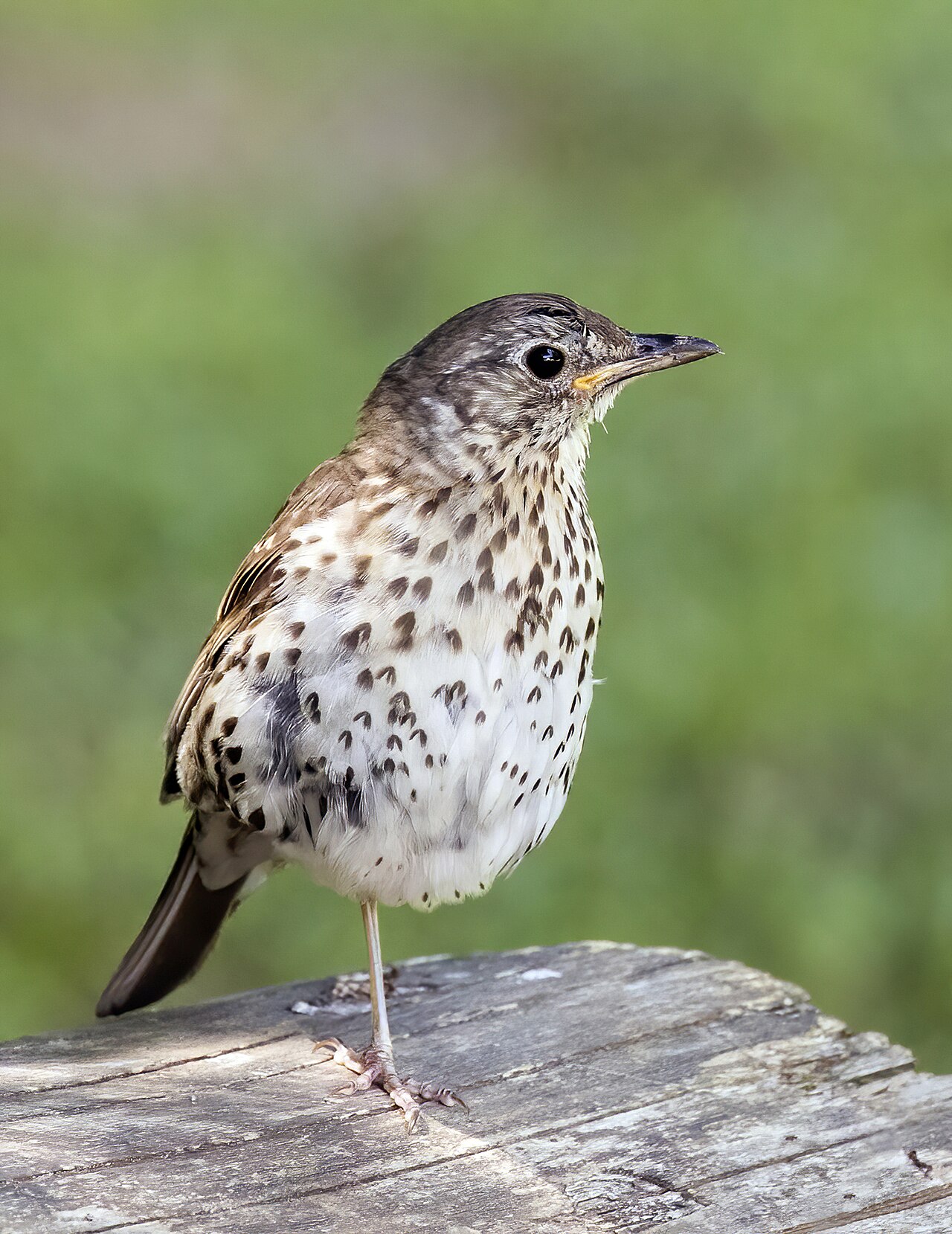
The Song Thrush of New Zealand gardens is exactly the same bird as the European one: brown above, creamy white with dark teardrop spots below, and with the song that announces spring in Europe. It simply does not belong there. Between 1862 and the 1880s the acclimatisation societies released thousands of British songbirds to make the new country sound familiar, and of all those species the Song Thrush has proved one of the most successful: it now occupies the whole of New Zealand, from city garden to native forest and far out to the outlying islands.
Voice
The song is the hallmark of the species and at the same time the easiest means of identification. It consists of short, clear and highly varied whistled motifs, and each motif is repeated two to four times before the next comes — no other thrush repeats so systematically, and it gives the bird away to anyone who cannot see it. It sings from a high, open perch, early in the morning and late into the evening twilight, and in New Zealand almost all year, peaking from August to December. The flight call is a thin short tsip; in alarm comes a hard rattling chuck-chuck-chuck.
No freely licensed recording has been found for this species yet; what to listen for is described below.
Identification
Twenty-three centimetres: a medium-sized, upright thrush, slimmer and shorter than a Blackbird. The upperparts are plain warm olive-brown without markings. The underparts are creamy white to pale yellow and densely set with small, sharply defined blackish-brown spots shaped like an inverted teardrop or arrowhead and arranged in neat rows; over the breast sides and flanks lies a warm ochre wash. The face is dull with a pale eye-ring and a dark line along the edge of the cheek. The bill is dark with a yellowish base, the legs flesh-coloured. Beneath the wing the ochre-buff axillaries show, especially in flight. The sexes look alike.
Confusion species
In New Zealand there is hardly a real rival: the female Blackbird (Turdus merula) is larger, darker and plainer brown and shows at most a vague mottling on the breast, never the crisp teardrop spots in rows. Starlings and mynas are smaller and glossy-speckled rather than brown with spots. More important for this guide is the contrast with Australia: there, against this introduced European thrush, stands the native Russet-tailed Thrush (Zoothera heinei), which is rusty brown above and carries below not separate teardrop spots but a fine, continuous dark scaling, and which inhabits the rainforest floor instead of lawns and gardens. The same scaling is worn by Bassian Thrush (Zoothera lunulata), which is larger and longer-tailed. The distinction is therefore not only one of plumage but one of origin: spotted and in the garden is the introduced species, scaled and in the forest the native one.
Habitat
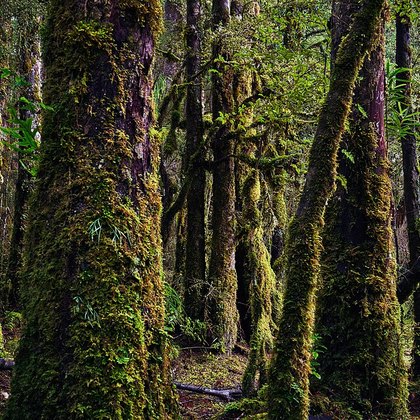
Gardens and parks, town and village edges, orchards and field margins, hedges, shelter belts, pine plantation and the edges of native forest; in New Zealand the species penetrates further into intact native forest than it ever would in Europe. It forages on the ground, hopping and then standing still with head cocked to listen for worms, and also takes snails, insects and, in late summer, a great many berries. Characteristic is the anvil: the bird carries a garden snail to a regular stone or paving slab and smashes the shell there, leaving a heap of fragments — precisely the behaviour of the pittas in Australia, and one of the few instances of tool use among songbirds.
Where the bird is most often found, arranged by main group and formation.


Range and movements
Native to Europe, western Asia and north-western Africa. In Australasia the species is wholly the product of introduction. The New Zealand population goes back to releases by the acclimatisation societies of Nelson, Canterbury, Otago, Wellington and Auckland from 1862 onwards; within a few decades the bird was spread over both main islands, and it later reached the Chathams, Stewart Island, the Kermadecs, the Snares and the Auckland and Campbell Islands. In Australia the same venture fared far less well: there the species holds on only in the older suburbs of Melbourne and its surroundings, in a small and non-expanding area. There is no migration in Australasia; the birds are resident, with at most some wandering in winter.
- Resident
- dark = core range, pale = thinly spread
Where and when to look
In New Zealand this is a garden bird one need not look for but will hear in the morning. To learn to recognise it, attend above all to the repetition: each motif two to four times, then a new motif. On the lawn watch the carriage — the Song Thrush runs in short dashes, then stands rigid with head cocked and stabs down — and look along garden walls and paved paths for the anvil stone with its heap of fragments. In Australia the advice is the reverse: outside Melbourne a brown thrush with teardrop spots is so improbable that a good record is exceptional.
Conservation
Least Concern (LC). In New Zealand and Australia the Song Thrush is an established introduction and no object of protection; in New Zealand it does not fall under the legal protection that native birds enjoy. The species damages fruit in orchards and gardens, and, more important for conservation management, it carries the seeds of invasive shrubs such as rowan, holly and various firethorns into native forest in its droppings, so helping to shape the weed invasion of forest margins. How heavily it presses on native birds through competition for invertebrates has not been well established and is therefore not presented here as fact. In its original European range the species has in several countries actually declined through agricultural intensification — a difference that gives the bird a double reputation in this guide.
Scientific name
Turdus philomelos | Brehm, 1831
Christian Ludwig Brehm described the species in 1831 in his Handbuch der Naturgeschichte aller Vögel Deutschlands. Turdus is simply the Latin word for thrush. The epithet philomelos refers to Philomela of Greek myth, who by tradition was turned into a nightingale, and amounts in practice to 'song-loving'. The Dutch zanglijster, the English Song Thrush and the Spanish zorzal común all name the song, or in the Spanish case the bird's abundance. The name the species carries in New Zealand is one from its country of origin, travelling with the birds themselves: there is no Maori name dating from before the introduction, as there always is for native New Zealand birds.