All species › Passerines › Fairywrens, grasswrens and emu-wrens › Southern Emu-Wren
Southern Emu-Wren | Stipiturus malachurus
Roodooremoesluiper | Maluro meridional
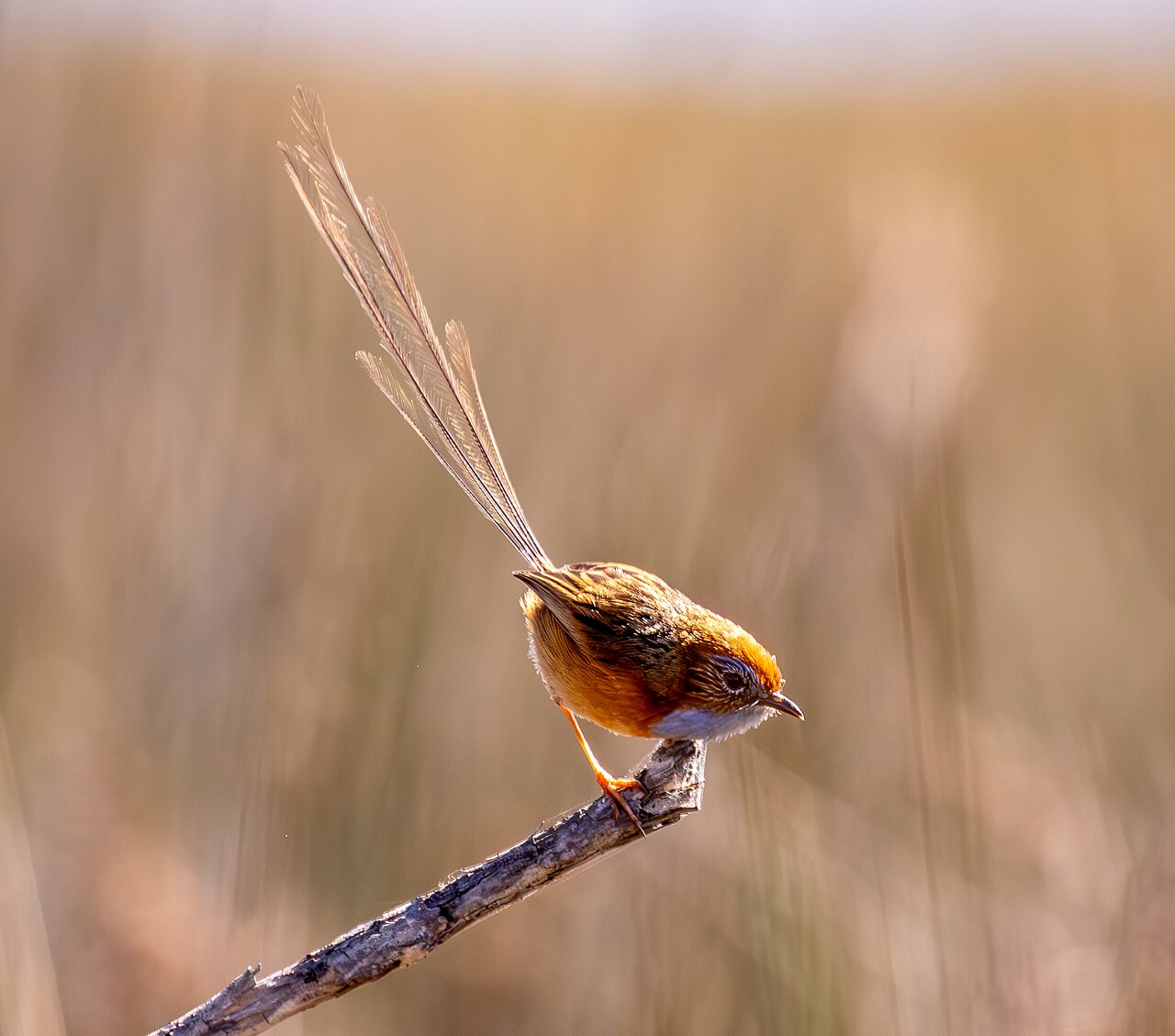
The Southern Emu-Wren is the largest and longest-tailed of the three emu-wrens and the only one of the southern and eastern coasts. Of its sixteen to nineteen centimetres nearly ten are tail: six loose, hair-like feathers with the light showing through, an emu feather in miniature.
Voice
A very high, thin trill of a few seconds that carries only a short way; in wind or surf it is inaudible. The contact note is a thin, sharp tseet, given by the birds of a group from within the heath without showing themselves. In the field the species is almost always heard before it is seen.
Recording: Romuald Mikusek — CC BY-NC-SA 4.0 · Wilsons Promontory, South Gippsland Shire, Victoria, Australia · xeno-canto
Identification
Sixteen and a half to nineteen centimetres, well over half of it tail: six limp, filamentous feathers with widely spaced barbs, usually carried raised at an angle or trailing loose. The upperparts are rufous-brown with heavy black streaking, the crown included; the ear-coverts and cheeks are warm rufous, to which the Dutch name refers. The male has a pale blue throat and upper breast; the female is off-white to pale buff there. The belly is dull buff. Across the vast, broken range the local forms differ in tone and in the extent of streaking.
Confusion species
Rufous-crowned Emu-Wren (Stipiturus ruficeps) is smaller and shorter-tailed and has a plain, unstreaked rufous crown; it lives in the spinifex (spiny, hummock-forming desert grass of the interior) of the arid interior and does not overlap with this species. Mallee Emu-Wren (Stipiturus mallee) is likewise smaller, with a shorter tail, and lives only in the spinifex-floored mallee (low, multi-stemmed eucalypt scrub of dry southern Australia) of north-western Victoria. Within the coastal heath and swamp of the south and east this is therefore the only emu-wren, and the filamentous tail separates it from all the fairywrens of the genus Malurus, which have an ordinary closed tail. A brown bird diving into heath with no tail visible cannot be named at all: wait for the tail.
Habitat
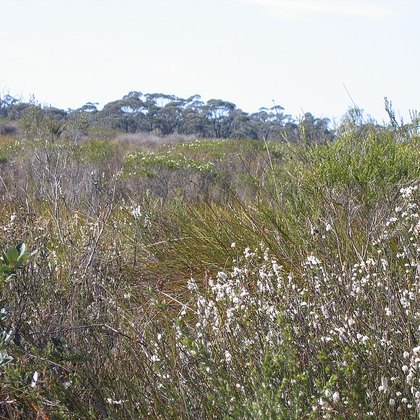
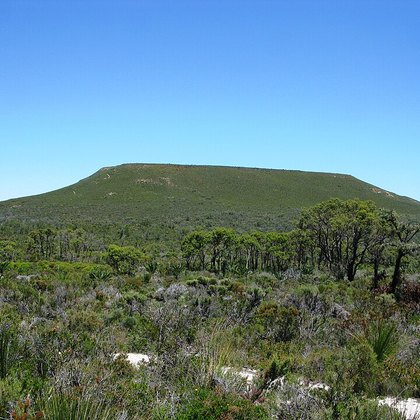
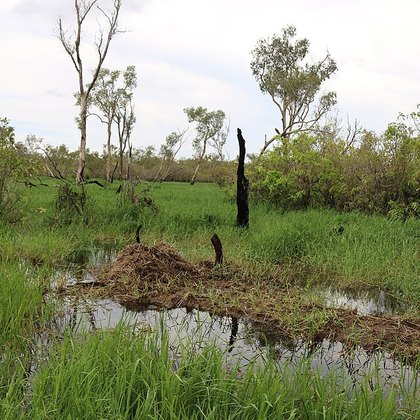
Dense low growth that stays closed to the ground: coastal heath, sedgeland and reed fringes, buttongrass (tussocky sedge of wet Tasmanian plains) moorland in Tasmania, and in Western Australia the kwongan (species-rich heath-like scrub of south-western Australia) heath. The height of the vegetation matters less than its density; open ground is not crossed. It favours damp soil and disappears where swamp is drained.
Where the bird is most often found, arranged by main group and formation.

Range and movements
In a series of detached blocks along the southern and eastern coasts of Australia: south-western Western Australia, Eyre Peninsula and the country south of Adelaide in South Australia, coastal Victoria, the whole of Tasmania, and the coast of New South Wales into far south-eastern Queensland. Large gaps lie between those blocks, and several local forms are thereby wholly isolated. Resident; the birds stay for life in the same small patch.
- Resident
- dark = core range, pale = thinly spread
Where and when to look
Stand at the edge of a piece of dense heath or sedgeland, keep still, and wait for the high call; if a bird climbs to the top of a bush for a few seconds it is almost always a singing male. The tail is the feature everything turns on, so wait until you have seen it before writing anything down. The birds are most active early in the morning and in the last hours before sunset. Do not walk through the vegetation: the nests sit just above the ground.
Conservation
Least Concern (LC) as a species, but that verdict hides how matters stand locally. The range consists of isolated blocks, several of which have shrunk through the draining of swamp, coastal urban growth, and burning that is too frequent. The population of the Fleurieu Peninsula south of Adelaide is regarded in Australia as critically endangered and is kept going by swamp restoration and targeted fire management; on Eyre Peninsula the local form is rare as well. Restoration works: where swamp is rewetted and the vegetation closes over, the species returns.
Scientific name
Stipiturus malachurus | (Shaw, 1798)
George Shaw described the bird in 1798 in the Transactions of the Linnean Society of London as Muscicapa malachura, that is, among the flycatchers; because the species was later moved to another genus, author and year stand in parentheses. The type locality is Sydney. malachurus is formed from Greek malakos (soft) and oura (tail): soft-tailed, after those same loose feathers. The genus Stipiturus was introduced by Lesson in 1831, explained from Greek stypos (stalk, stem) and oura (tail). The Dutch name points to the rufous ear-coverts, the English one to the emu-like tail.