All species › Passerines › Fairywrens, grasswrens and emu-wrens › Mallee Emu-Wren
Mallee Emu-Wren | Stipiturus mallee
Mallee-emoesluiper | Maluro del Mallee
The Mallee Emu-Wren is a bird of five grams, more than half of it tail: six loose, hair-like feathers with widely spaced barbs, an emu feather in miniature. It lives only in prickly spinifex (spiny, hummock-forming desert grass of the interior) hummocks beneath the mallee (low, multi-stemmed eucalypt scrub of dry southern Australia) eucalypts of north-western Victoria and is one of Australia's most threatened songbirds.
Voice
An extremely high, thin trill lying close to the upper limit of human hearing; many observers cease to hear it in later life. Alongside it a thin, squeaking tseep serves as a contact note, and through the spinifex it is almost impossible to place. In practice anyone looking for this species is listening for that sound rather than looking for the bird.
Recording: Jack Armstrong — CC BY-NC-SA 4.0 · Hattah - Kulkyne National Park (near Hattah), Mildura Rural City, Victoria, Australia · xeno-canto
Identification
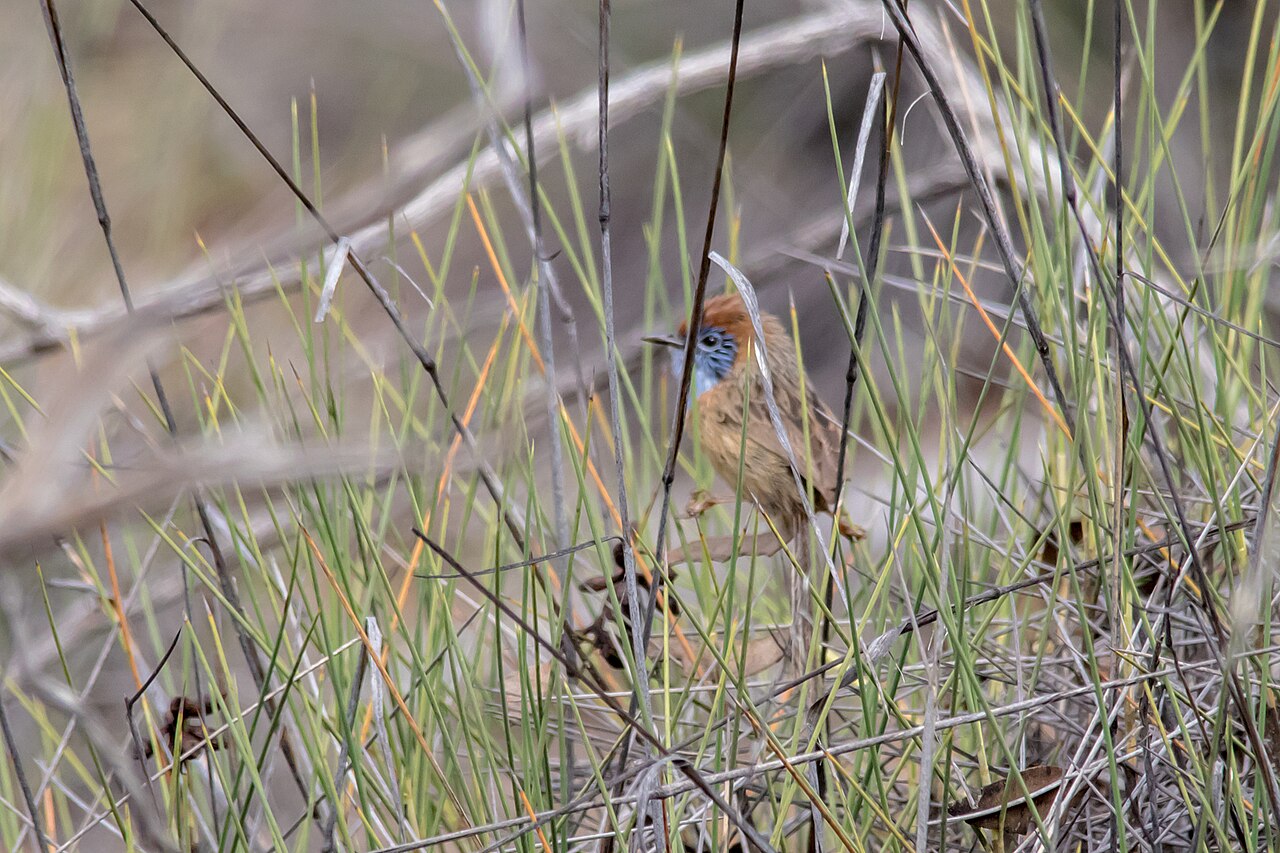
Fourteen to sixteen centimetres, of which the tail alone measures a good eight: six limp, filamentous feathers standing apart from one another, with light showing through. The male has a rufous crown streaked with black, a sky-blue throat and upper breast, a rufous back streaked black, and a dull buff belly. The female lacks the blue and is off-white on the throat. The whole effect is less that of a bird than of a mouse trailing a wisp.
Confusion species
Only the other two emu-wrens truly resemble this species. Rufous-crowned Emu-Wren (Stipiturus ruficeps) has a plain rufous crown without black streaks and is smaller still; it lives in the spinifex of the arid interior, hundreds of kilometres further north. Southern Emu-Wren (Stipiturus malachurus) is clearly larger, with a longer tail and a browner, less rufous crown, and occupies damp coastal heath and swamp in the south and east. In practice range decides: within the spinifex-floored mallee of north-western Victoria this is the only emu-wren. Fairywrens of the genus Malurus have an ordinary, closed tail and are separated on that alone.
Habitat
Mallee eucalypt on sandy soil with an understorey of spinifex hummocks (Triodia). Those hummocks are both cover and nest site, and that sets a hard condition on fire history: only about a decade after a fire are the hummocks large enough, and after several decades they break apart again. Its habitat therefore consists of blocks of mallee of the right age, which must grow back after every fire.
Where the bird is most often found, arranged by main group and formation.


Range and movements
Now only in north-western Victoria, in the large reserves of the Murray-Sunset, Hattah-Kulkyne, Wyperfeld and Big Desert country. In South Australia it occurred in the Ngarkat country, but that population was lost in extensive fires; birds from Victoria have since been released there to re-establish the species. Resident in the strictest sense: the birds seldom move more than a few hundred metres, and a burnt block is reoccupied only from an adjoining unburnt one.
- Resident
- dark = core range, pale = thinly spread
Where and when to look
Stand along an edge of old spinifex in the first light of a windless morning and listen; the bird is heard before it is seen, and anyone who can no longer hear the high notes does better to search with a recorder and headphones. Now and then a group flies briefly from one hummock to the next: a low, fluttering flight of a few metres at most, the tail trailing loose behind. Keep to the tracks, because the hummocks themselves are the nest sites.
Conservation
Endangered (EN) on the Red List. The range is small and fragmented and the population is estimated at a few thousand birds. The decisive threat is fire: a single large, hot fire can render a whole block uninhabitable at once, and the species returns only after about ten years. The fires of 2014 removed the South Australian population. Management therefore turns on a fire mosaic, that is, on preventing continuous tracts from burning at the same time, and on reintroduction. Climate change, which makes large fires more likely, works against both.
Scientific name
Stipiturus mallee | Campbell, 1908
Archibald James Campbell described the bird in 1908 in the journal The Emu, from a specimen out of the Victorian mallee, and simply gave the species the name of that landscape. Mallee is itself a word from an Aboriginal language of Victoria for the low eucalypts that throw up several stems at once from an underground lignotuber. The genus Stipiturus was introduced by Lesson in 1831; the name is explained from Greek stypos (stalk, stem) and oura (tail), after the bare shafts of the tail feathers. The Dutch and English names point to that same tail: the feathers resemble those of an emu.