All species › Passerines › Fairywrens, grasswrens and emu-wrens › Rufous-crowned Emu-wren
Rufous-crowned Emu-wren | Stipiturus ruficeps
Roodkapemoesluiper | Maluro coronirrufo
The Rufous-crowned Emu-wren is the emu-wren of Australia's dry heart: under five grams, with a bright rufous crown and a tail of six loose, hair-like feathers longer than the rest of the bird. It lives in spinifex, shuffles from hummock to hummock, and is seldom seen well.
Voice
A very high, thin trill of a few seconds, close in pitch to the squeak of a mouse; it carries poorly and is lost entirely in wind. Alongside it a short, sharp tsit serves as a contact note between the birds of a group, usually given from the ground between the hummocks.
No freely licensed recording has been found for this species yet; what to listen for is described below.
Identification
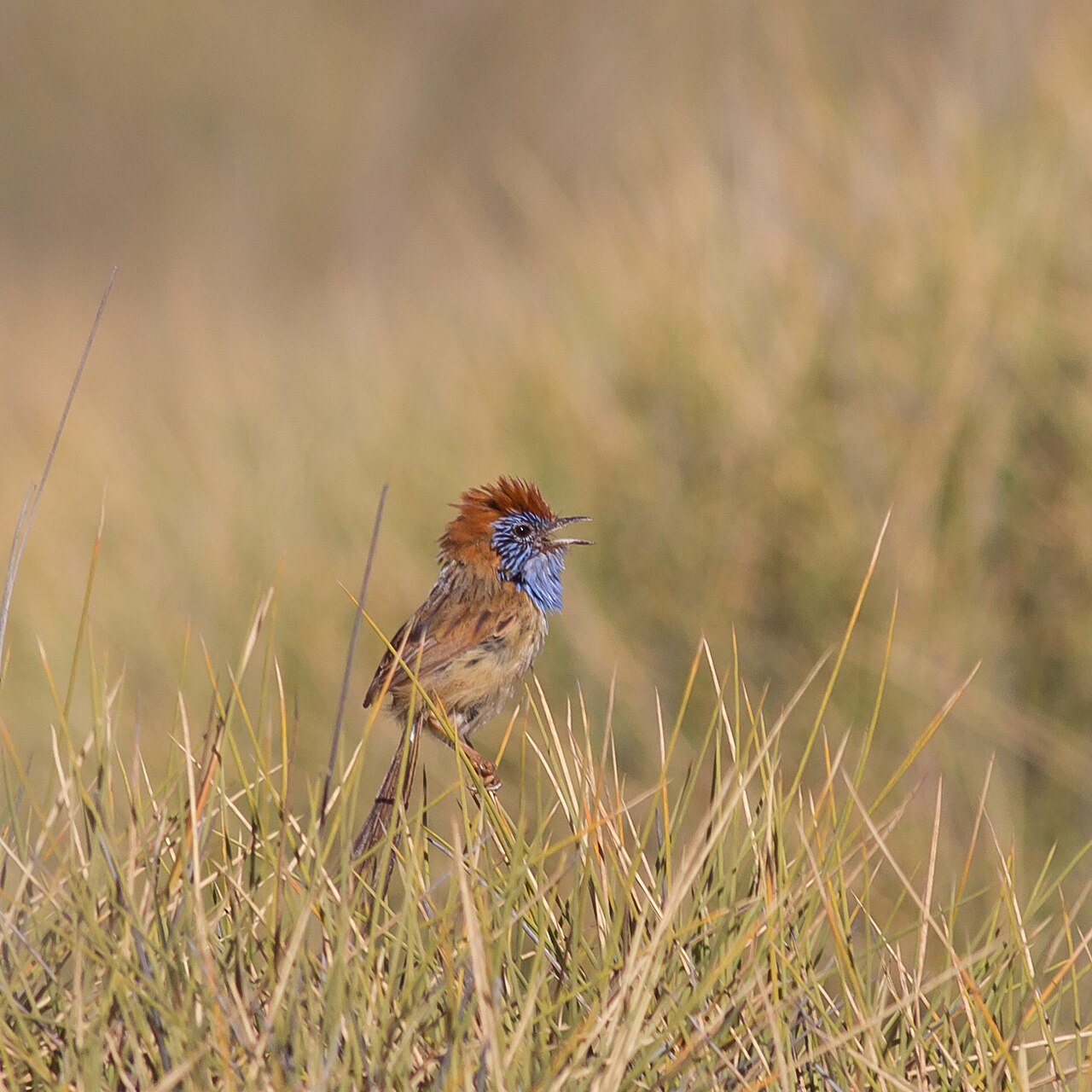
Twelve and a half to fifteen centimetres, well over half of it tail: six filamentous feathers with widely spaced barbs, usually carried raised at an angle. The male has a plain, bright rufous crown without black streaks, a sky-blue throat and upper breast, a grey-brown finely streaked back and a rufous belly. The female has the same rufous crown but lacks the blue and is off-white on the throat. Of the three emu-wrens this is the smallest and the shortest-tailed.
Confusion species
Mallee Emu-wren (Stipiturus mallee) has a black-streaked crown rather than a plain rufous one, is slightly larger, and occurs only in the mallee of north-western Victoria; there is no overlap. Southern Emu-wren (Stipiturus malachurus) is clearly larger and longer-tailed, with a browner, streaked crown, and occupies damp heath and swamp along the southern and eastern coasts. In the spinifex this species shares ground with grasswrens of the genus Amytornis, such as Striated Grasswren (Amytornis striatus); those are much larger, with an ordinary closed tail and a far heavier bill. Fairywrens of the genus Malurus are separated on that closed tail as well.
Habitat
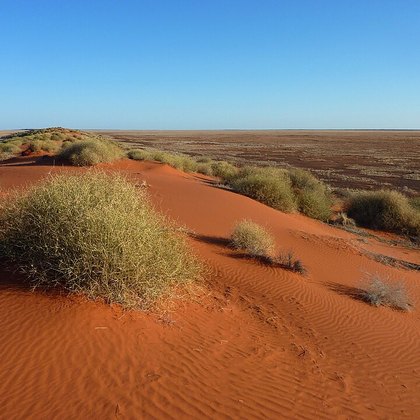
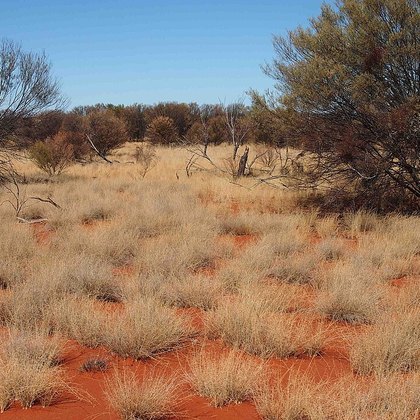
Spinifex hummocks (Triodia) in the arid interior, on flat sandy country and dunes as well as on stony slopes and rocky ranges. It also occurs in mulga and other acacia scrub as long as spinifex grows beneath. The hummocks must be large and dense; small young hummocks soon after a fire are avoided.
Where the bird is most often found, arranged by main group and formation.


Range and movements
The arid interior of Western and central Australia: from the Pilbara and North West Cape through inland Western Australia and the southern Northern Territory to south-western Queensland and northern South Australia. Distribution is patchy and follows the spinifex, with large empty tracts between occupied areas. Resident, but after a fire it disappears locally for years.
- Resident
- Winter
- dark = core range, pale = thinly spread
Where and when to look
Walk slowly through a field of old, large spinifex hummocks and watch for movement of the tail: that loose wisp is often the only part showing above the hummock. The bird prefers not to fly and shuffles from hummock to hummock; flush it and you see at most a short, wobbling flight of a few metres. The best chance is the first hour after sunrise, when the groups call. Mind what you wear: spinifex pierces thin trousers.
Conservation
Not threatened. The range is vast and lies for the most part in thinly settled country. The main local problem is the altered fire regime: where small-scale burning by Aboriginal communities has lapsed, large tracts burn at once and the old hummocks the species needs disappear. Overgrazing by stock and by introduced camels works in the same direction.
Scientific name
Stipiturus ruficeps | Campbell, 1899
Archibald James Campbell described the species in 1899 in The Victorian Naturalist, from a bird taken at North West Cape in Western Australia. ruficeps is Latin for red-headed, from rufus (reddish) and the ending -ceps (-headed); the English and Dutch names translate it directly. The genus Stipiturus was introduced by Lesson in 1831; the name is explained from Greek stypos (stalk, stem) and oura (tail), after the bare shafts of the tail feathers, which recall an emu feather.