All species › Passerines › Bristlebirds › Eastern Bristlebird
Eastern Bristlebird | Dasyornis brachypterus
Bruine borstelvogel | Picocerdas oriental
The Eastern Bristlebird is a shy, long-tailed ground bird of coastal heath and tussock grass in eastern Australia. It hardly ever flies, preferring to run through dense cover, and survives in four separated populations. With fewer than about 2,500 birds in the wild it is one of the chief concerns of Australian bird conservation.
Voice
The song is loud, clear and melodious, a run of three to five whistled notes with a metallic ring that carries far over open heath; the male sings from a low vantage point to mark his territory, mainly in the first hours after sunrise. The female often answers with a shorter rattling passage, so that the whole sounds like a duet. In alarm comes a sharp short tick, and a pair keeps contact in cover with soft low notes. Song is heard all year, peaking in the breeding season from August to February.
No freely licensed recording has been found for this species yet; what to listen for is described below.
Identification
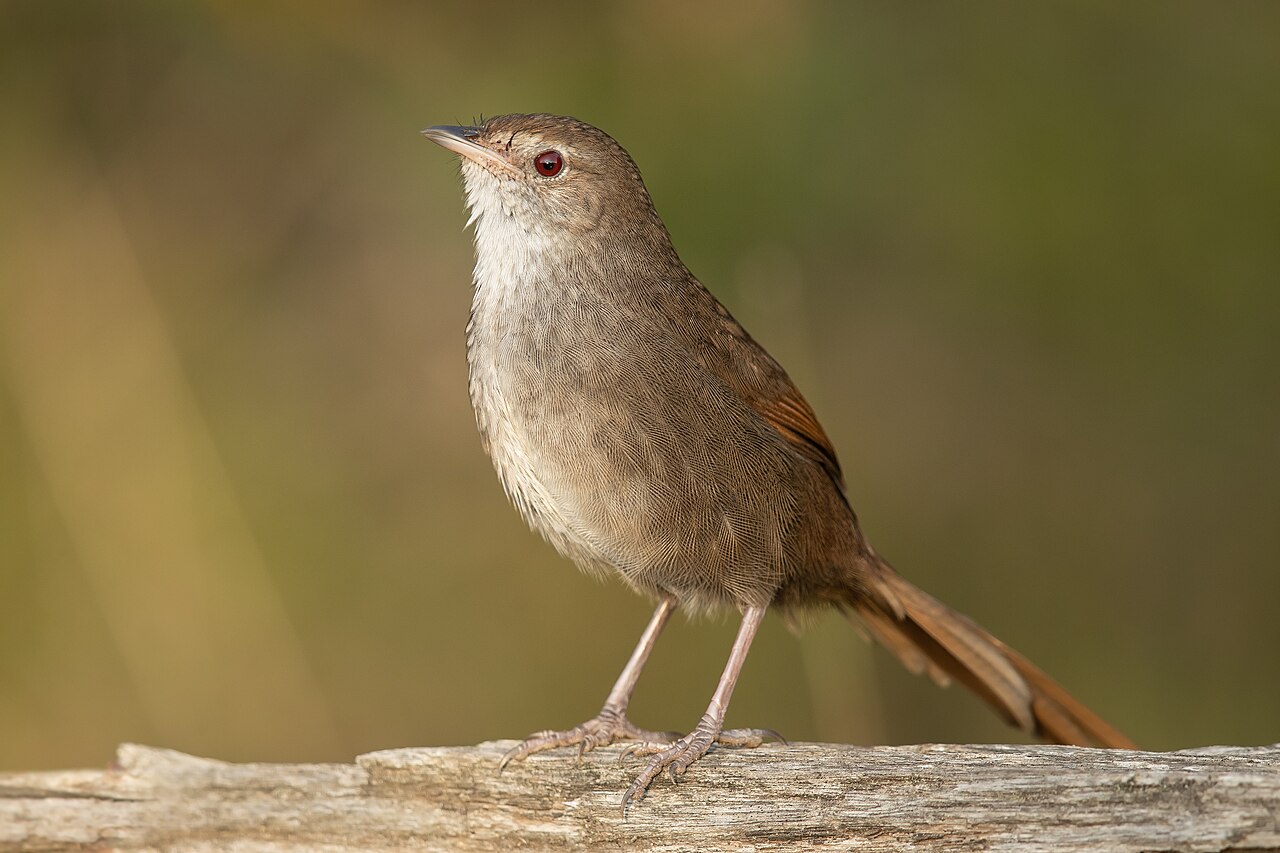
Seventeen to twenty-two centimetres, a good part of it tail: a long, broad tail, often slightly cocked and flicked continually as the bird walks. The upperparts are dull olive-brown, the wings more rufous, the underparts pale grey-brown and the throat whitish. The iris is red-brown and shows well in the field. At the base of the bill stand three stiff, downcurved bristles on each side, the character that gives the family its name. The sexes are alike; the wings are short and rounded and the legs heavy and strong.
Confusion species
Rufous Bristlebird (Dasyornis broadbenti) is much larger, with a rufous crown, nape and ear coverts and a grey eye-ring running forward to the bill — and occurs a thousand kilometres further west, so in practice there is no overlap. Western Bristlebird (Dasyornis longirostris) lives only in south-western Australia and is no alternative here. Within its own range the real pitfall is Eastern Whipbird (Psophodes olivaceus), likewise brown, long-tailed and skulking, but with a black crest, a black throat with a white cheek patch and a completely different, whip-crack song. Scrub-birds of the genus Atrichornis do not occur here.
Habitat
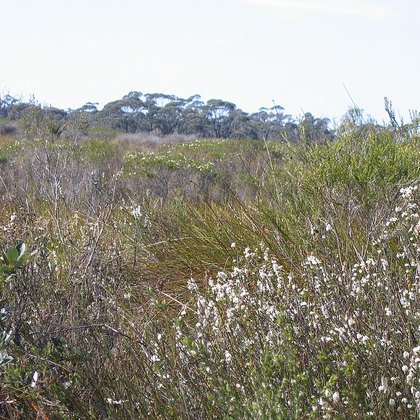
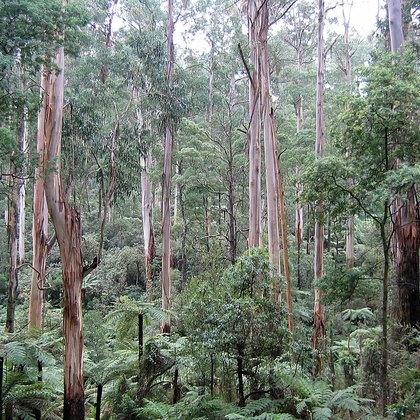
Two rather different types, depending on the population. In the north, at the New South Wales and Queensland border, it is open ground with dense tussock grass clumps abutting rainforest edge or wet gully. In the centre and south it is dense coastal heath and low shrubland on sand, usually within a few kilometres of the sea. In both cases the constant requirement is a closed, low vegetation roof at walking height with open running space beneath. It forages on the ground for ants and other insects, with seeds and small fruits, and nests low in a tussock or dense bush.
Where the bird is most often found, arranged by main group and formation.
Range and movements
Four isolated populations along the east coast. The northern one, of around forty birds, lies around Border Ranges National Park on the Queensland and New South Wales border. The central populations are in the Illawarra, the Kiama escarpment and the Jervis Bay area; this is the species' stronghold. The southern population straddles the New South Wales and Victoria border, with Nadgee Nature Reserve and Croajingolong National Park as its core. It is strictly sedentary and the populations exchange no birds; the country between is too open or too built up.
- Resident
- dark = core range, pale = thinly spread
Where and when to look
Go in still weather at first light to a track through the heath at Jervis Bay or Barren Grounds and stand where you hear the song; that is the best and often the only way. Seeing it almost always means a brown bird crossing the track in one second with its tail up. Do not use playback: the species is vulnerable, the territories are counted, and repeated playback demonstrably disturbs breeding success.
Conservation
Vulnerable (VU) on the world list, but listed as endangered in Australia itself and in New South Wales, Queensland and Victoria; in late 2021 the wild population was put at about 2,500 birds. Fire is the heaviest threat: one severe summer fire can wipe out a subpopulation in a night, because a bird that cannot fly clear has no escape — the fires of 2019-2020 hit several core areas. Beyond that come habitat loss, foxes and feral cats, and, in the small northern population, loss of genetic variation. Management turns on fire compartments, predator control, genetic rescue from the larger populations under the Saving our Species programme, and a captive breeding programme at Currumbin Wildlife Sanctuary in Queensland.
Scientific name
Dasyornis brachypterus | (Latham, 1801)
Latham described the bird in 1801 as Turdus brachypterus, from material out of Sydney; because the species later moved to Dasyornis, author and year stand in parentheses. Dasyornis is formed from Greek dasys (bristly) and ornis (bird), after the stiff bristles at the base of the bill. brachypterus means 'short-winged', from brachys (short) and pteron (wing), and describes exactly why this bird would rather run than fly. The Dutch name points to the plain brown colour, against the rufous crown of the Rufous Bristlebird.