All species › Passerines › Bristlebirds › Rufous Bristlebird
Rufous Bristlebird | Dasyornis broadbenti
Rosse borstelvogel | Picocerdas rufo
At about twenty-seven centimetres the Rufous Bristlebird is the largest bristlebird and also the most strongly marked: rufous on crown, nape and ear coverts, with a grey ring around the eye. It occupies the dense shrub layer of the southern coast of Victoria and South Australia, runs rather than flies, and along the Great Ocean Road is one of the few bristlebirds a walker may simply see crossing the path.

Voice
A loud, rich and sustained song of clear whistled notes with a metallic ring, usually in short phrases of a few seconds; it carries remarkably far through dense thicket. Males learn between twelve and thirty different song types and share about sixty-five per cent of them with their territorial neighbours, females about fifty-nine per cent — a local dialect, then, recognisable after a few mornings. Song is given all year, strongest in early spring; alarm is a hard short tick.
No freely licensed recording has been found for this species yet; what to listen for is described below.
Identification
About twenty-seven centimetres and a good seventy-five grams, the largest of the family, with a long tail and short rounded wings. The upperparts are dark brown, but crown, nape and ear coverts are bright rufous, and set in them is a light grey ring around the eye that runs forward to the bill as a stripe — together the decisive character. The underparts are pale grey-brown with clear scalloping on throat and breast; the iris is red-brown. At the base of the bill stand the family's stiff bristles. The sexes are alike.
Confusion species
Eastern Bristlebird (Dasyornis brachypterus) is much smaller, lacks the rufous head and the grey eye-ring, and occurs only along the coast of New South Wales and eastern Victoria; the ranges do not meet. Western Bristlebird (Dasyornis longirostris) lives only in south-western Australia. Within its own range the pitfalls are scrubwrens and ground-feeding songbirds: all are far smaller and move more openly. More likely one mistakes a Common Blackbird (Turdus merula) on the ground — but that has a short tail and a yellow bill and flies at once, where the bristlebird stubbornly keeps running.
Habitat
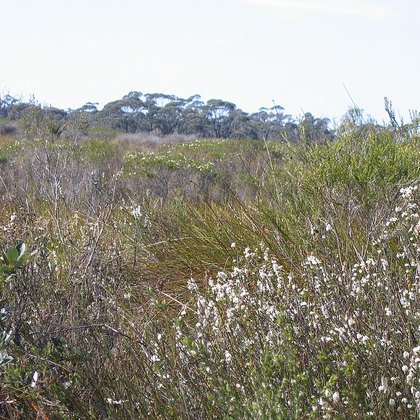
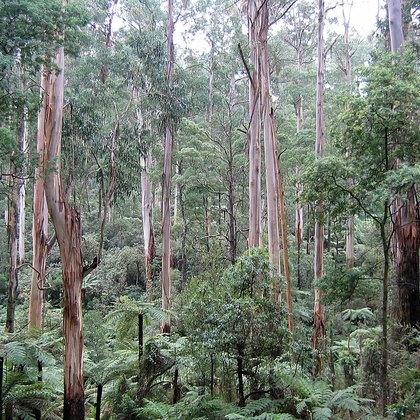
Dense, moderately tall shrub layer over a metre high: coastal heath and tea-tree scrub on clifftops and dunes, rushes and sedges in damp hollows, the vegetated margins of gullies and watercourses in the Otway country, and dense coastal forest understorey. About seventy per cent of records lie within a hundred metres of a drainage line, where the cover is moister and denser. It searches the ground for insects, and is found up to forty kilometres inland where suitable gullies run.
Where the bird is most often found, arranged by main group and formation.

Range and movements
A narrow coastal strip in south-eastern Australia, in two surviving subspecies. Dasyornis broadbenti broadbenti runs from the mouth of the Coorong in South Australia to Portland Bay and Port Fairy in Victoria; Dasyornis broadbenti caryochrous holds the Otway Ranges coast, from Anglesea to Naringal East near Warrnambool. The western subspecies Dasyornis broadbenti litoralis of south-western Australia is extinct; the last certain record dates from 1906. The species is sedentary and territories are fixed year-round.
- Resident
- dark = core range, pale = thinly spread
Where and when to look
The Great Ocean Road makes this the most approachable of the bristlebirds. Go at first light to a coastal track at Anglesea, Aireys Inlet or the Twelve Apostles, walk slowly and watch the scrub edge along the path: the bird often forages right beside the walking track and crosses it with its tail raised. Listen for the rich whistled song; if you hear it close by, stand still rather than approach. Playback is out of place in a species whose two Victorian subspecies are both listed under state law.
Conservation
Least Concern (LC) on the world list, with an estimated population of over 17,800 birds, but that figure hides the position of each subspecies. In Victoria caryochrous of the Otways is listed as vulnerable and broadbenti of the Coorong country as endangered, and the Western Australian subspecies litoralis has been gone for over a century. The pressures are loss and fragmentation of coastal scrub to coastal building, gradual degradation of what shrub layer remains, predation by foxes and cats, road mortality along coastal roads, and rising fire frequency tied to climate change. Management aims at linking coastal strips and at fire regimes that spare mature shrubbery.
Scientific name
Dasyornis broadbenti | (McCoy, 1867)
McCoy described the bird in 1867 as Sphenura Broadbenti, from material near Portland Bay in Victoria; because the species was later placed in Dasyornis, author and year stand in parentheses. The specific epithet honours Kendall Broadbent, the collector. Dasyornis is formed from Greek dasys (bristly) and ornis (bird), after the stiff bristles at the base of the bill that give the family its name. The Dutch name points to the rufous head that separates the species from its two relatives.