All species › Tubenoses › Petrels, shearwaters and diving petrels › Streaked Shearwater
Streaked Shearwater | Calonectris leucomelas
Gestreepte pijlstormvogel | Pardela canosa
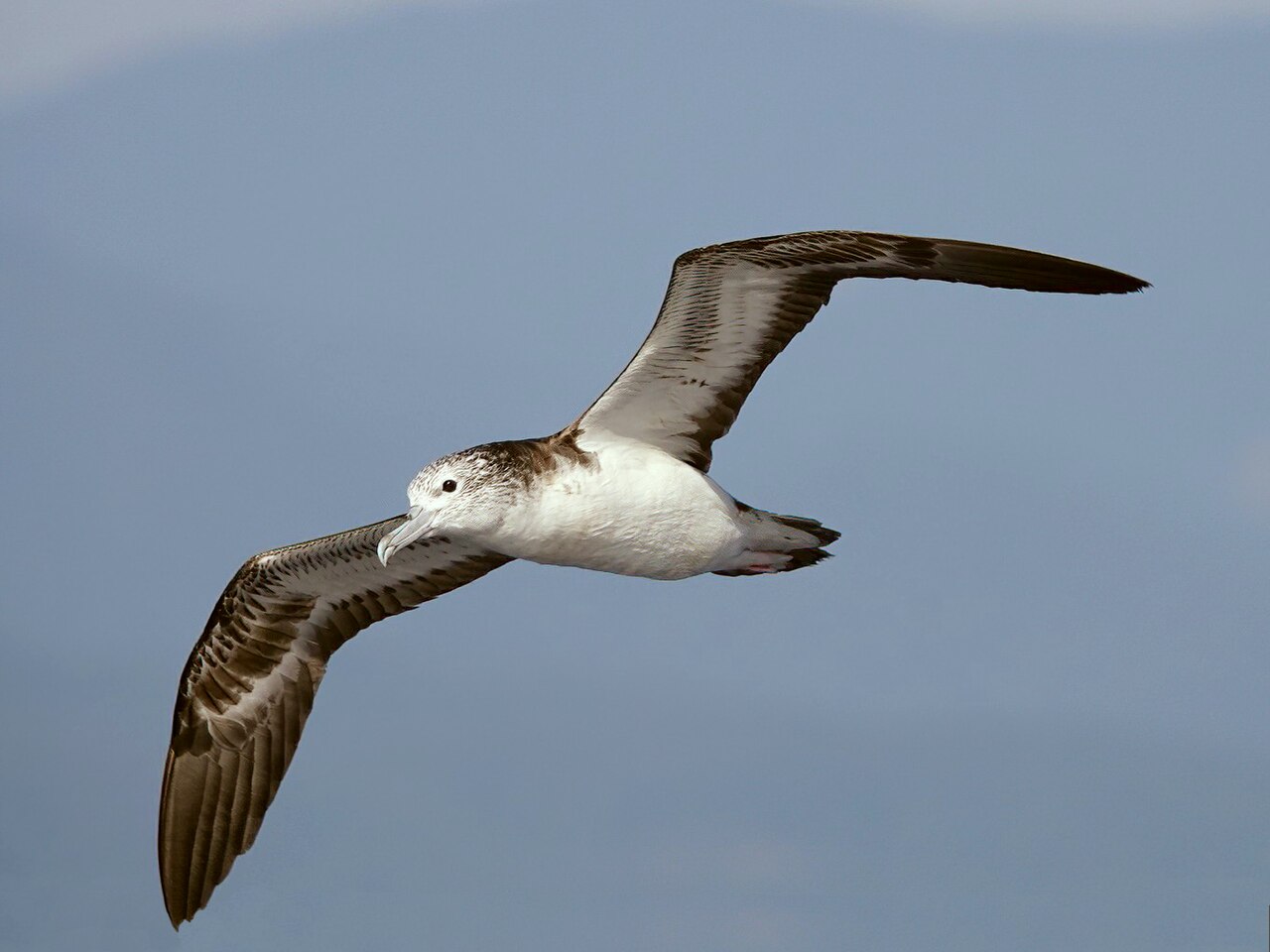
The Streaked Shearwater is a large, pale shearwater from East Asia that appears in the north of this region as a non-breeding visitor. It stands out for its white, finely dark-streaked head, which at range simply reads as white, and for its long slender pale bill — a combination no other shearwater here shows.
Voice
In this region it is not heard: at sea it is silent, as all shearwaters are, and it breeds thousands of kilometres to the north. At the colonies in Japan and Korea it is loud at night, with cat-like wailing and moaning notes and sharp screams in disputes over nest sites; none of that sound reaches this region.
No freely licensed recording has been found for this species yet; what to listen for is described below.
Identification
Forty-eight centimetres and about half a kilo, so one of the largest shearwaters in the region, with long and fairly broad wings and a slow, sailing flight on slightly bowed wings. The upperparts are mottled pale brown, without a sharp M. Head and neck are white with fine dark streaks that thicken towards the crown, so the face reads white and the bird is distinctly pale above the eye — a good field mark. The underside is white; the underwing is largely white with dark flight feathers and a dark margin along the leading edge of the outer wing. The bill is long and slender, pale grey-horn with a dark tip, and measures about thirty-nine millimetres at the nostrils.
Confusion species
Buller's Shearwater (Ardenna bulleri) is also pale below, but has a grey back with a sharp black M, an even dark-brown cap running below the eye and an all-dark bill — the exact reverse of this species' white streaked head and pale bill. Great Shearwater (Ardenna gravis), a vagrant here, also has a dark cap, plus a dark belly patch and a white band above the tail. Wedge-tailed Shearwater (Ardenna pacifica) occurs in this region only in the dark-bellied form, so a large white-bellied shearwater off northern Australia is more likely to be this species. When in doubt, look at the bill: long, slender and pale with a dark tip is close to decisive on a large shearwater in this region.
Habitat
Open sea, both over the continental shelf and beyond it; in Australian waters mainly over the warm seas north of the tropic and along the shelf break. It does not breed in this region, so its breeding habitat — burrows and cavities under shrubs on wooded islets off Japan, Korea and China — plays no part here.
Where the bird is most often found, arranged by main group and formation.

Range and movements
It breeds on islands off the Russian Far East, Japan, Korea, eastern China and Taiwan, and moves south outside the breeding season to the seas off New Guinea, the Arafura Sea and the South China Sea. Within this map window it is a regular if not numerous visitor to northern Australian waters, with records in recent years extending down the east coast into Queensland and New South Wales. In New Zealand it is a true vagrant: three records so far — a dead bird at Kawhia Beach in February 2006, a live bird east of the Poor Knights in November 2023, and remains at Moa Point, Wellington, in October 2024. There is a single record at Norfolk Island.
- Breeding (summer)
- Passage
- dark = core range, pale = thinly spread
Where and when to look
The best season is the Australian summer, when the northern breeders come south. Look for it on pelagic trips and ferries in the Arafura Sea, Torres Strait and Coral Sea, and on trips out of south-east Queensland; it rarely comes close inshore. The image to carry is a large, unhurried shearwater sailing on slightly bowed wings and showing a strikingly white head on every turn.
Conservation
Near Threatened (NT), with a world population of about three million birds in gradual decline. Almost all the threats lie outside this map window, in the East Asian breeding grounds and the fishing waters beside them: entanglement in nets, drowning on longline hooks, and introduced cats and rats on the breeding islands. Chicks are still harvested on some islands. For the birds that reach Australia, fisheries in the tropical seas are the main direct factor.
Scientific name
Calonectris leucomelas | (Temminck, 1836)
Temminck described the species in 1836 as Procellaria leucomelas; because it was later placed in another genus, author and year go in parentheses. The epithet is Greek, from leukos ('white') and melas ('black'), after the sharp contrast between the white underside and the dark upperparts. The genus Calonectris was introduced by Mathews and Iredale in 1915, from Greek kalos ('beautiful') and nektris ('swimmer'). The type locality lies in the seas of Japan, at the bay of Nagasaki.