All species › Passerines › Thornbills, scrubwrens, gerygones and allies › Tasmanian Thornbill
Tasmanian Thornbill | Acanthiza ewingii
Tasmaanse doornsnavel | Acantiza de Tasmania
The Tasmanian Thornbill is the thornbill of the island's wet forest: ten to eleven centimetres of olive-brown, with a rufous panel on the folded wing and, as the one mark that really settles it, snow-white undertail-coverts. It shares Tasmania with the Brown Thornbill, and anyone hoping to separate the two should look not at the head but at the base of the tail.

Voice
A sweet musical warble, usually the first sign the bird is there at all in dense wet forest. Between the phrases come sharp rattling scolds and a thin high contact note that holds a foraging party together. The song is very close to that of the Brown Thornbill, and in Tasmania the two cannot be told apart reliably by voice alone.
No freely licensed recording has been found for this species yet; what to listen for is described below.
Identification
Ten to eleven centimetres, about seven grams. Olive-brown above, with a rufous wash on a forehead that is only faintly scalloped, a dull rufous-brown rump patch and a bold rufous panel on the folded wing. The underparts are off-white with diffuse fine dusky mottling on chin, throat and breast; the undertail-coverts are clean white and fluffy. The tail is fairly long. Sexes are alike.
Confusion species
Across Tasmania it shares the forest with the Brown Thornbill (Acanthiza pusilla), and that is the only confusion that matters: the Brown has dull buffish rather than clean white undertail-coverts, a more strongly scalloped rufous forehead, a shorter tail and heavier breast streaking, and it holds the drier slopes while A. ewingii keeps to the wet gullies. Striated Thornbill (A. lineata) and Buff-rumped Thornbill (A. reguloides) are absent from Tasmania: the first has a white-streaked crown and feeds in the canopy, the second a buff rump and a pale eye. Tasmanian Scrubwren (Sericornis humilis) is larger with a pale eye; Scrubtit (Acanthornis magna) shows a white throat and belly.
Habitat
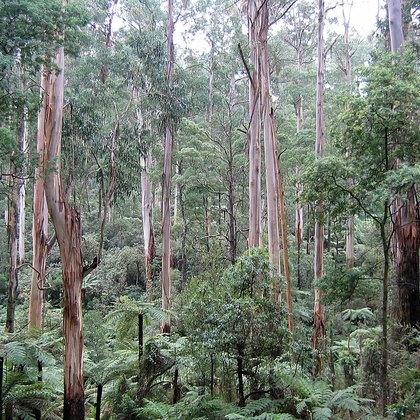
The wetter side of Tasmanian forest: dense eucalypt forest with a well-developed shrub layer, temperate rainforest with tree ferns and moss, and the cover along creeks and in gullies. It also works the wet sedgelands and peat country that the Brown Thornbill usually leaves alone. From sea level up into montane forest, wherever the understorey is thick enough to vanish into.
Where the bird is most often found, arranged by main group and formation.


Range and movements
Endemic to Tasmania and the islands of Bass Strait, and found nowhere else in the world. It does not migrate: a pair holds the same territory the year round. Two subspecies are recognised, the nominate form on Tasmania and A. e. rufifrons on King Island. Within Tasmania it is common and widespread, densest in the wet west and southwest.
- Resident
- dark = core range, pale = thinly spread
Where and when to look
Look for it where the forest is wet and the ferns reach your waist. Make a soft hissing noise and it will often come in close. At that moment check the base of the tail from below: clean white, fluffy undertail-coverts belong to this species, dull buff to the Brown Thornbill. Australian birders remember it as the bird wearing the white underpants.
Conservation
Least Concern (LC), and rated secure both federally and within Tasmania, where it is common and widespread. It does depend on wet forest with a dense understorey, and where that forest is logged or the shrub layer burnt out it does not return. The King Island form is in a worse position than the Tasmanian one, since little suitable forest is left on that island.
Scientific name
Acanthiza ewingii | Gould, 1844
John Gould described the species in 1844; the type locality is Tasmania. The epithet honours the Reverend Thomas J. Ewing, headmaster of the Queen's Orphan Schools in Tasmania, with whom Gould stayed during his Tasmanian visit of 1838-1839. The genus Acanthiza was introduced by Vigors and Horsfield in 1827, from Greek akantha, 'thorn', and zao, 'to live': the bird of the thorn-brake.