All species › Passerines › Thornbills, scrubwrens, gerygones and allies › Yellow-rumped Thornbill
Yellow-rumped Thornbill | Acanthiza chrysorrhoa
Geelstuitdoornsnavel | Acantiza culigualda
The Yellow-rumped Thornbill is the largest and by far the best-known thornbill in Australia, and the only one everybody recognises at once: a ground-feeding party that flushes and shows a bright yellow rump. It also builds the strangest nest in the family, an untidy dome with a second, empty cup on top — a false nest whose purpose nobody has settled.
Voice
A musical, cheery, tinkling song ending in two clear whistled notes, repeated all day long. It is sweet and high, with the quality of small bells. The species also has short contact notes that keep a party together while it works across the ground, and it regularly mimics other birds, in particular the alarm call of Noisy Miner (Manorina melanocephala).
No freely licensed recording has been found for this species yet; what to listen for is described below.
Identification
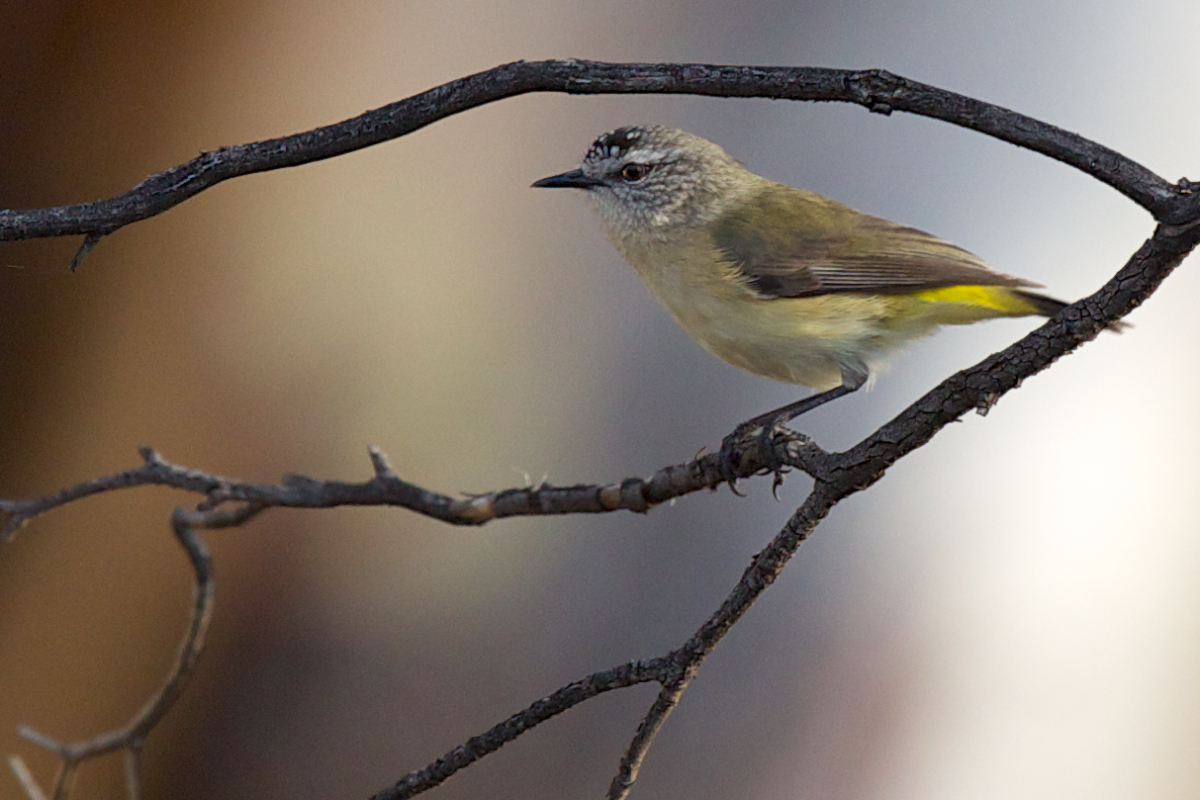
Ten to twelve centimetres, the largest thornbill, with a bright yellow rump set against an olive-grey to brownish-grey back which is almost always the first thing seen. The dark crown is finely spotted white, a white line runs above the eye and a dark stripe through it, the throat is white and the underparts cream. The tail is black with white tips. The sexes are alike; juveniles have softer, fluffier plumage. Four subspecies are recognised, among them leachi of Tasmania.
Confusion species
Buff-rumped Thornbill (Acanthiza reguloides) is the awkward one: it is smaller, has a dull yellow to buff rump rather than a bright yellow one, a plain buff forehead without white spots, a pale iris and no sharp dark eye-stripe. Slender-billed Thornbill (Acanthiza iredalei) shows only an olive-yellow wash at the tail base and is besides a bird of treeless samphire and chenopod flats. Chestnut-rumped Thornbill (Acanthiza uropygialis) has a chestnut, not yellow, rump and a white iris. Yellow Thornbill (Acanthiza nana) is yellow across the whole underside rather than only on the rump, and forages in foliage rather than on the ground. From the remaining thornbills — among them Inland Thornbill (Acanthiza apicalis) and Striated Thornbill (Acanthiza lineata) — the yellow rump separates it outright.
Habitat
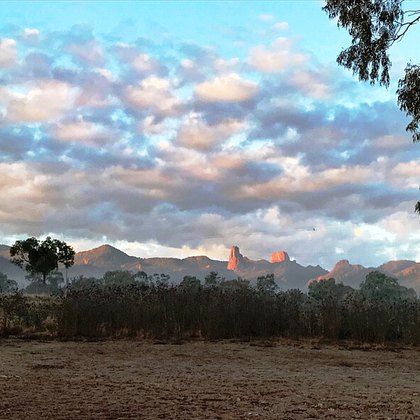
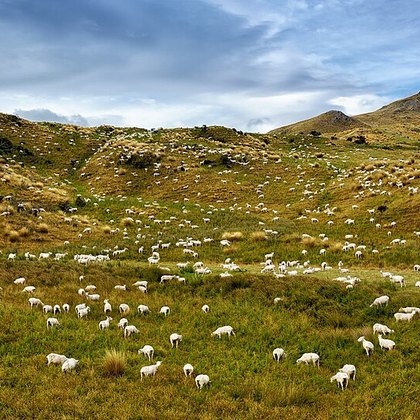
Open country with trees: dry eucalypt forest and woodland, shrubland and grassland with scattered trees, but equally crop margins, pasture, roadsides, creek lines, parks and gardens. It feeds mainly on the ground, never far from cover, taking ants, beetles, bugs and lerp, supplemented with spiders, flies and seed. Parties of three to twelve birds stay together the year round and sometimes breed cooperatively, with helpers at the nest.
Where the bird is most often found, arranged by main group and formation.

Range and movements
Widespread across western, southern and eastern Australia including Tasmania, and on through the southern Northern Territory and over the Nullarbor. It is absent from the north coast of Western Australia, from the heart of the deserts and from parts of the tropical north, and is scarce in the dense rainforest east of the Great Dividing Range. The species is sedentary; a party stays in the same ground for years. It does not occur in New Zealand.
- Resident
- dark = core range, pale = thinly spread
Where and when to look
Read the behaviour before the colour: a scatter of small brown birds working over short grass or a roadside verge that flies as one body to the nearest tree when you approach is almost certainly this species — and that is the moment the yellow rump lights up. The nest is equally diagnostic: look in a low tree or shrub for an untidy dome of grass and bark with a cup on top. That cup is empty; the entrance to the real chamber is hidden at the side.
Conservation
Least Concern (LC) and common; the species benefits from open, lightly grazed country with scattered trees and holds on in farmland and gardens. Ringed birds have reached nine years. Nests are parasitised by Shining Bronze-Cuckoo (Chrysococcyx lucidus) and Fan-tailed Cuckoo (Cacomantis flabelliformis), and are robbed or pulled apart for nest material by ravens, Australian Magpies and larger honeyeaters. None of these threatens the species as a whole.
Scientific name
Acanthiza chrysorrhoa | (Quoy & Gaimard, 1832)
The French naturalists Jean René Constant Quoy and Joseph Paul Gaimard described the species in 1830 as Saxicola chrysorrhoa, from a specimen taken at King George Sound in Western Australia; the parentheses around their names record the later move to Acanthiza. The epithet comes from Ancient Greek khrysos ('gold') and orrhos ('rump'), hence 'golden-rumped'. The English Yellow-rumped Thornbill, the Dutch geelstuitdoornsnavel and the Spanish acantiza culigualda all take the same character as the scientific epithet.