All species › Waders, gulls and terns › Sandpipers and allies › Terek Sandpiper
Terek Sandpiper | Xenus cinereus
Terekruiter | Andarríos del Terek
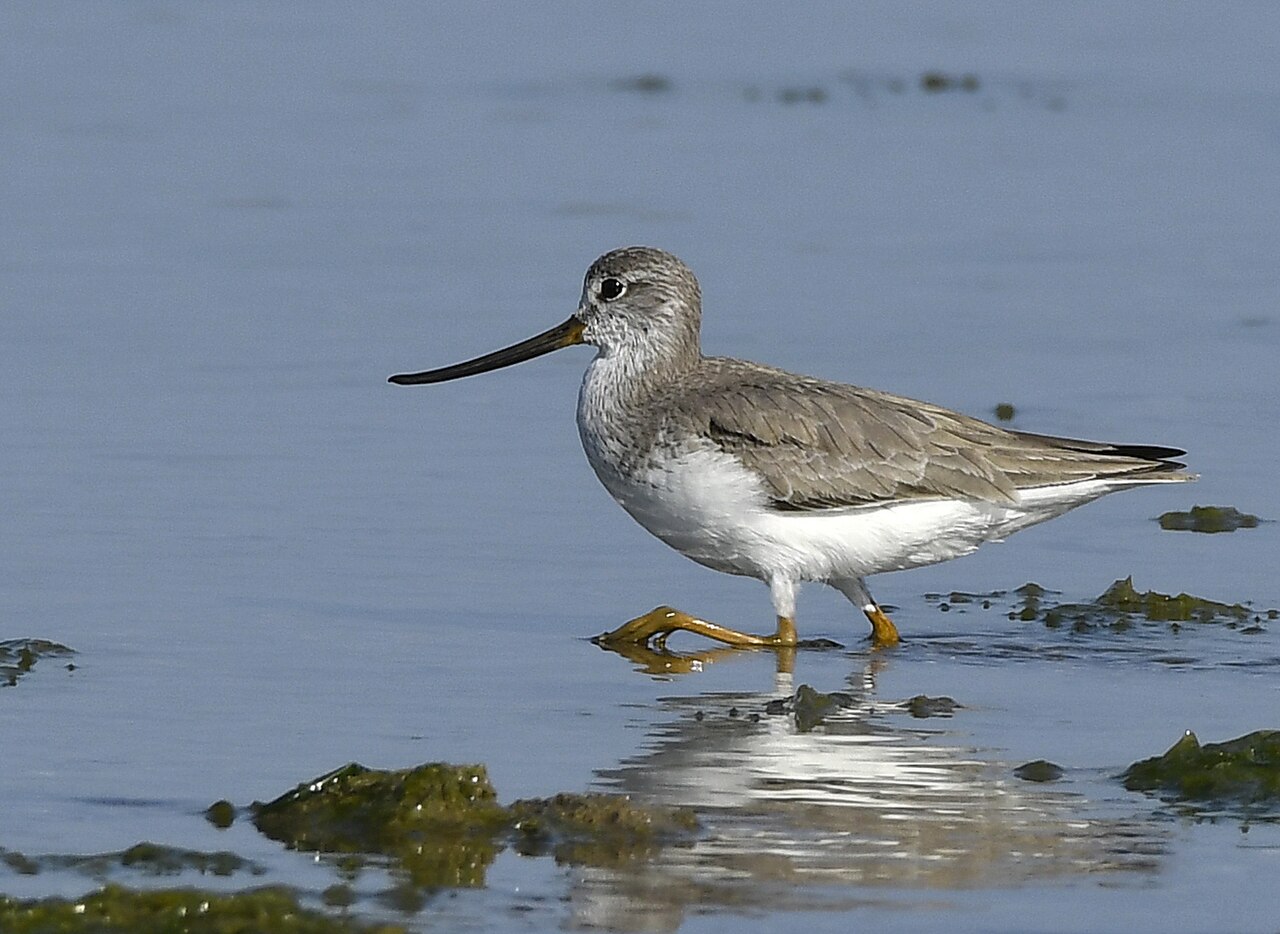
The Terek Sandpiper can be named by its bill at a hundred metres: a long, clearly upturned bill with an orange-yellow base, on a dumpy, short-legged grey body with a steep forehead. It does not belong with the Tringa shanks but in a genus of its own, though its build recalls the tattlers; its hyperactive, running way of feeding makes it stand out at once on a flat.
Voice
The call is variable but usually fluty and cheerful in tone: a clear two-part wee-we and a rapidly repeated twit-wit-wit, often on take-off and growing in a party into a busy twittering. It is clearly higher and more musical than the low whistling of Common Greenshank and lacks the plaintive quality of Common Redshank. Feeding birds are silent, but at a high-tide roost a party of Terek Sandpipers calls almost without pause.
Recording: Ray Tsu 诸仁 — CC BY-NC-SA 4.0 · Jiuduansha Wetland National Nature Reserve, Shanghai, China · xeno-canto
Identification
A dumpy, short-legged wader of twenty-two to twenty-four centimetres and about ninety-five grams, brown-grey above and on the breast sides, white below, with a steep forehead that gives the head a square look. Everything hangs on the bill: long, clearly upturned and orange-yellow at the base, black towards the tip — in non-breeding plumage the yellow base dulls. The legs are short and orange-yellow, shorter than on any Tringa here. In breeding plumage two dark lines run across the scapulars. In flight the upperwing is dark with a narrow but crisp white trailing edge to the secondaries; the rump is grey and the legs barely project beyond the tail. It teeters its rear end a little, but less continuously than Common Sandpiper.
Confusion species
No other wader here combines a long upturned bill with short orange legs, so the bill settles it almost every time. At range and against the light it can still be confused: Grey-tailed Tattler (Tringa brevipes) is equally dumpy and also has short yellow legs, but its bill is dead straight and its upperparts darker and plainer. Common Sandpiper (Actitis hypoleucos) is smaller, shorter-billed, has the white wedge at the bend of the wing and grey-green legs. Common Greenshank (Tringa nebularia) also has a slightly upturned bill, but is far larger, long-legged and green-legged and shows a white wedge up the back. Among the stints and sandpipers, Curlew Sandpiper (Calidris ferruginea) may come to mind for its curved bill, but that curves down rather than up, and its rump is white.
Habitat
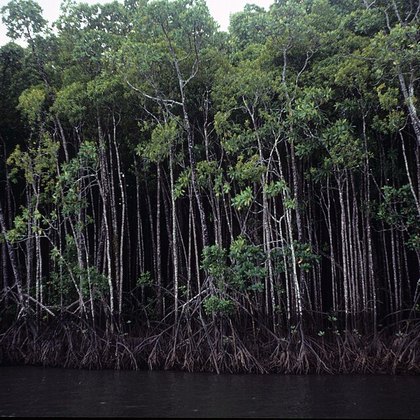
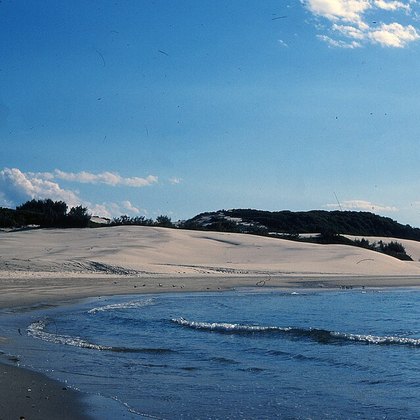
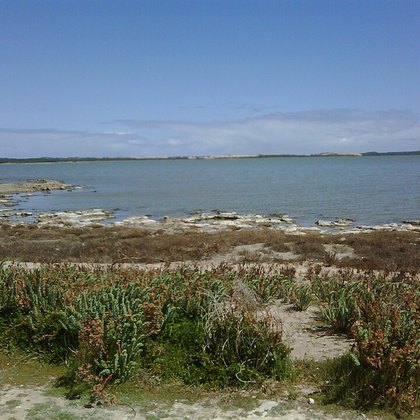
Soft intertidal mud by preference, and within that the edges bordering mangrove: the flats of estuaries and sheltered bays, mangrove creeks and their mud banks, and at times a sandy beach or the edge of a saltworks pond. It feeds strikingly actively: it runs with the head held low across the mud after crabs, jabs and probes in the mud, and in shallow water sometimes sweeps its bill from side to side like an avocet. At high water it roosts on mangrove roots, sandbars and jetties.
Where the bird is most often found, arranged by main group and formation.

Range and movements
Chiefly the north and east coasts of Australia, with the largest numbers on the flats of the Kimberley and around Broome, in the Top End, in the Gulf of Carpentaria and along the Queensland coast into Moreton Bay; south and west it thins out rapidly and nowhere is it truly abundant. Birds arrive from August and leave between March and April. In New Zealand it has declined sharply: in the 1980s it was regular at Kaipara Harbour and Miranda, but today it probably no longer reaches the country every year, and the records there are of single birds among Wrybills and other small waders, from Northland to Awarua Bay.
- Resident
- Breeding (summer)
- dark = core range, pale = thinly spread
Where and when to look
Work the mangrove edge on a falling tide and look not for colour but for movement: a small, low grey bird running head-down across the mud and stopping abruptly again and again is almost certainly this species. Then check the bill in profile — the upward curve shows even in silhouette — and note the leg colour, brighter orange than on any shank here.
Conservation
Least Concern (LC): it breeds in a long belt of taiga bog from Finland to the Kolyma in eastern Siberia and the world population is large. For the birds that come here the state of the Yellow Sea weighs heavily, because the flats there are their only filling station on a journey of three and a half to nearly five thousand kilometres a leg. The sharp fall in New Zealand since the 1980s shows how fast a species can vanish from the edge of a flyway when numbers drop halfway along it. In Australia the local loss of mangrove fringes adds to that, precisely the habitat it depends on most.
Scientific name
Xenus cinereus | (Güldenstädt, 1775)
Güldenstädt described the species in 1775 as Scolopax cinerea, from birds on the Terek River near the Caspian Sea; Kaup introduced the genus Xenus in 1829, so author and year stand in parentheses. That genus name comes from Greek xenos, 'stranger' — a bird that fitted no existing genus. The epithet cinereus is Latin for 'ash-grey', from cinis, cineris, 'ashes'. The English and Dutch names both refer directly to that type river in the Caucasus.