All species › Waders, gulls and terns › Buttonquails › Chestnut-backed Buttonquail
Chestnut-backed Buttonquail | Turnix castanotus
Rosse vechtkwartel | Torillo dorsicastaño
The Chestnut-backed Buttonquail is the buttonquail of the rocky savanna of tropical northern Australia, with a warm chestnut back that separates it at once from all its relatives. It lives on sandstone and quartzite ridges and plateaux with sparse grass and scattered eucalypts, and is hard to find there because it flushes only at a few metres. As in all buttonquails the female is the larger and the brighter coloured: she calls, she wins the males, and she leaves the incubating and the rearing to them.

Voice
The calling sex is the female, and her voice is a low, hollow booming oom, repeated at intervals of a few seconds and swelling slowly, carrying surprisingly far across an open rocky slope and yet almost impossible to place. She calls mainly in the early morning, at dusk and at night, and most in the wet season. The male is all but silent, and a flushed bird makes nothing but the loud whirr of its wings.
No freely licensed recording has been found for this species yet; what to listen for is described below.
Identification
A medium-sized buttonquail of fifteen to nineteen centimetres, with three toes: the hind toe is missing, which separates all buttonquails from the true quails. The decisive mark is the mantle: warm, almost even chestnut, contrasting sharply with black-and-white spotted wing coverts. The face and throat are whitish and finely streaked, the breast orange-buff and black-spotted on the breast sides and flanks, and the belly white. The bill is blue-grey, the legs yellowish and the eye pale cream. The sexual difference runs the other way round: the female is larger and far deeper chestnut on the back, the male smaller, duller and more buff-marbled — this reversed sexual dimorphism is unique among Australian birds to the buttonquails. In flight it is darker and heavier than the small species, and the rufous of the back stays visible.
Confusion species
Red-backed Buttonquail (Turnix maculosus) shares the tropical north and is the main confusion: smaller, with a yellow bill and yellow legs, a grey face and a rufous back broken by black barring and white speckling rather than even chestnut, and it sits in tall, damp grass along swamps while Chestnut-backed keeps to dry, stony slopes. Little Buttonquail (T. velox) is smaller, much paler and sandy and has a white flank stripe. Red-chested Buttonquail (T. pyrrhothorax) carries its rufous on the belly rather than the back and barely touches this range. Painted Buttonquail (T. varius) is larger, greyer, with pearl-white drops and an orange-red eye, and does not occur in this part of Australia. Partridge Pigeon (Geophaps smithii) walks the same savanna ground but is a pigeon: far larger, with a bare red eye-ring and a hind toe.
Habitat
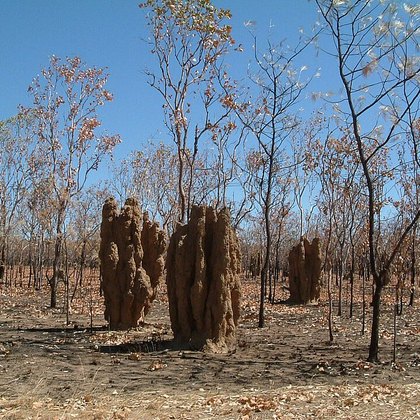
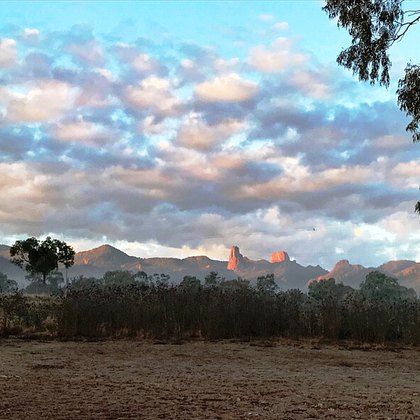
Low, sparse grassland and open eucalypt woodland on stony ground, with a marked preference for quartzite and sandstone ridges, plateaux and escarpment edges. The country involved has much loose rock, short spinifex and annual grasses and scattered trees, in districts receiving more than eight hundred millimetres of summer rain. Dense, tall grass and flooded plains it leaves to its relatives.
Where the bird is most often found, arranged by main group and formation.


Range and movements
Tropical northern Australia, from the Dampier Peninsula in Western Australia through the Kimberley and the Northern Territory to Westmoreland Station in the Gulf Country of north-western Queensland, together with Melville Island and Groote Eylandt. The Queensland birds were only confirmed with certainty in 2020, which shows well how poorly the species is known. Within that range it is local and unevenly spread, with its stronghold on the sandstone plateaux of Arnhem Land and the Kimberley. It does not reach New Zealand.
- Resident
- dark = core range, pale = thinly spread
Where and when to look
Look for it in and just after the wet season on a stony slope or a sandstone plateau with short grass, and walk that ground slowly and in zigzags; the bird flushes only at a few metres and then vanishes behind the first rock ledge. In those few seconds look at the back: even chestnut against black-and-white spotted wings is decisive. At dusk, listen from a high point for the female's low booming, which carries far across the open slope.
Conservation
Least Concern (LC), with a large range in the thinly settled tropical north where the habitat is still largely intact. Even so the species is poorly known and the hard data are few: the changed fire regime in the savannas of northern Australia, in which late, hot dry-season fires thin the grass layer and the seed supply, is named as the main concern, together with grazing by stock and feral stock and predation by feral cats, which take small ground birds on a large scale across the north. That its presence in Queensland was confirmed only in 2020 marks how uncertain any estimate of number or trend for this species remains.
Scientific name
Turnix castanotus | (Gould, 1840)
Gould described the bird in 1840 as Hemipodius castanotus; because it was later placed in another genus, author and year stand in parentheses. The genus Turnix was introduced by Bonnaterre in 1791 and is a shortening of Latin coturnix, 'quail'. castanotus is formed from Greek kastanon, 'chestnut', and noton, 'back', after the mark by which the species is settled in the field. The type locality lies in north-western Australia; the type was collected by Benjamin Bynoe, surgeon of HMS Beagle.