All species › Kingfishers, bee-eaters and rollers › Kingfishers › Torresian Kingfisher
Torresian Kingfisher | Todiramphus sordidus
Witkraagijsvogel | Alción acollarado
The Torresian Kingfisher is the big, heavy-billed kingfisher of the mangroves: dark blue-green above, white below, with a broad white collar right round the neck. It has been a species in its own right only recently — until lately it counted as the Australian form of the widespread Asian Collared Kingfisher — and it rarely leaves the tidal forest.

Voice
The call is a hard, strident series of three or four even notes, chek-chek-chek-chek, which carries across the mudflats and sounds louder and rawer than the Sacred Kingfisher's. In excitement it speeds up and takes on a rasping edge; from a dead mangrove branch pairs answer one another in the early morning and around high tide. Outside the breeding season the bird is notably silent.
No freely licensed recording has been found for this species yet; what to listen for is described below.
Identification
At about twenty-four centimetres this is the largest kingfisher in the guide apart from the two kookaburras: bulky, short-tailed, with a heavy, almost wholly black dagger of a bill whose only pale part is a pink-white base to the lower mandible. The upperparts are dark blue-green — blackish green on the crown and bluer on the back in the male, more uniformly olive-brown in the female — and the underparts white, at times with a dingy buff wash. The broad white collar runs right round the nape and sets off a black eye band that carries across the hindneck.
Confusion species
Sacred Kingfisher (Todiramphus sanctus) is the species it sits beside in the mangroves: clearly smaller and finer-billed, brighter turquoise above, and with a cream rather than white collar and breast. Forest Kingfisher (Todiramphus macleayii) is smaller, deep blue on the crown, and shows a large white wing panel in flight that this species lacks. Red-backed Kingfisher (Todiramphus pyrrhopygius) has a pale streaked crown and a chestnut rump and does not enter mangrove. Size and bill weight are the most reliable measure here: beside a Sacred Kingfisher this bird looks massive.
Habitat
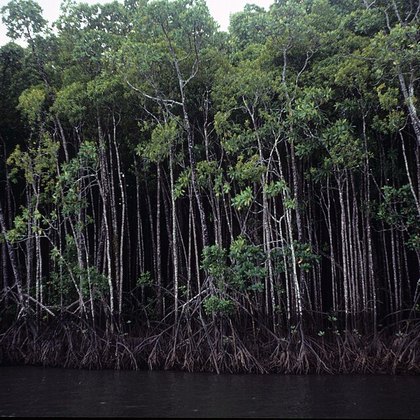
Mangrove above all: it hunts crabs, prawns, worms, small fish and lizards from a low root or branch on the exposed mud, working with the tide. Beyond that it uses adjoining mudflats, estuaries, tidal creeks and coconut palms, and at the edge of its range monsoon forest and coastal parkland. The nest is a cavity in a dead mangrove trunk or a chamber dug into an arboreal termite mound.
Where the bird is most often found, arranged by main group and formation.


Range and movements
The northern coastline of Australia, in three separate stretches: the form pilbara along the Pilbara and Kimberley coasts of Western Australia, the nominate form from the Top End across the Gulf of Carpentaria to Cape York, and the form colcloughi along the coast of southeastern Queensland and northeastern New South Wales. Beyond the map window it also occurs on the Aru Islands and along the south coast of New Guinea. It does not occur in New Zealand.
- Resident
- dark = core range, pale = thinly spread
Where and when to look
Walk a mangrove boardwalk at low tide in the early morning — at Darwin, Broome, Cairns or Townsville — and stop where the mud lies bare under the roots. If you hear a hard, strident series, look at the bill: heavy, almost entirely black, and the bird is bigger than you expect a kingfisher to be. Check the collar too: clean white, not cream.
Conservation
The IUCN has not yet assessed this species separately (NE): it is still counted within Collared Kingfisher Todiramphus chloris, which is listed as Least Concern. In Australia the bird is numerous in intact mangrove, but its fate hangs almost wholly on that habitat: port works, coastal building, aquaculture and the straightening of tidal creeks all cost mangrove, and the southern form colcloughi holds the smallest and most exposed population.
Scientific name
Todiramphus sordidus | (Gould, 1842)
John Gould described the bird in 1842 as Halcyon sordidus; since it now sits in Todiramphus, author and year take parentheses. sordidus is Latin for 'dirty' or 'dingy' and refers to the buff, less crisp wash over the underparts compared with the clean white of the Asian Collared Kingfisher. The type locality is the north coast of Australia, narrowed by Mathews in 1912 to Cape York. Only in the 21st century was the species split from Todiramphus chloris, which produced the English name Torresian Kingfisher; the Dutch name stayed with the collar.