All species › Passerines › Sittellas › Varied Sittella
Varied Sittella | Daphoenositta chrysoptera
Australische boomloper | Neosita variable
The Varied Sittella works head-down along trunks and branches in parties that call incessantly — behaviour no other songbird of this region shows. It is the only sittella in Australia and belongs to a small family of Australia and New Guinea. In the field it is recognised by its behaviour rather than by its plumage, because that plumage differs from district to district.

Voice
A thin, high chwit as a contact note, swelling in a foraging party into a sustained, metallic tchweit-tchweit-tchweit from all the birds at once. It is one of those sounds one learns to hear as 'a party is coming', before anything is in sight. The species has no true song; the calling goes on all day and stops only at the nest. In danger comes a sharper, faster rattle.
No freely licensed recording has been found for this species yet; what to listen for is described below.
Identification
Ten to eleven centimetres: small, dumpy, with a short tail, broad rounded wings and a long, slightly upturned bill. The iris is dark orange, the eye-ring, legs and feet orange-yellow, and the bill orange with a black tip. Crown and head may be white, grey or black and the underparts white or grey streaked with black, according to the form; the wingbar is white or cinnamon and shows strongly in flight. Male and female differ by form, usually in the amount of black on head or throat. The bird climbs downward and around the trunk in short jerks, and on taking off spreads the wings with the bar in full view.
Confusion species
Nuthatches are absent from this region, so climbing head-down is by itself decisive. The treecreepers of the genus Climacteris climb up and not down, have a longer tail and lack the conspicuous wingbar. Thornbills are as small but move in the foliage and not on the bark. If in doubt, wait for the bird to fly: no other small bird has the broad pale band across the primaries.
Habitat
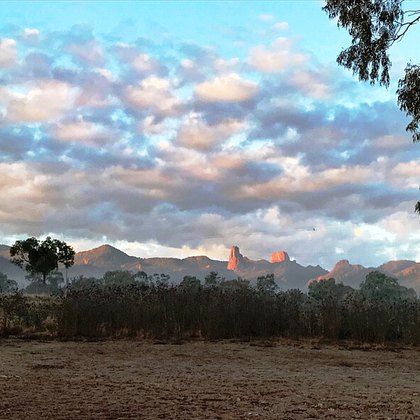
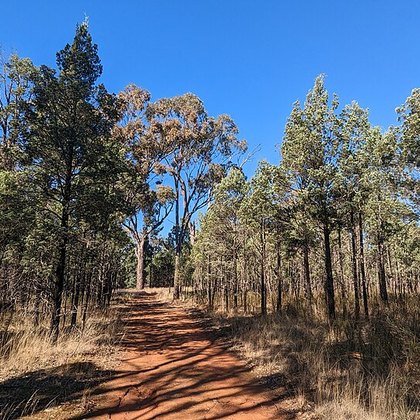
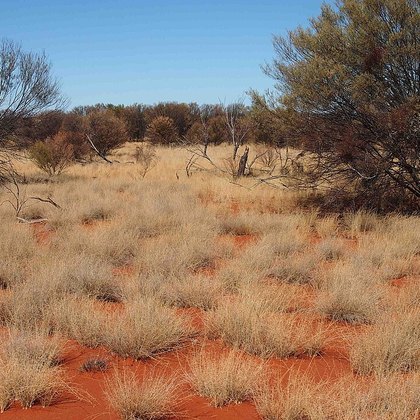
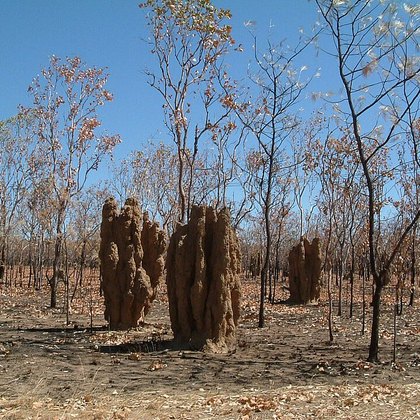
Eucalypt forest and woodland of every kind, with a preference for rough-barked stringybark and ironbark and for old trees with dead limbs. Also mallee, callitris, acacia scrub, riverine woodland along creeks and, in the north, eucalypt savanna. It needs rough bark to search in; smooth gum trunks are passed over. It does not use closed rainforest or treeless country.
Where the bird is most often found, arranged by main group and formation.


Range and movements
Across almost the whole Australian mainland wherever there are trees, from the south-western corner to Cape York and from the east coast far into the dry interior; it is absent from Tasmania. Resident, in parties of three to twelve that stay together all year and in winter, in June and July, range over a wider area. In the south-east the species has declined in recent decades where old forest has been replaced by young growth without dead limbs. Elsewhere the range is unchanged; with nearly fifty thousand records in ten years it is one of the best-reported small woodland birds of the interior.
- Resident
- Breeding (summer)
- dark = core range, pale = thinly spread
Where and when to look
Watch the bark and not the leaves, and look for movement going downward. A party is usually past within a minute; anyone who hears the rattle should run the binoculars over the trunks at once. On every sighting note crown, throat and wingbar: where two forms meet, everything in between occurs.
Conservation
Not threatened and spread over the whole range, but locally much reduced in south-eastern Australia. The cause is the loss of old forest with rough bark and dead limbs, and of the fallen wood and spider web the nest is built from. Where that forest is left standing, the bird holds on.
Scientific name
Daphoenositta chrysoptera | (Latham, 1801)
John Latham described the bird in 1801 as Sitta chrysoptera, among the nuthatches; because the species was later moved to another genus, author and year stand in parentheses. Charles Walter De Vis introduced the genus Daphoenositta in 1897, from Greek daphoinos (blood-red, tawny) and sitta (nuthatch). chrysoptera is Greek for 'golden-winged', from khrysos (gold) and pteron (wing), after the pale wingbar. Thirteen forms of the species have been described, five of which long passed as separate species; this guide follows AviList, which keeps them all under one name. The type locality is Sydney, New South Wales.