All species › Passerines › Woodswallows, bellmagpies and allies › Grey Currawong
Grey Currawong | Strepera versicolor
Grijze klauwierkraai | Verdugo cenizo
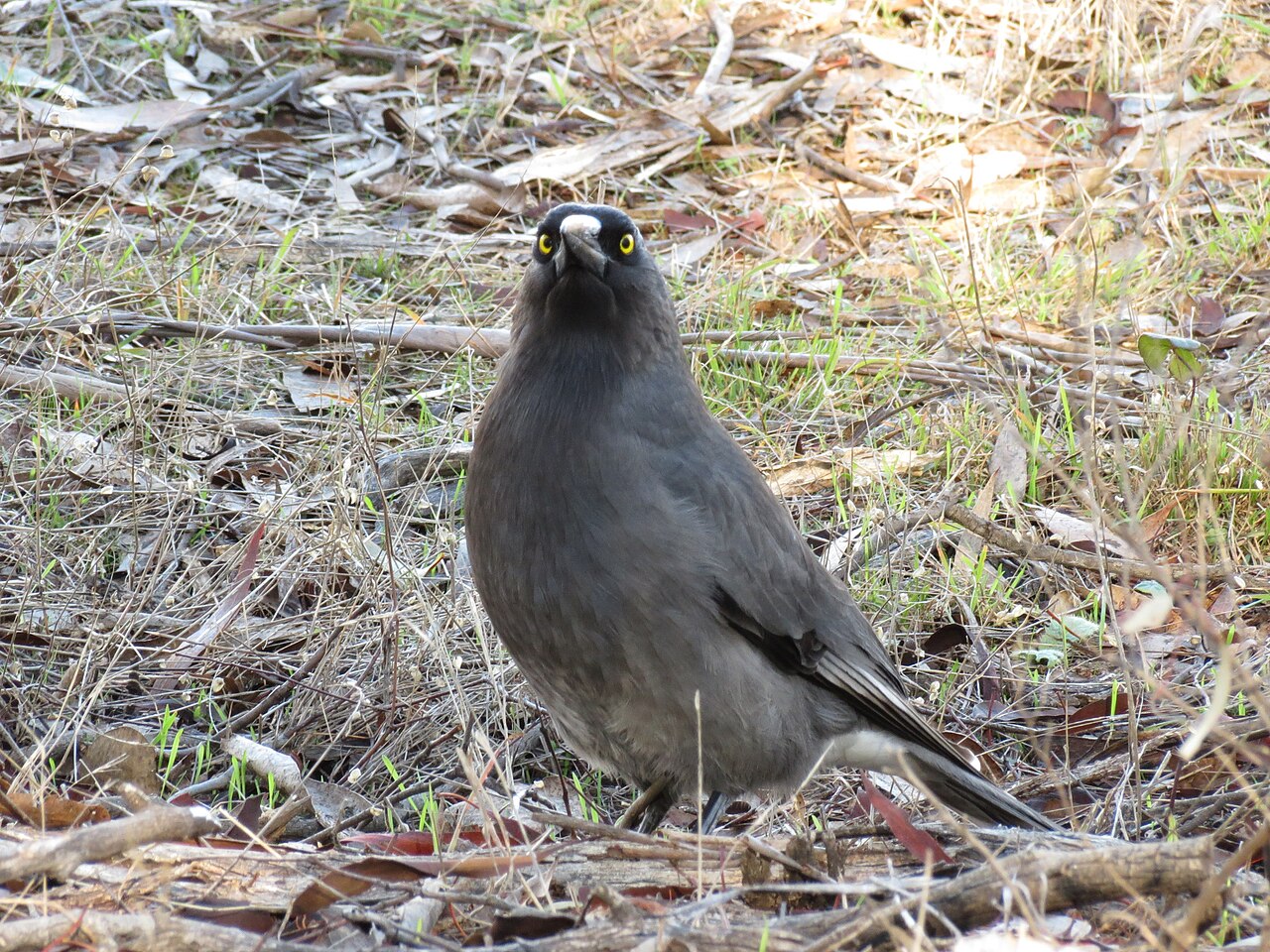
The Grey Currawong is the currawong of the south: a large, dull grey bird with a bright yellow eye and a heavy black bill, turning up in mallee, dry forest and suburban gardens from Perth to Tasmania. It varies so much in colour and voice from district to district that some subspecies carry names of their own — the Tasmanian birds are called after their metallic clink.
Voice
The call is loud and carries far, but differs from the ringing curra-wong of the Pied Currawong: on the mainland a strong, slightly grating kar-plonk or prink, in Tasmania a clear metallic clink-clink as though steel were being tapped. There are also hoarse croaks and a high rising whistle. Birds call from the canopy and answer one another across long distances.
No freely licensed recording has been found for this species yet; what to listen for is described below.
Identification
A large, long-tailed bird of 45 to 50 centimetres, duller and greyer than the other currawongs, though the subspecies run from ash grey to nearly sooty black. There is a large white wing patch that opens as a broad window in flight, a white tail tip and white undertail coverts — but no white rump. The eye is bright yellow, the bill heavy, black and hooked.
Confusion species
Pied Currawong (Strepera graculina) is blacker, has a white rump and white at the tail base and a smaller wing patch. Black Currawong (S. fuliginosa) is almost wholly black with white only at the wing tips and tail tip; in Tasmania the two occur side by side, and there Grey Currawong is told by its duller grey tone, its larger white wing patch and the metallic clink. The ravens and crows (Corvus) have a white eye and lack any white in wing or tail.
Habitat
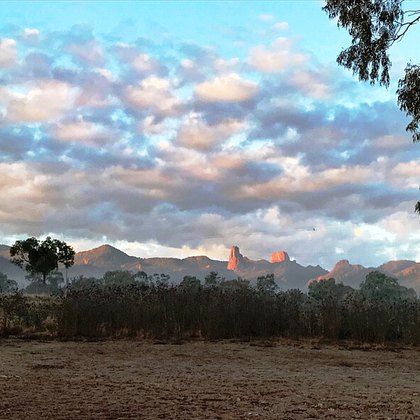
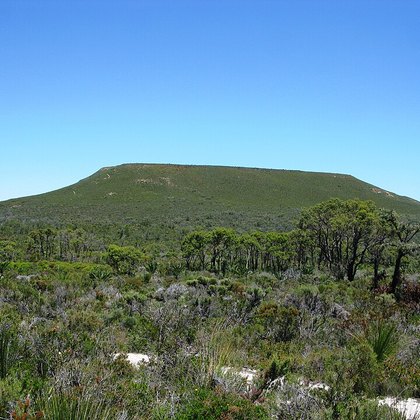
Mallee, dry eucalypt forest and woodland, kwongan heath and other southern scrub, plus planted street trees, parks and gardens at the edge of towns. It forages in the canopy, on the ground, in bark crevices and in the litter, and in winter is also found on farmland and along roads. In Tasmania it reaches into wet forest.
Where the bird is most often found, arranged by main group and formation.


Range and movements
Southern Australia, from western New South Wales and Victoria through South Australia to the southwest of Western Australia, plus Tasmania and several islands; the tropics are missing entirely. Six subspecies, with striking differences in colour and voice: arguta in Tasmania, melanoptera in the mallee, plumbea in the west and halmaturina on Kangaroo Island. Sedentary, with local movements outside the breeding season.
- Resident
- dark = core range, pale = thinly spread
Where and when to look
Check the rump: grey or black means this species, white means Pied Currawong. On birds passing overhead, note the size of the white wing window — in Grey Currawong it is generous. In Tasmania let the voice decide: the clear metallic clink belongs to this species, the raucous kar-week-week to Black Currawong.
Conservation
Least Concern (LC) as a species, but the picture differs sharply by subspecies. Birds of the mallee country have suffered from the wholesale clearing of mallee for cropping and have declined locally, while the Tasmanian and southwestern populations appear stable. Fragmentation of dry woodland and the loss of old trees with heavy limbs are the main concerns.
Scientific name
Strepera versicolor | (Latham, 1801)
Latham described the species in 1801 as Corvus versicolor, among the crows; the later move puts author and year in parentheses. The genus Strepera was introduced by Lesson in 1831, from Latin streperus, 'noisy'. versicolor means 'of changeable colour' — an apt name for a species whose subspecies run from grey to nearly black.