All species › Passerines › Woodswallows, bellmagpies and allies › Pied Currawong
Pied Currawong | Strepera graculina
Bonte klauwierkraai | Verdugo pío
The Pied Currawong is the big black bird with the yellow eye that announces winter in eastern Australia: as soon as it turns cold in the ranges, flocks drop to the lowlands and the towns, and their ringing curra-wong carries over the roofs. It is predator, fruit-eater and scavenger at once, and hangs its prey in a fork like a shrike.

Voice
The call is loud, ringing and two-syllabled — ka-dow-ka-dang, written as curra-wong — and flocks give it in chorus, above all at sunrise and before rain. There is also a high rising whistle like a wolf whistle, wheeo, and a deep hoarse croak. In winter that chorus is the first sound of the day in many a suburb.
Recording: James Ray — CC BY-SA 4.0 · Faulconbridge, Blue Mountains City Council, New South Wales, Australia · xeno-canto
Identification
A heavy, long-tailed bird of 44 to 51 centimetres, wholly black apart from the white markings: a white patch at the base of the primaries that lights up as a window in flight, a white rump and undertail, and a broad white tail tip with white at the tail base. The eye is bright yellow, the bill heavy, black and hooked at the tip. Females are often greyer below, young birds duller and browner.
Confusion species
Grey Currawong (Strepera versicolor) is a duller grey-black, has a larger white wing patch and lacks the white rump; Black Currawong (S. fuliginosa) of Tasmania is all black but for the wing tips. Australian Magpie has a white nape and back, a pale blue bill and a red-brown eye. Australian Raven and Little Raven are plain black with a white eye and no white in wing or tail.
Habitat
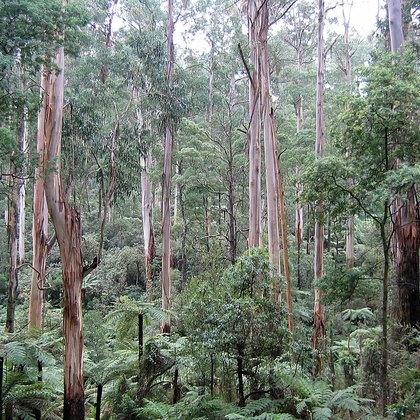
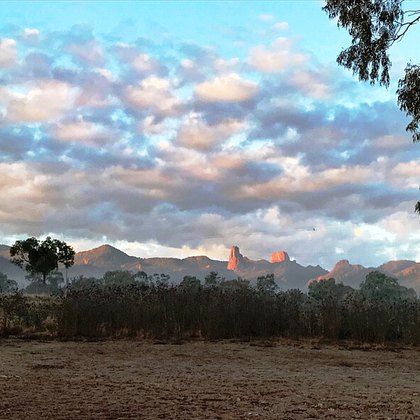
Wet montane forest and dry eucalypt forest are the breeding ground; in winter gardens, parks, street trees and the built-up area are added in full. It forages everywhere: in the canopy, on lawns, along roads, at bins and picnic grounds. Rainforest edges and planted suburbs with fruiting shrubs are its best feeding country in the cold season.
Where the bird is most often found, arranged by main group and formation.


Range and movements
Eastern Australia, from Cape York in the north to Victoria, with its own subspecies on Lord Howe Island; it is absent from Tasmania, where Black Currawong takes its place. Six subspecies. In the southeast it is an altitudinal migrant: mountain birds come down to the coast and the cities in June and July and move back up in September to breed.
- Resident
- dark = core range, pale = thinly spread
Where and when to look
Listen at first light in a suburb in winter: the chorus of a flock settles the species before a bird is seen. On birds passing overhead, check the white window in the wing and the white tail base. Search a tree fork or a barbed-wire fence for a larder — a lizard, a nestling or a scrap of meat hung up for later.
Conservation
Least Concern (LC), and increasing: planted suburbs and exotic fruiting shrubs have improved winter survival. That has a cost. The species raids the nests of small songbirds, and on Cabbage Tree Island removing currawongs proved necessary before a threatened petrel could recover; it also spreads the seeds of privet, camphor laurel and asparagus fern. The western subspecies ashbyi has all but gone.
Scientific name
Strepera graculina | (Shaw, 1790)
Shaw described the species in 1790 as Corvus graculinus, among the crows; the later move puts author and year in parentheses. The genus Strepera was introduced by Lesson in 1831, from Latin streperus, 'noisy'. graculina means 'jackdaw-like', from graculus, 'jackdaw'. The type locality is near Sydney, New South Wales.