All species › Passerines › Woodswallows, bellmagpies and allies › Black Currawong
Black Currawong | Strepera fuliginosa
Zwarte klauwierkraai | Verdugo fuliginoso
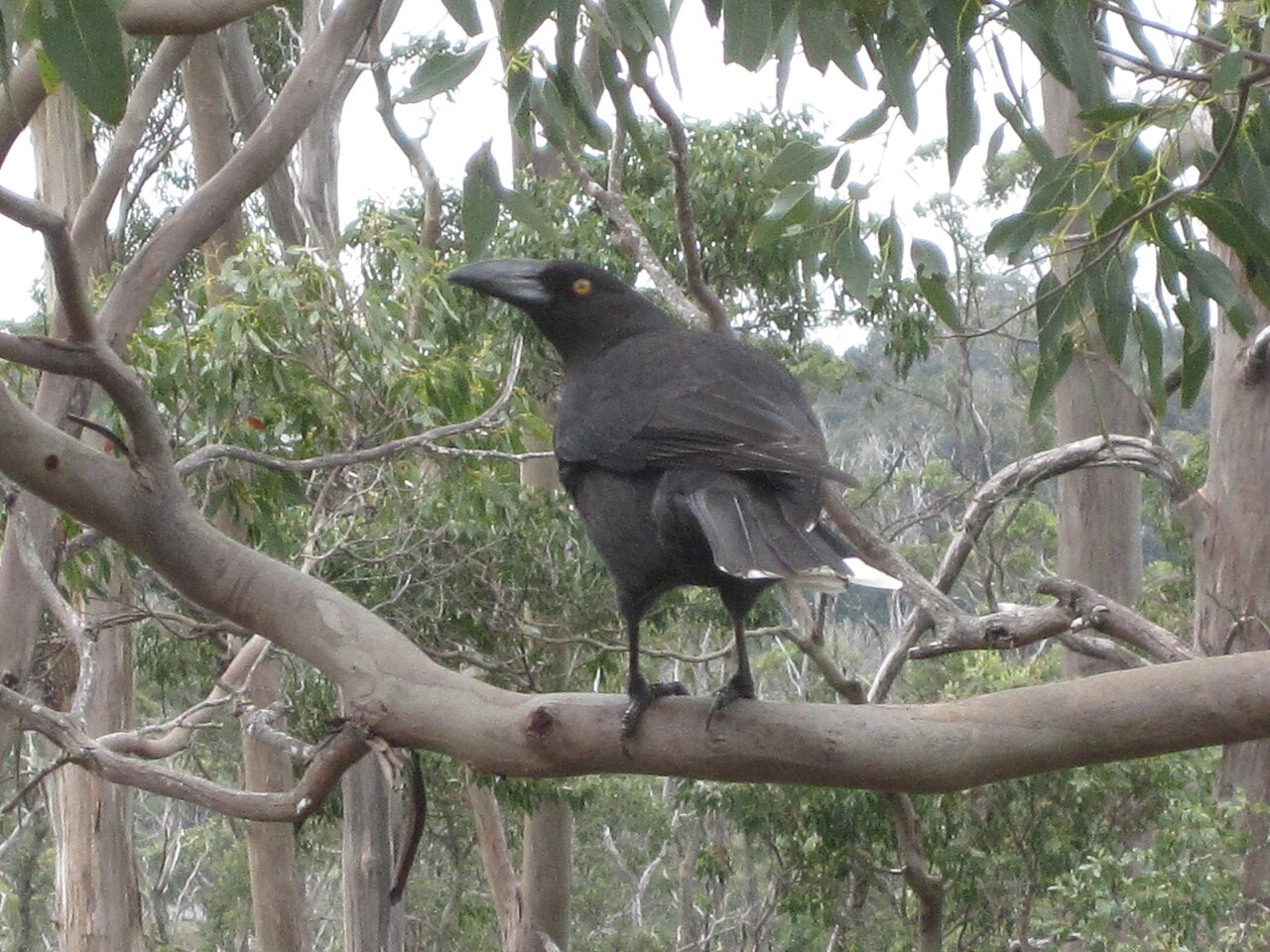
The Black Currawong is the big black bird of the Tasmanian highlands: at any car park, hut or picnic table in the mountain forest a flock turns up within ten minutes, yellow-eyed, heavy-billed and with a voice that sounds like an argument in progress. It occurs nowhere in the world but Tasmania and the islands of Bass Strait.
Voice
A loud raucous series often written as kar-week week kar-week: irregular, hoarse and alarmed in tone, quite unlike the clear metallic clink of the Grey Currawong on the same island. Flocks call over one another, above all in the morning and when there is danger or food. There are also low croaks, and begging young with a high sustained screech.
No freely licensed recording has been found for this species yet; what to listen for is described below.
Identification
A heavy, crow-like songbird of 46 to 49 centimetres, sooty black over the whole body except a small white field at the wing tips and a narrow white tail tip; there is no white rump. The eye is bright yellow, the bill heavy, black and hooked at the tip, the legs sturdy. The tail is relatively short, which gives the bird a stocky look. Young birds are duller, with a browner cast and a darker eye.
Confusion species
Grey Currawong (Strepera versicolor), represented in Tasmania by the subspecies arguta, is duller grey, longer-tailed, has a far larger white wing patch and calls a metallic clink — the two live side by side on the island, so 'all black' alone is no proof. Forest Raven (Corvus tasmanicus) is as large but has a white eye, no white at all in wing or tail, and a deep husky korr-korr. Pied Currawong (S. graculina) is absent from Tasmania.
Habitat
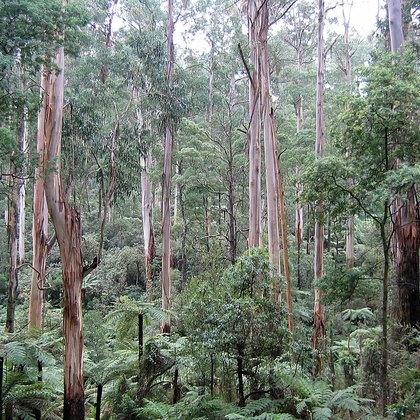
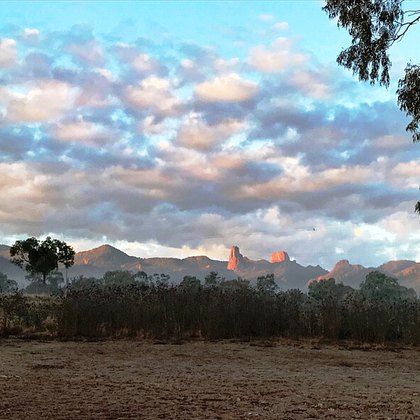
Wet eucalypt forest, southern beech forest and mountain rainforest, dry eucalypt forest, and above the treeline subalpine shrubland and herbfield. In winter many birds drop to lower forest, farmland, coastal woodland and the edges of towns. Mountain huts, ski villages and picnic grounds are favoured feeding places, where the species is strikingly bold.
Where the bird is most often found, arranged by main group and formation.


Range and movements
Endemic to Tasmania and the islands of Bass Strait, with separate subspecies on King Island and in the Furneaux group. It does not occur on mainland Australia. Sedentary, but with clear altitudinal movement: breeding in mountain forest, wintering lower and nearer the coast.
- Resident
- dark = core range, pale = thinly spread
Where and when to look
An all-black, yellow-eyed bird in Tasmanian mountain forest is almost certainly this species — still, check the wing tip for the small white field. In doubt let the voice decide: raucous and irregular here, clear and metallic in Grey Currawong. Look in national park car parks: nowhere else is the species so easily seen close up.
Conservation
Least Concern (LC) and common in Tasmania itself. The island populations are more delicate: the King Island birds are regarded as rare and vulnerable, since most of the original forest there has been cleared. On the main island the forests are still extensive; the habit of feeding around people does bring conflict and road casualties.
Scientific name
Strepera fuliginosa | (Gould, 1837)
Gould described the species in 1837 as Coronica fuliginosa, with Van Diemen's Land, today's Tasmania, as type locality; the move to Strepera puts author and year in parentheses. Strepera goes back to Latin streperus, 'noisy', and fuliginosa to fuligo, 'soot' — sooty black, exactly what the English name says.