All species › Passerines › Woodswallows, bellmagpies and allies › Black Butcherbird
Black Butcherbird | Melloria quoyi
Zwarte orgelvogel | Verdugo negro
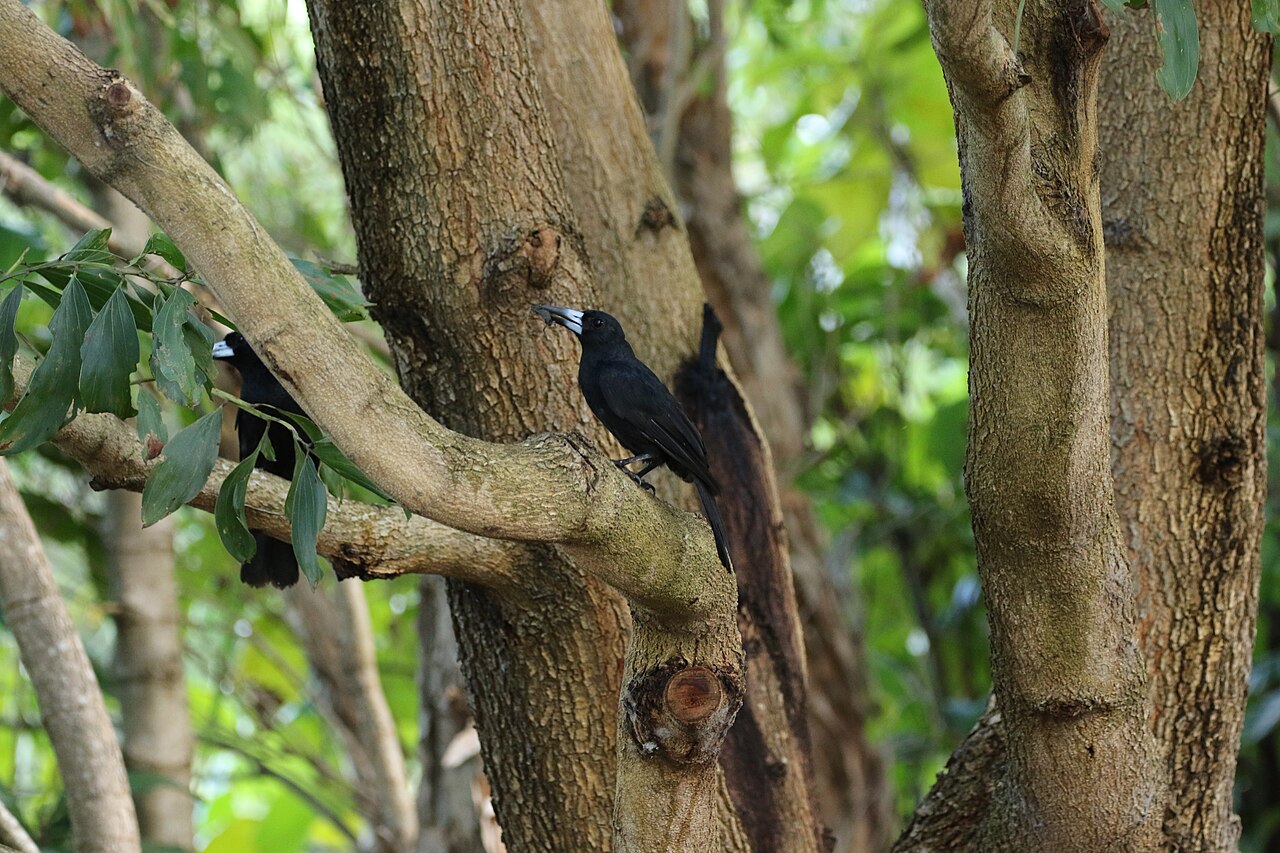
The Black Butcherbird is the largest and the darkest of its family: an entirely glossy black bird with a heavy, blue-grey, hook-tipped bill, living in the mangrove and rainforest of tropical Australia and New Guinea. It is a formidable predator that takes crabs, lizards and nestlings as well as insects, and at the same time one of the finest singers of the north: pairs sing in duet with deep, full whistled notes.
Voice
A rich, loud and remarkably full voice that does not match the sombre appearance. The song consists of deep, bell-like whistles and yodelling phrases with a ringing, almost organ-like tone, often delivered as a duet: the partners fit their phrases together so tightly that the whole sounds like one bird. Alongside it comes a harsh, grating and persistent scolding when disturbed and around the nest, and a short, sharp contact note. In the quiet of the mangrove at high tide the song carries remarkably far.
No freely licensed recording has been found for this species yet; what to listen for is described below.
Identification
A heavily built, crow-like songbird with a strikingly massive head. In adults the plumage is glossy black over the whole body, with no white or grey anywhere. The bill is the character everything rests on: heavy, straight, blue-grey to lead-blue with a black, clearly down-hooked tip, far more massive than that of any crow. The eye is dark brown to black, the legs black. The sexes are alike. Young birds are brownish with rusty fringes and a paler bill. In the north of Cape York there is in addition a rufous form in which even adults remain rufous-brown with black barring — anyone seeing a barred brown butcherbird there is not necessarily looking at a juvenile. The bearing is upright and unhurried, the flight heavy and level, with short glides.
Confusion species
The decisive character is the combination of uniformly black plumage, a dark eye and a heavy blue-grey hooked bill. The currawongs (Strepera) are also dark and crow-like, but have a bright yellow eye-ring and white panels in wing and tail, and their bill is slimmer and without a clear hook. The native crows and ravens (Corvus) have a white or pale eye in adults, a straight, unhooked bill and pointed throat hackles. Pied Butcherbird (Cracticus nigrogularis) is pied black and white and cannot be confused. The only real problem is young and rufous birds: at a distance these can suggest a large thrush or a young butcherbird of another species, and then the bill shape remains the anchor. In New Guinea other black, heavy-billed songbirds overlap the range, but within Australia the species is the only entirely black bird with this bill in its habitat.
Habitat
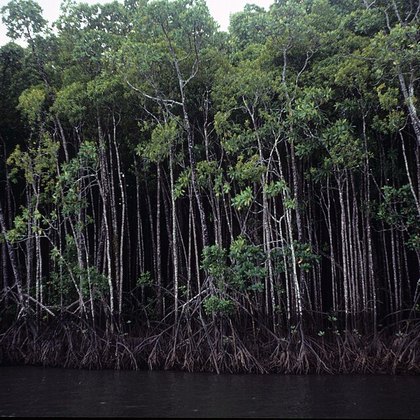
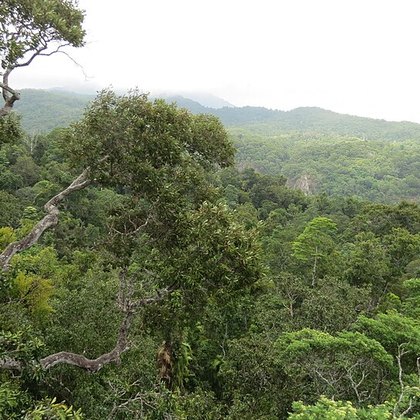
Mangrove is the core habitat and not a fallback: the bird forages there on the root systems and in the mud at low tide, taking crabs and prawns. It also inhabits tropical rainforest, monsoon forest and vine thicket, and gallery woodland along creeks, and it penetrates into gardens and village edges wherever forest runs up to the buildings. The diet is broad: large insects, crabs, frogs, lizards, small mammals and above all nestlings and eggs, for the species is a formidable nest robber. The nest is a stout cup of twigs in the fork of a tree or a mangrove.
Where the bird is most often found, arranged by main group and formation.


Range and movements
New Guinea and adjacent islands, and in Australia the tropical north: the Kimberley and the Top End, the Gulf Country, Cape York Peninsula and south along the Queensland coast. The species is resident and strongly tied to its site; there is no seasonal migration and no large wandering. The range is therefore almost entirely bound to the coastal zone and the moist forest types of the north.
- Resident
- dark = core range, pale = thinly spread
Where and when to look
Stand beside a mangrove creek at low tide and listen: the deep, ringing duet carries a long way and gives the bird away before it can be seen. If you do see it, look only at the bill — heavy, blue-grey, with a black hook — and at the eye, which is dark. Those two characters together rule out crows and currawongs in one step, even against the light when the colour of the plumage says nothing any more.
Conservation
The species is listed as Least Concern (LC). The range is large, covering New Guinea and tropical northern Australia, and the chief habitats — mangrove and rainforest — are still intact over great areas in the north. The species is no pronounced follower of human settlement but accepts village edges and gardens where forest adjoins. The main longer-term risks are the loss of mangrove to coastal development and the fragmentation of lowland rainforest; at the continental scale there is no demonstrated decline.
Scientific name
Melloria quoyi | (Lesson & Garnot, 1827)
René Primevère Lesson and Prosper Garnot described the bird in 1827 as Barita quoyi, from material from Dorey — present-day Manokwari — on the Vogelkop of New Guinea. The epithet honours Jean René Constant Quoy, the French naval surgeon and naturalist who with Gaimard assembled the collections of several French voyages of discovery. The taxonomic history is notable: the species was long placed simply with the butcherbirds in Cracticus, but Gregory Mathews proposed the separate genus Melloria in 1912 — generally taken to honour the Australian ornithologist John White Mellor — and molecular work later showed that quoyi does indeed fall outside Cracticus and forms a sister group to it. Melloria has been in use again since, although not every list carries the name: the eBird branch of AVONET still knows the bird as Cracticus quoyi. The Dutch zwarte orgelvogel, the English Black Butcherbird and the Spanish verdugo negro all name the colour; orgelvogel and butcherbird place the accent differently, the first on the ringing song, the second on the habit of impaling prey on a branch.