All species › Passerines › Woodswallows, bellmagpies and allies › Australian Magpie
Australian Magpie | Gymnorhina tibicen
Zwartrugfluitvogel | Verdugo flautista
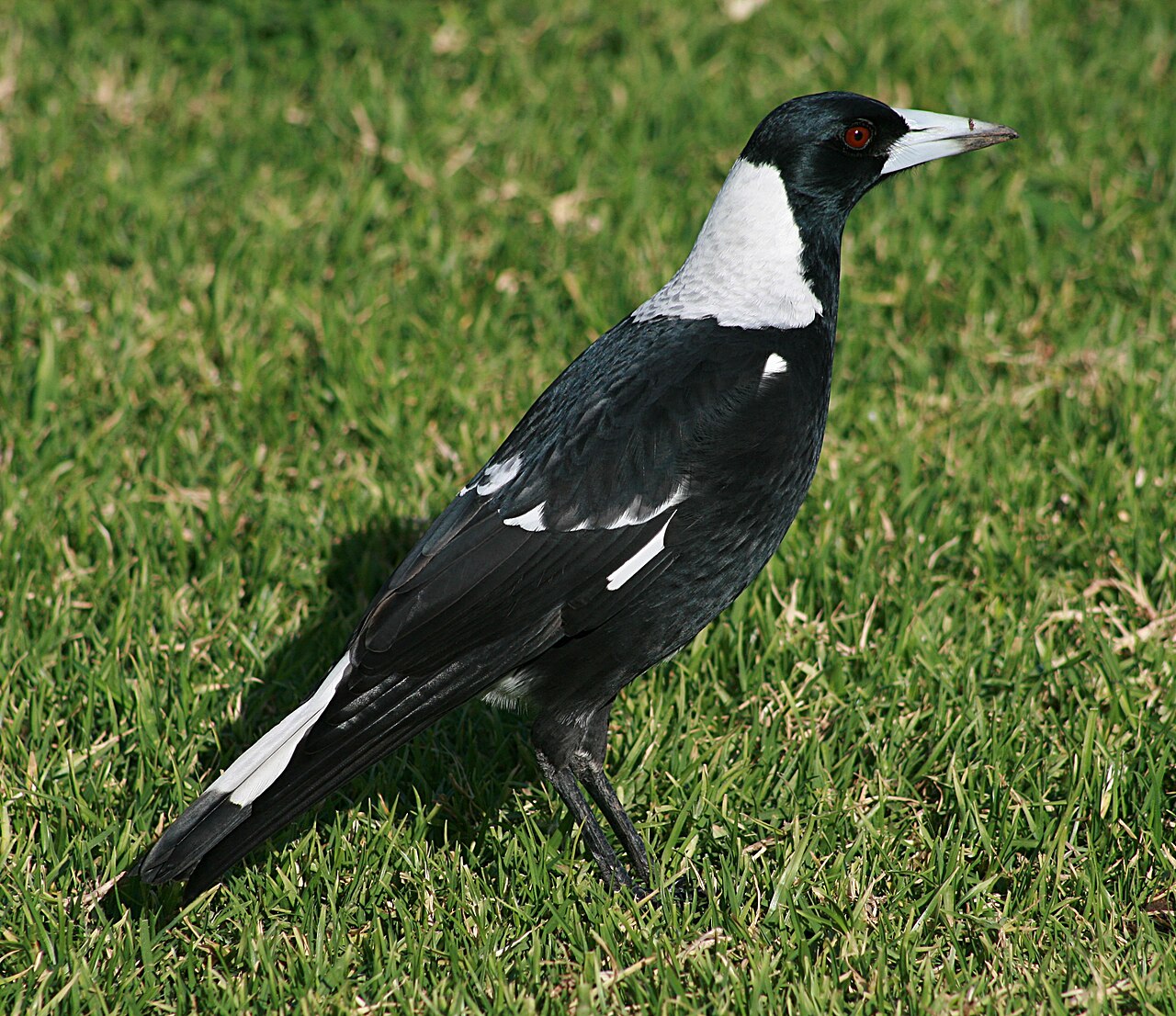
The Australian Magpie is black and white, walks upright across lawns and playing fields, and sings one of the most complex songs in the bird world. It is neither a crow nor a magpie in the European sense: it belongs to the Artamidae, an Australian family with nothing to do with the crows.
Voice
The best-known sound is carolling: a series of clear, flute-like bell notes performed by a pair or a whole group, one bird starting and the others joining in, in the early morning and at late dusk. Alongside it goes a long, soft, muttered subsong with mimicry of other birds worked into it, kept up for hours and audible only from close by. At an intruder comes a hard, chopping chak.
Recording: craig wilson — CC BY 4.0 · Birchfield, Buller District, West Coast Region, New Zealand · xeno-canto
Identification
Thirty-seven to forty-three centimetres, with a heavy blue-white bill tipped black, a red-brown iris and long legs on which it walks upright. The male has a pure white nape, rump and shoulders; in the female nape and mantle are marbled grey. The rest is black, except that in the south-east, the centre, the far south-west and Tasmania the back and rump are white as well: the white-backed forms against the black-backed. Juveniles are dull grey-brown and mottled.
Confusion species
Pied Currawong (Strepera graculina) is larger and wholly black with white patches in wing and tail, has a yellow iris and an all-black hooked bill. Pied Butcherbird (Cracticus nigrogularis) is smaller, has an entirely black head with a white collar, and sits in trees rather than on the grass. The smallest candidate is Magpie-lark (Grallina cyanoleuca): barely half the size, with a pointed white bill, a pale iris and a thin pee-wee.
Habitat
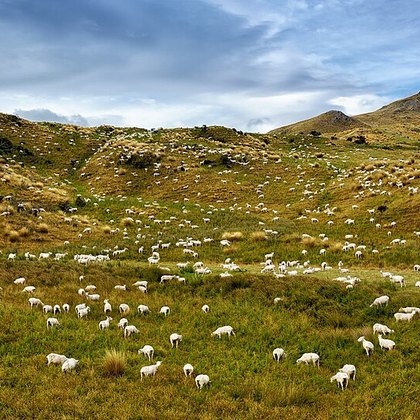
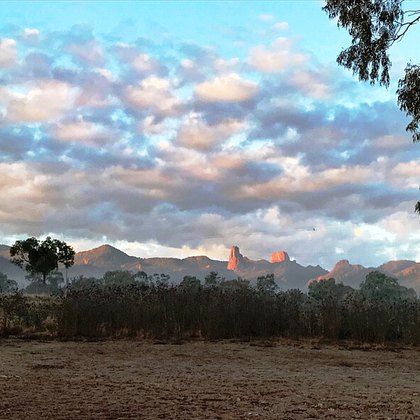
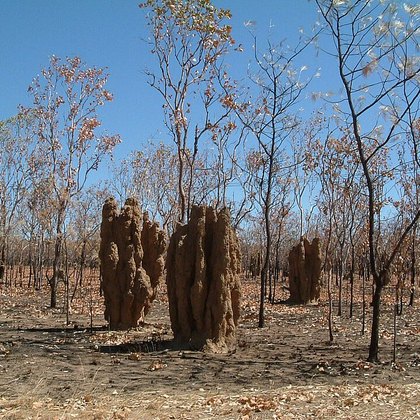
Anywhere trees and short grass lie side by side: pasture, playing fields, parks, verges, gardens and the edges of towns and cities, and in the north the open eucalypt savanna. It needs trees to nest and roost in and open, short-grazed ground to forage on; one without the other does not work. It avoids dense forest and the bare sand deserts of the interior.
Where the bird is most often found, arranged by main group and formation.



Range and movements
Almost all of Australia apart from the densest forest and the driest desert, and the whole of Tasmania. Resident in the strictest sense: a group of two to about ten birds holds the same territory for years. Between 1864 and 1874 more than a thousand birds were taken to New Zealand, where it is established across both main islands. Because it is native to Australia this guide does not mark it as introduced; the New Zealand birds were released there and are treated locally as a pest.
- Resident
- dark = core range, pale = thinly spread
Where and when to look
Go to a grass field with old eucalypts between first light and sunrise and listen: the carolling of a group carries hundreds of metres. On every bird check the nape — pure white in the male, marbled grey in the female — and the back, which gives away the form of your district. In spring, from August to November, a small proportion of males swoop at passers-by; the bird attacks from behind.
Conservation
Numerous, widespread and stable to increasing; it is among the birds that have profited from pasture, parks and lawns. Traffic, snail-bait poisoning and the loss of old nest trees are local causes of loss. In New Zealand it was long controlled for displacing native birds; research has mostly not borne that out.
Scientific name
Gymnorhina tibicen | (Latham, 1801)
Latham described the species in 1801 as Coracias tibicen, among the rollers; because it was later moved to another genus, author and year stand in parentheses. Gray introduced the genus Gymnorhina in 1840, from Greek gymnos (naked) and rhis (nostril), after the unfeathered nostrils. tibicen is Latin for 'piper', after the song. The type locality is New South Wales. Part of the literature places the species in Cracticus; this guide follows AviList, which keeps Gymnorhina.