All species › Parrots › Old World parrots › Western Rosella
Western Rosella | Platycercus icterotis
Stanleyrosella | Perico carigualdo
The Western Rosella is the smallest rosella and the only one in south-western Australia. The male has a deep red head and underparts with a sharply defined bright yellow cheek patch — the mark that gave the species its scientific name. It is also the quietest rosella: where the others screech, this one gives a soft pink-pink.

Voice
The contact note is a soft, musical pink-pink or chink-chink, often in a rapid run of three to five notes and remarkably low in volume for a rosella. In flight comes a short, high ching-ching-ching. Feeding parties keep up a low murmur that fades within a few metres, and it is exactly this restraint that makes the species easy to miss.
No freely licensed recording has been found for this species yet; what to listen for is described below.
Identification
At about twenty-seven centimetres and under seventy grams, the smallest and slimmest rosella. The male has head, neck and the whole underside deep red, with a crisply bounded lemon-yellow cheek patch; the mantle is black with red, green and buff feather edges, the tail blue-green. The female is far duller: green where the male is red, with a narrow red band across the forehead, scattered red feathers on the breast and a smaller, paler yellow cheek. Juveniles resemble the female but are greener still and lack the yellow cheek altogether. The inland form is paler, with a cream rather than yellow cheek.
Confusion species
Australian Ringneck (Barnardius zonarius), here in the form semitorquatus, shares the ground everywhere: much larger, plain green with a black head, a yellow collar on the hindneck and no scalloped mantle — confusion arises only with green females and juveniles at range. Red-capped Parrot (Purpureicephalus spurius) is also a south-western bird and shows, in the male, a purple-red crown, a yellow-green cheek and a long narrow bill, along with a far noisier, creaking call. No other rosella occurs in Western Australia: anyone who thinks they see an Eastern Rosella (Platycercus eximius) or Crimson Rosella (Platycercus elegans) is looking at an escaped cage bird.
Habitat
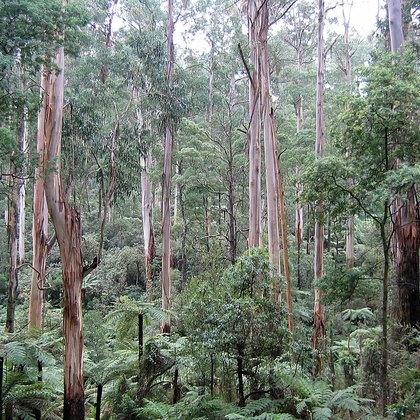
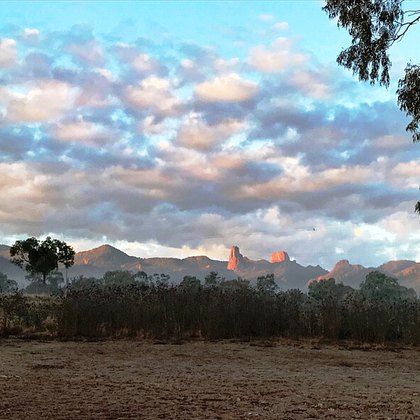
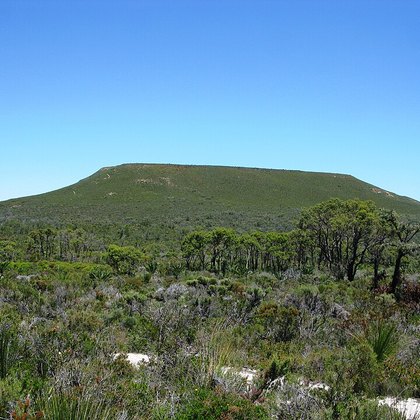
South-western eucalypt forest and woodland, with a liking for wandoo, karri and marri; also kwongan heath, scrub and, especially in the wheatbelt, remnant patches along crop edges and roadsides. It feeds much on the ground among grass and fallen seed and uses orchards, parks and gardens in towns such as Albany and Pemberton. It nests in hollows in old eucalypts, sometimes low down.
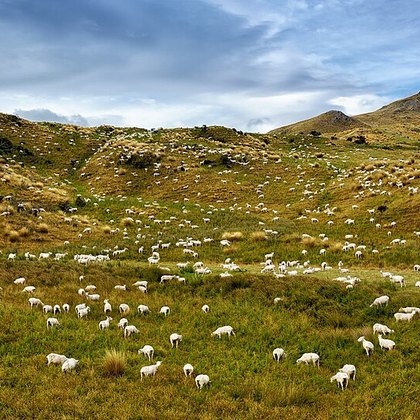
Where the bird is most often found, arranged by main group and formation.


Range and movements
South-western Australia only. The coastal form holds the humid south-west below Dandaragan, the inland form the semi-arid wheatbelt; together they run from the Swan River and the Perth district south and east to the Stirling Range and Esperance. The species occurs nowhere else on the continent, and not at all in New Zealand. It is resident, with at most short movements to a good food supply.
- Resident
- dark = core range, pale = thinly spread
Where and when to look
Look in wheatbelt wandoo woodland for pairs working the ground among the grass; they flush late and then go low and fast to the next tree. Listen not for loudness but for softness: the restrained pink-pink is often all you hear of them. Karri forest near Pemberton and the margins of the Stirling Range are reliable places.
Conservation
Least Concern (LC) globally, but that hides a real problem. Numbers have fallen sharply since colonisation with the wholesale clearing of south-western woodland for agriculture, and the inland wheatbelt form in particular has declined badly; in Western Australia it is treated as likely to become extinct. The loss of old hollow trees and competition for nest hollows with introduced species weigh heavily. The species is listed on CITES Appendix II.
Scientific name
Platycercus icterotis | (Temminck & Kuhl, 1820)
Temminck and Kuhl described the species in 1820 as Psittacus icterotis; because it was later moved to another genus, author and year stand in parentheses. The genus Platycercus was introduced by Vigors in 1825, from Greek platus, 'broad', and kerkos, 'tail'. icterotis is formed from Greek ikteros, 'yellow', and ous, 'ear', so 'yellow-eared', after the yellow cheek patch. The type locality is King George Sound near Albany in Western Australia. Two subspecies are recognised: icterotis on the coast and xanthogenys inland. The Dutch guide name honours Edward Smith-Stanley, thirteenth Earl of Derby, whose bird collection lay behind many early descriptions.