All species › Passerines › Woodswallows, bellmagpies and allies › White-breasted Woodswallow
White-breasted Woodswallow | Artamus leucorynchus
Witborstspitsvogel | Artamo ventriblanco
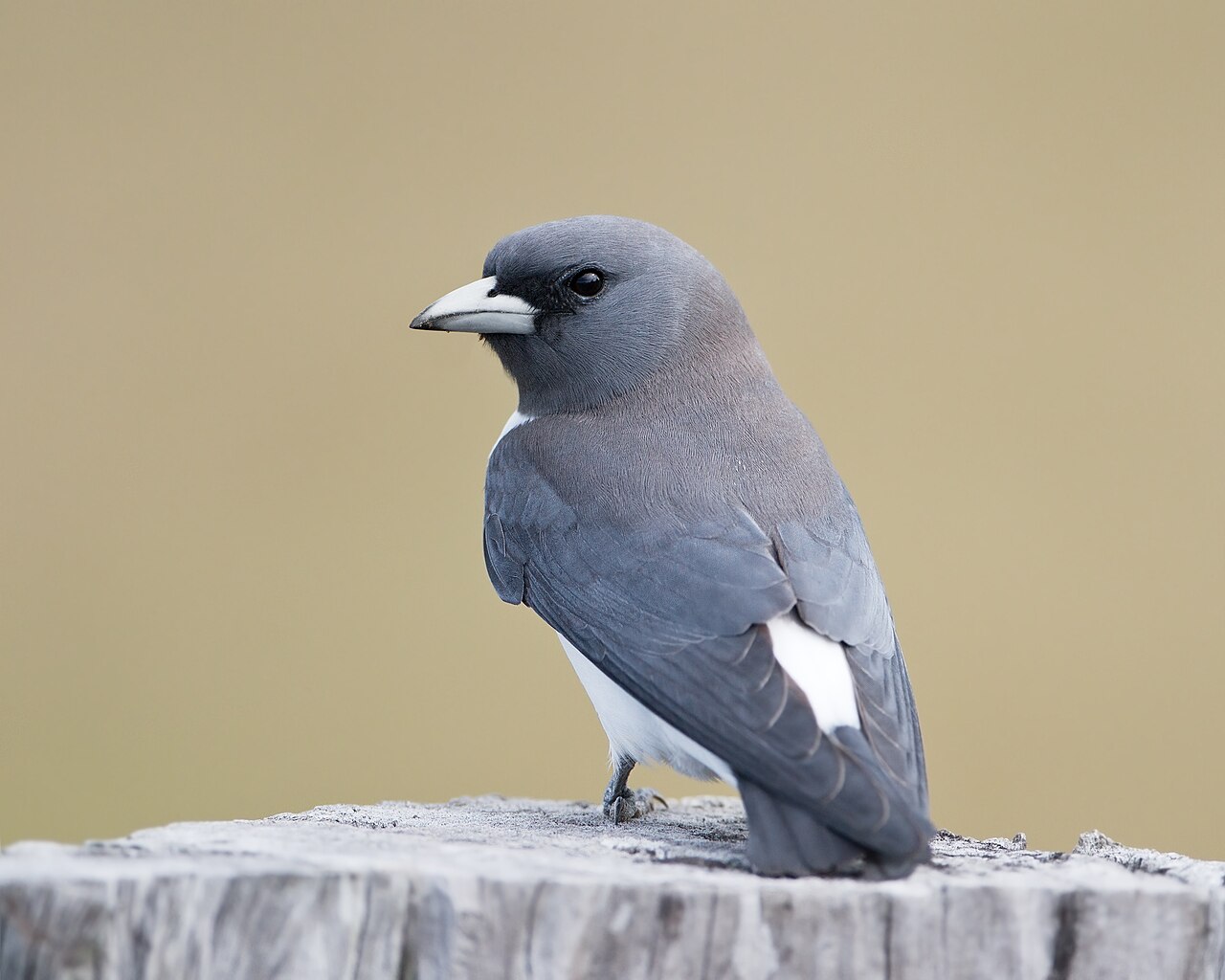
The White-breasted Woodswallow is the most widespread species of the genus — its range runs from the Andamans and the Philippines through Indonesia and New Guinea to Australia and the islands of the south-west Pacific — and at the same time the easiest to recognise. It is sharply divided in two: a dark grey hood over head, throat and upper breast, and pure white below it. In Australia it belongs to water: river banks, mangroves and the wires along the road beside them.
Voice
A soft, nasal and slightly hoarse vut or peurt, which parties keep up continually and which, being so short, is easily overlooked. The song is a soft, sustained chatter of scratchy and squeaky notes, often with imitations of other species woven in, usually from a wire or dead branch. At the nest, and against raptors and crows, comes a sharp, excited rattling, the whole group attacking at once.
No freely licensed recording has been found for this species yet; what to listen for is described below.
Identification
A thickset, broad-winged woodswallow whose plumage falls into two cleanly cut halves. Head, throat, upper breast, mantle and wings are dark slate to sooty grey; breast, belly, flanks, undertail coverts and rump are pure white. The border between the two runs straight across the breast and is sharp, with no zone of transition — that is the character everything turns on. The white rump stands out strongly in flight against the dark back and tail. The tail is uniformly dark and lacks the white tip most other woodswallows carry. The bill is pale blue-grey with a black tip and looks almost white in sunlight; the eye is dark, the legs short and grey. The sexes are alike; young birds are browner and faintly streaked on head and breast. Parties like to sit in a row on wires or on a dead branch, and outside the breeding season they cluster tightly together.
Confusion species
Within the genus this is the only species with pure white underparts beneath an evenly dark hood, which separates it from all the others at a glance. Watch the tail above all: where Dusky Woodswallow (Artamus cyanopterus), Black-faced Woodswallow (Artamus cinereus) and Little Woodswallow (Artamus minor) have a white tail tip, it is absent here — and the white rump is in turn absent in those three. Masked Woodswallow (Artamus personatus) has a sharply bounded black face mask but is pale grey below rather than white, and there the dark hood does not extend onto the breast. Further afield, confusion with the Black Butcherbird or other Artamidae is ruled out by size. In mixed flocks over the interior, where several woodswallows fly together, this is the bird with the white rump — the most usable character from above and from the side.
Habitat
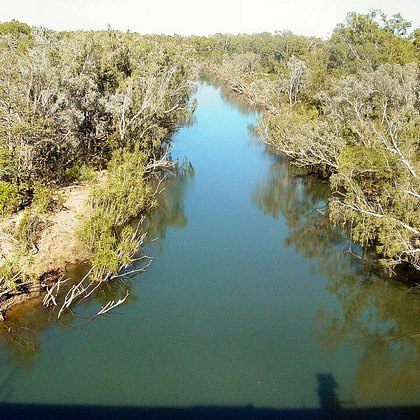
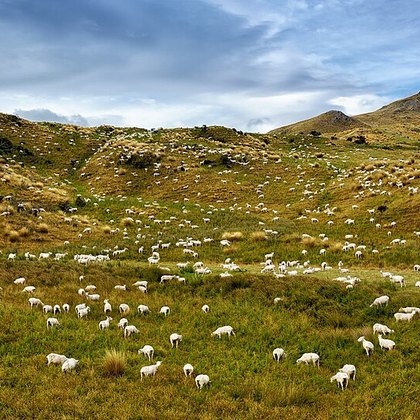
Almost always near water: gallery woodland and creek banks, mangrove, open forest and woodland along the coast, and besides these a great deal of man-made country — pasture with scattered trees, roadsides, telephone and power lines, parks and village edges. The bird hunts flying insects on soaring, gliding wings, often over water, and returns each time to the same lookout. The nest is a flimsy cup of twigs in a tree hollow, behind the leaf base of a palm, in a forked branch, on a fence post or in a human structure; the same spot is used for years on end.
Where the bird is most often found, arranged by main group and formation.


Range and movements
The largest range of any woodswallow: from the Andamans, the Philippines and Borneo through the Lesser Sundas and New Guinea to Palau, New Caledonia and Fiji, and in Australia over almost the whole mainland except the coolest southern parts and Tasmania. In the north the species is resident; in the south of the Australian range birds move away northward in autumn and return in spring, so that there it is distinctly a summer bird. Vagrants do not reach New Zealand.
- Resident
- Breeding (summer)
- dark = core range, pale = thinly spread
Where and when to look
Drive along a river or a mangrove edge and watch the wires: a row of thickset grey-and-white birds that flutter up, take a circuit on gliding wings and come back to the same spot is this species. Fix the view from above — dark back with a conspicuous white rump and an evenly dark tail — because that still works when the bird is too far off to see the sharp breast border.
Conservation
The species is listed as Least Concern (LC), with a range spread over much of South-East Asia, Melanesia and Australia and a population under pressure nowhere. It is one of the few Australian woodland birds to have profited rather than suffered from the human landscape: wires, poles, fences and open pasture with scattered trees supply exactly the lookouts and open airspace it needs, and villages and parks are simply occupied. Loss of mangrove and riverine woodland is locally unfavourable.
Scientific name
Artamus leucorynchus | (Linnaeus, 1771)
Carl Linnaeus described the bird in 1771 as Lanius leucorynchus, from material from Manila on Luzon in the Philippines — a reminder that this species is by no means an Australian speciality. The epithet leucorynchus joins Greek leukos ('white') to rhunkhos ('bill') to give 'white-billed', and so refers not to the white breast but to the pale bill, which in sunlight looks almost white; the Dutch witborstspitsvogel, the English White-breasted Woodswallow and the Spanish artamo ventriblanco all choose the other, more conspicuous field character. The genus name Artamus comes from Greek artamos, 'butcher', after the kinship with the butcherbirds.