All species › Passerines › Woodswallows, bellmagpies and allies › Dusky Woodswallow
Dusky Woodswallow | Artamus cyanopterus
Blauwvleugelspitsvogel | Artamo sombrío
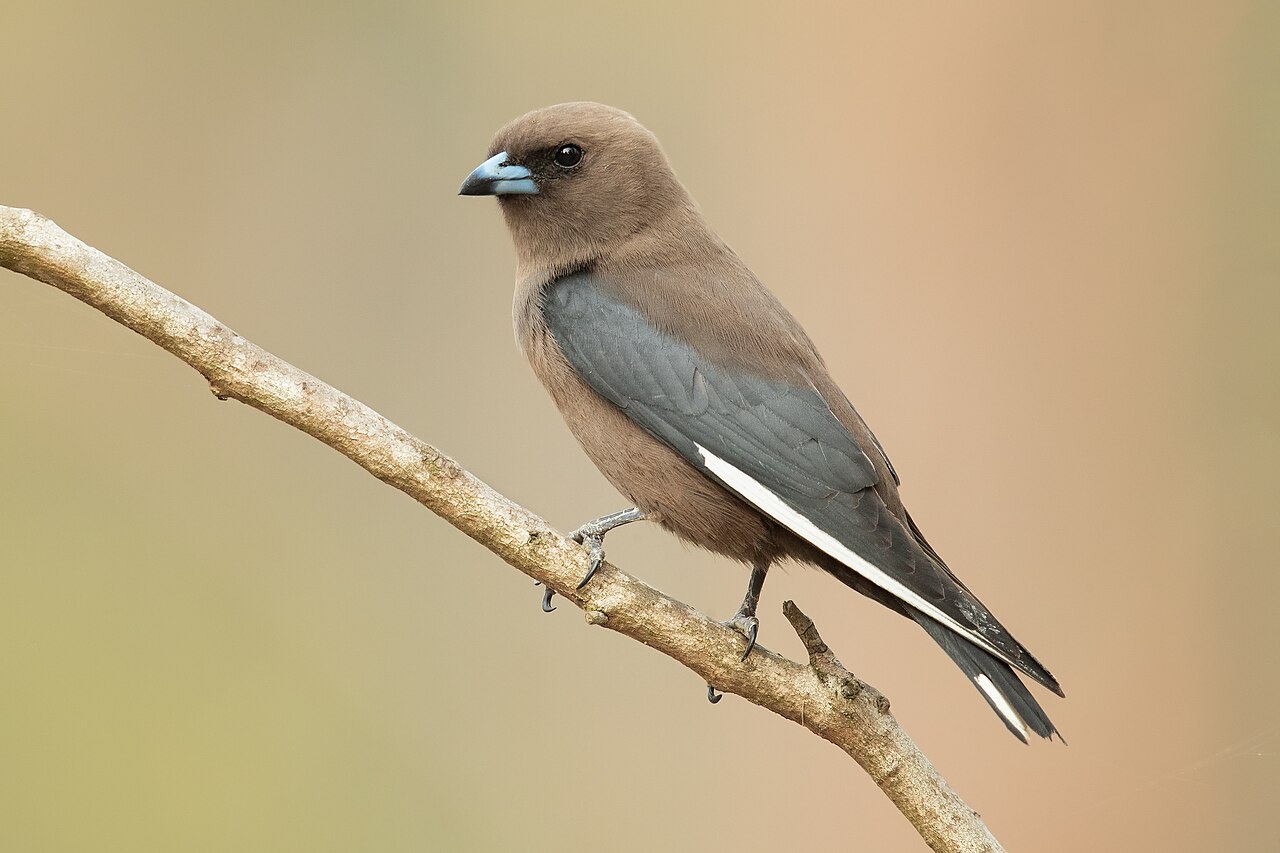
The Dusky Woodswallow is the woodswallow of the temperate south. Where most members of the genus criss-cross the dry interior, this is the only one that is genuinely common in south-eastern and south-western Australia and in Tasmania. It is a smoky brown bird with a narrow, sharply drawn white stripe along the leading edge of the wing, soaring in loose parties over open eucalypt woodland and pressing itself at night into dense clusters against a trunk or branch.
Voice
Soft and unobtrusive, without the insistent call of many other woodland birds. The usual contact note is a short, nasal vit or tchet, which parties keep up continually as they circle. Alongside it comes an untidy, scratchy chattering subsong, into which snatches of other species are regularly woven. At the nest and when disturbed the call sharpens into a rattling alarm. Anyone who hears a flock before seeing it registers mainly that soft, persistent piping out of the sky.
Recording: Greg McLachlan — CC BY-NC-SA 4.0 · Nangar National Park, New South Wales, Australia · xeno-canto
Identification
A thickset songbird with triangular, sharply tapering wings and a short tail, built for soaring and gliding. The plumage is smoky brown to warm grey-brown throughout, darker and duller than in most relatives, with a small black loral patch before the eye but no true mask. The wing settles it: along the leading edge runs a narrow, pure white stripe formed by the white outer webs of the primary coverts, sharply set off against the dark wing coverts. The primaries are blackish, the underwing silver-grey. The tail is black with a narrow white tip. The bill is blue-grey with a black tip, the eye dark, the legs short and grey. The sexes are alike. Characteristic too is the clustering: outside the breeding season groups pack tightly together against a trunk or dead branch, dozens of birds forming a single lump.
Confusion species
Among the six Australian woodswallows the face pattern decides, and this species has no mask at all — only a small black loral patch. Little Woodswallow (Artamus minor) is far smaller and darker, almost chocolate-brown, lacks the white wing stripe entirely and is tied to rocky gorges and cliffs. Black-faced Woodswallow (Artamus cinereus) is greyer and paler, also has a black lore but no white wing edge, and carries a broader white tail tip. Female Masked Woodswallow (Artamus personatus) is a uniform grey-brown bird with at most a faint dark wash on the face and no white wing stripe. White-breasted Woodswallow (Artamus leucorynchus) shows a sharp division between a dark grey hood and pure white underparts. Male White-browed Woodswallow (Artamus superciliosus), with its white brow and chestnut underparts, is unmistakable. The difficulty is that woodswallows travel in mixed flocks: a single flock over the interior may hold three or four species flying together, and then nothing helps but patiently working through bird by bird.
Habitat
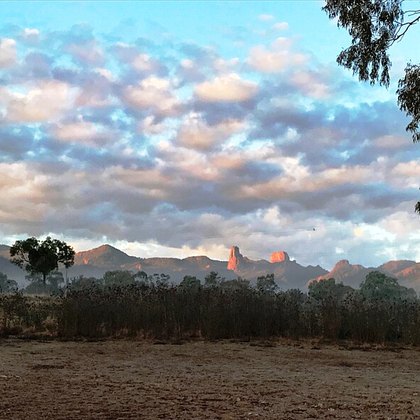
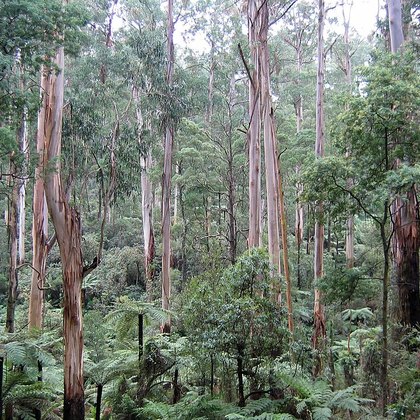
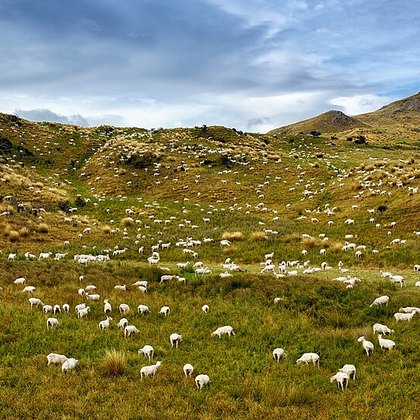
Open eucalypt forest and woodland form the core, from the dry woodland of the interior to moister forest in Tasmania and the south-east. Edges, clearings, logged ground with standing trees left behind, and shelterbelts in pasture are particularly favoured, because the bird needs open airspace above a perch to take insects. It hunts flying prey on soaring, gliding wings and returns each time to the same branch. The nest is an untidy cup of twigs and rootlets in a forked branch, behind loose bark or in a tree stump, often in loose colonies of a few pairs together.
Where the bird is most often found, arranged by main group and formation.

Range and movements
Two separate areas: an eastern range from south-eastern Queensland through New South Wales and Victoria to south-eastern South Australia, Tasmania included, and a smaller western range in the south-west of Western Australia. The bird is partly migratory: southern breeders move away north and north-east in autumn, and the Tasmanian population crosses Bass Strait to winter on the mainland. In the south-east the species is therefore far more numerous in summer than in winter.
- Resident
- Breeding (summer)
- dark = core range, pale = thinly spread
Where and when to look
Watch the wing edge, not the head. In the glide, wings held out and tail spread wide, the white leading edges light up as two narrow lines — no other woodswallow has them. In winter look for clusters: a lump of birds against a trunk, at a distance easily taken for a piece of loose bark, is almost always this species.
Conservation
The species is Red-listed as Least Concern (LC) and the range is large. Even so, a substantial decline has long been reported from south-eastern Australia, bound up with the loss of open woodland, the tidying away of dead wood and standing dead trees, and the disappearance of the loose bark behind which the bird nests.
Scientific name
Artamus cyanopterus | (Latham, 1801)
John Latham described the bird in 1801 as Loxia cyanoptera, from New Holland material, in practice the Sydney district; as it was later moved to another genus, author and year stand in parentheses. The epithet cyanoptera joins Greek kuanos ('dark blue') to pteron ('wing') to give 'blue-winged', which the Dutch name blauwvleugelspitsvogel follows literally, although in the field the wing looks grey rather than blue. The genus name Artamus goes back to Greek artamos, 'butcher' — a nod to the kinship with the butcherbirds, which impale their prey on a branch. The Dutch spitsvogel refers to the pointed, triangular wing. The English name Dusky Woodswallow and the Spanish artamo sombrío both name the dull, dark plumage rather than the colour of the wing.