All species › Passerines › Woodswallows, bellmagpies and allies › Black-faced Woodswallow
Black-faced Woodswallow | Artamus cinereus
Zwartteugelspitsvogel | Artamo carinegro
The Black-faced Woodswallow is the woodswallow that sits on the fence everywhere in the dry interior. It is the most sedentary of the six, holds the same ground all year, and is therefore often the only species present when the wandering Masked and White-browed Woodswallows are elsewhere. The plumage is an unremarkable smoky grey; the only clear head marking is a narrow black loral stripe from bill to behind the eye — not a closed mask.

Voice
A soft, nasal and slightly hoarse chef or peut, usually in short series, which pairs and parties keep up without interruption. The song is a soft, rambling chatter of scratchy and twittering notes, often with imitations of other species in it, and in spring it is sustained for long stretches from a post or dead branch. When disturbed comes a fierce, repeated rattling alarm, at which the whole group rises together and attacks.
No freely licensed recording has been found for this species yet; what to listen for is described below.
Identification
A medium-sized, thickset woodswallow, smoky grey to grey-brown overall, a little darker above than below, without sharp contrasts in the body plumage. The head is a soft, vaguely bounded grey cap running into the grey of the neck and mantle without a dividing line — the exact reverse of Masked Woodswallow. The only clear facial character is a narrow black loral stripe running from the base of the bill back through the eye; that stripe is sharp but small and does not enclose chin and throat. The tail is black with a broad, well-visible white tip. The bill is blue-grey with a black tip, the eye dark, the legs grey and relatively long. The sexes are alike. The undertail matters: in the north and east the undertail coverts are white, while in the centre of the continent a separate form has them black, so that one species may look different in the field.
Confusion species
The head pattern decides, and here it is precisely the weak point. Male Masked Woodswallow (Artamus personatus) wears a closed, jet-black mask taking in forehead, cheek, chin and throat and edged with a white line; this species has only the narrow loral stripe and a vague grey cap. Female Masked, though, is much harder: a dull grey-brown bird with at most a dark wash on the face, and then the broad white tail tip of this species must decide, together with behaviour — perched on a fence on settled ground as against soaring high in a flock. Dusky Woodswallow (Artamus cyanopterus) is browner and carries a white wing edge absent here. Little Woodswallow (Artamus minor) is far smaller and dark sooty brown. White-breasted Woodswallow (Artamus leucorynchus) has pure white underparts, a white rump and no white tail tip. The hardest case remains the mixed flock: four or five species travel together over the interior, and then this is the dull grey bird with a white tail tip and no further marking — a negative character, which takes patience.
Habitat
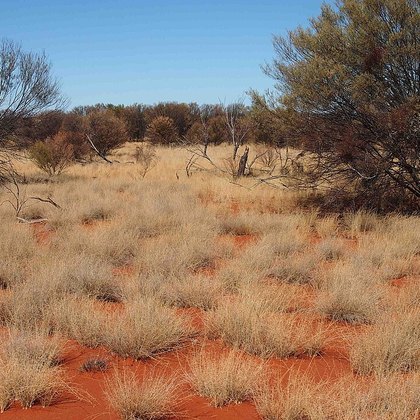
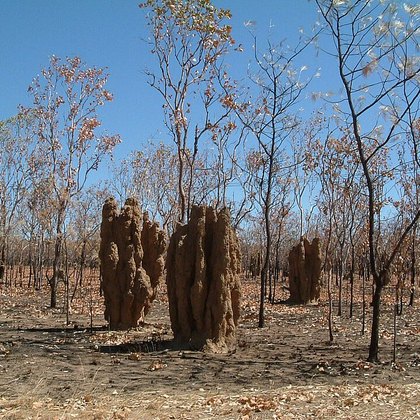
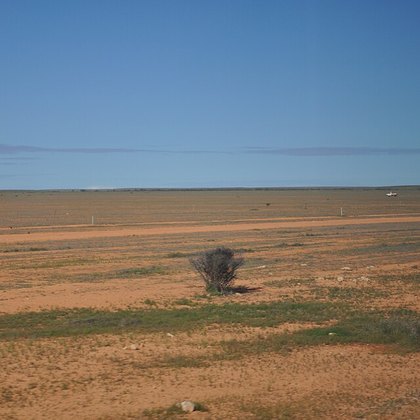
Open dry country in the widest sense: mulga and acacia scrub, savanna with scattered eucalypts, saltbush and bluebush plain and gibber plain, and alongside these every human-opened variant of them, with fences, wires and stock posts as lookouts. The bird hunts flying insects on soaring wings but also drops regularly to the ground to take prey — a habit much less developed in the other woodswallows and legible in the long legs. The nest is a flimsy cup of twigs in a shrub, a fork, a hollow stump or a fence post, often low down.
Where the bird is most often found, arranged by main group and formation.

Range and movements
Almost the whole Australian mainland except Tasmania, the wettest coastal strips of the south-east and the densest forest, with the centre of gravity in the dry interior. Outside Australia the species occurs on Timor and a few surrounding islands of the Lesser Sundas — the area the original type came from. In Australia it is resident and site-faithful, with at most local shifts in extreme drought; it does not make the great weather-driven wanderings of Masked and White-browed Woodswallow.
- Resident
- dark = core range, pale = thinly spread
Where and when to look
Drive an inland road and watch the fence posts and wires: pairs and parties of three to six dull grey woodswallows sitting quietly there and taking short circuits are almost always this species — the wandering species perch much less and soar much more. Check the tail tip: broad white in this species. Only then look at the head, and expect little from it: a narrow black stripe through the eye, and nothing else.
Conservation
The species is listed as Least Concern (LC). It is one of the few inland songbirds to have gained rather than lost from pastoralism: fences, wires, stock posts and troughs supply lookouts and water in a landscape where both are scarce, and the opening up of scrub does it no harm. Local decline is reported where scrub disappears altogether with nothing to replace it, but on the whole the population is large and stable.
Scientific name
Artamus cinereus | Vieillot, 1817
Louis Pierre Vieillot described the bird in 1817 as Artamus cinereus, from Timor material — not from Australia, which in so widespread a species is no accident. The epithet cinereus is Latin for 'ash-grey' and names the dull grey plumage. The Dutch name zwartteugelspitsvogel ('black-lored woodswallow') is more accurate than the English Black-faced Woodswallow and the Spanish artamo carinegro, for the black really is confined to the lore and the area around the eye and does not form a black face as in Masked Woodswallow; anyone going by 'black face' will name the wrong species. The genus name Artamus goes back to Greek artamos, 'butcher', after the kinship with the butcherbirds.