All species › Passerines › Boatbills › Yellow-breasted Boatbill
Yellow-breasted Boatbill | Machaerirhynchus flaviventer
Geelborstbootsnavel | Monarca piquiplano pechiamarillo
The Yellow-breasted Boatbill is a small, vivid yellow and black bird of the rainforest of Cape York and the wet tropics, with a broad, flat bill that looks in profile like an upturned boat. It belongs to the boatbills, a family of two species from Australia and New Guinea named for that bill. Small, high in the forest and seldom silent: that is exactly why it is seldom seen.

Voice
A fine, thin series of five to eight piping notes falling in pitch, roughly tsee-tsee-tsee-tsee, repeated at intervals of a few seconds. Between them comes a soft, rattling trrrt by which the pair keep contact in the canopy. The sound is high and weak and is lost at the least rustle of leaves. Anyone listening at eye level on a rainforest track usually hears it far overhead.
Recording: Étienne Leroy — CC BY-NC-SA 4.0 · Cook's Hut Camping Area, Iron Range National Park, Queensland, Australia · xeno-canto
Identification
Eleven to twelve and a half centimetres, and thereby one of the smallest birds of the Australian rainforest. The male is black on head, back and tail, with a yellow eyebrow, two white wingbars, a white throat patch and a bright yellow breast and belly. The female has the same pattern in olive-green and dull yellow instead of black and vivid yellow. The bill is broad, flat and black, hooked at the tip and set with strong bristles at the base; seen head-on it is almost as wide as the head. The bird hunts flying insects in short sallies and holds its tail stiffly cocked.
Confusion species
The fantails and monarchs of the same forest are larger, longer-tailed and lack the vivid yellow underparts. Of the small yellow forest birds the white-eye is the hardest: it has a broad white eye-ring, a pointed bill and moves in parties, while the boatbill goes in pairs. The olive-green female suggests a young honeyeater or a gerygone, but neither has two white wingbars. In every case the bill decides: head-on it is almost as wide as the head, and no other small bird of this forest has that.
Habitat
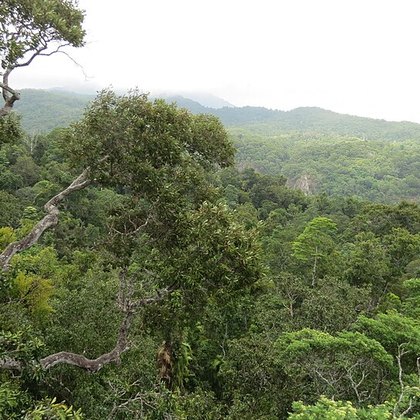
Closed rainforest in the lowlands and on the lower slopes, and the monsoon forest and vine thickets of Cape York. Also forest edges and gallery forest along creeks, provided the canopy closes over. The bird keeps to the middle and upper layers and rarely comes below five metres. It does not use dry, open eucalypt forest, even where that adjoins the rainforest.
Where the bird is most often found, arranged by main group and formation.


Range and movements
Within the guide area only north-eastern Queensland: Cape York south to about the latitude of Townsville, with the highest densities in the wet tropics around Cairns and on the Atherton Tableland. Beyond it, across almost all of New Guinea and some islands off it. Resident, with a pair staying together all year and holding a small territory. The range has not noticeably changed; it depends entirely on the extent of closed forest.
- Resident
- dark = core range, pale = thinly spread
Where and when to look
Walk a rainforest track with a gap in the canopy — a creek bed or an old forestry road — and look for movement ten to fifteen metres up. The pair often joins a mixed party of monarchs and gerygones; anyone who finds such a party should stay with it. The vivid yellow shows only when the bird turns its underside towards you; against the light it is no more than a silhouette with a broad bill.
Conservation
Least Concern (LC), and common in suitable forest; in the wet tropics it is one of the ordinary small birds, with well over ten thousand records in ten years. The species depends entirely on closed rainforest, so clearing and fragmentation are the only real threats. In the protected forest of north-eastern Queensland there is at present little of either.
Scientific name
Machaerirhynchus flaviventer | Gould, 1851
John Gould described the species in 1851 and in the same work introduced the genus Machaerirhynchus; because the bird still stands in that genus, author and year carry no parentheses. The genus name comes from Greek makhaira (short sword, dagger) and rhynchos (bill), after the broad, flat bill. flaviventer is compounded of Latin flavus ('yellow') and venter ('belly'). The type locality is Cape York, the northern tip of Queensland.