All species › Passerines › Whiteheads › Yellowhead
Yellowhead | Mohoua ochrocephala
Mohoua | Mohoua cabecigualda
Into the nineteenth century the Yellowhead was the commonest songbird of the South Island beech forest; anyone walking the valleys heard little else. Today it has gone from more than three-quarters of that country and holds on in a handful of valleys under predator control and on a series of predator-free islands. It is a stocky, bright yellow forest bird that works high in the canopy in noisy family parties and nests in a tree cavity — precisely the habit that has made it so vulnerable in a country with rats and stoats.

Voice
For its size the Yellowhead is strikingly loud. The male gives a sharp machine-gun rattle, a fast series of hard notes on one pitch that starts and stops abruptly, and besides that a canary-like, slightly husky twittering with sliding notes. Within the party the birds keep up a continuous hard tseet-like contact call, far rougher and more emphatic than the fine tinkling of the Pipipi. Because the birds stay high in the canopy that voice is usually the only sign of their presence; in beech forest where the species survives it carries the length of the valley.
No freely licensed recording has been found for this species yet; what to listen for is described below.
Identification
Fifteen centimetres, stockily built, with a short neck and a fairly short tail. Head, throat and breast are bright to ochre yellow and contrast sharply with the olive-brown back and the brown wings and tail; the belly is off-white to pale brown. The yellow is brightest on the male and runs further down his breast; the female is duller and often shows a brownish wash over the crown. The bill is black and stout, the legs blackish. Young birds are dull yellow with a brown head. The bird climbs and twists through the outer twigs of beeches, often upside down, and hacks bark loose with its bill to reach grubs.
Confusion species
Pipipi (Mohoua novaeseelandiae) lives in the same forest and behaves in the same way, but has a grey head with a pale eyebrow instead of a yellow head, is smaller and much lighter, and gives the fine pipipi against the Yellowhead's hard rattle. Whitehead (Mohoua albicilla) has a white head and occurs only on the North Island; there is no overlap. Tomtit (Petroica macrocephala) has a yellow breast in the male but a black head and back, and sits still on a branch instead of working restlessly through the canopy. Stitchbird (Notiomystis cincta) is black with a yellow band across the breast and occurs only on the North Island and its offshore islands.
Habitat
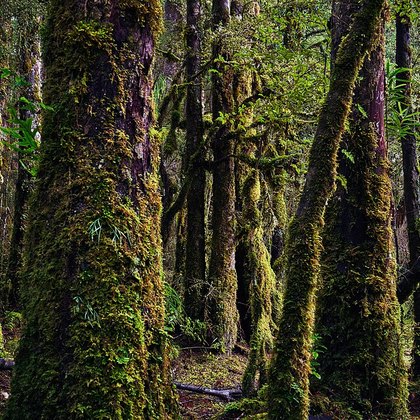
Tall, old southern beech forest in the valleys of the South Island, chiefly red and silver beech, and locally mixed podocarp-broadleaf forest. The species requires mature trees with cavities, for it nests in a hole and nowhere else, usually high in an old or dead trunk, and forages mainly in the canopy and along the large branches. A forest without cavity trees is of no use to it, however intact it may otherwise be. On the islands to which it has been moved it also uses lower, denser broadleaf forest. Pairs are territorial all year and often live in family groups with helpers from the previous season.
Where the bird is most often found, arranged by main group and formation.

Range and movements
Endemic to New Zealand and confined to the South Island and Stewart Island. Historically the species occupied nearly all South Island forest; by the end of the twentieth century less than a quarter of that remained. The surviving mainland populations lie in valleys under sustained predator control, among them the Catlins, the Landsborough, the Dart and the Eglinton, and in parts of Fiordland. Besides these the species is established on predator-free islands such as Chalky Island (Te Kakahu), Anchor Island, Breaksea, Ulva, Secretary and Blumine, where numbers have risen strongly. There is no migration.
- Resident
- Breeding (summer)
- dark = core range, pale = thinly spread
Where and when to look
Go to beech forest where the species still occurs and work entirely by ear: the birds stay high and against the light are often no more than silhouettes. Walk a valley track early in the morning, stop the moment the hard rattle sounds, and then search the outer twigs of the canopy with binoculars until a yellow head catches the light. On Ulva Island, where the birds use lower forest and know no shyness, a good view comes most easily; on the mainland a yellow head in the canopy is often all one gets.
Conservation
Near Threatened (NT), and nationally one of the best-known recovery projects in New Zealand. The decline began with logging and fire in the lowlands, but the decisive blow came from introduced predators. Because the female incubates in a tree cavity and cannot leave it when danger comes, a nest is a trap for a ship rat or a stoat: in a single night the whole brood and the female are lost. That pressure is not even. In years when the beech seeds heavily, rat numbers climb and stoats follow a year later; such a wave can wipe out a population in one season. On top of this, introduced wasps in honeydew beech forest take the sugars and the insects on which the birds and their young depend. The answer has been twofold: large-scale control of rats and stoats in the core valleys, timed to the beech seeding cycle, and moving birds to islands where no predators exist. Both work — island populations have grown strongly and several mainland valleys are holding — but the species remains dependent on management that can never be allowed to stop.
Scientific name
Mohoua ochrocephala | (Gmelin, 1789)
Johann Friedrich Gmelin described the species in 1789 from Latham's material out of Queen Charlotte Sound, as Muscicapa ochrocephala: here too the bird was first placed in a quite different family, in this case the flycatchers. The epithet is formed from Ancient Greek okhros ('pale yellow, ochre') and kephale ('head') and describes exactly what one sees. The genus name Mohoua is Maori, and the Dutch name mohoua takes it over directly; in Maori itself the bird is mohua. English uses Yellowhead, Spanish mohoua cabecigualdo. The species appears on the New Zealand hundred-dollar note, which makes it better known at home than most people will ever see it in the forest.