All species › Tubenoses › Petrels, shearwaters and diving petrels › White-chinned Petrel
White-chinned Petrel | Procellaria aequinoctialis
Witkinstormvogel | Fardela negra grande
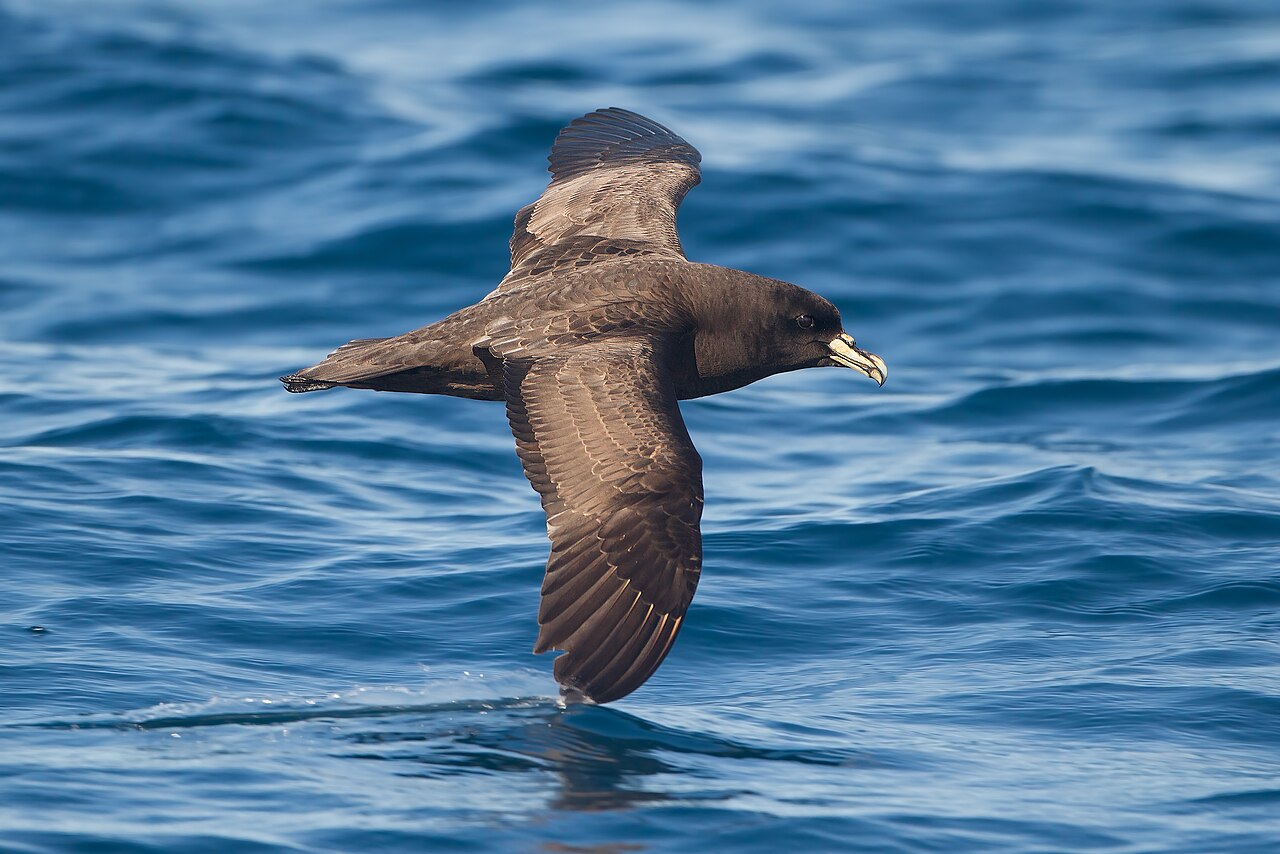
The White-chinned Petrel is the largest of the four dark Procellaria petrels and, after the giant petrels, the largest bird in the whole family: sooty black, with a heavy pale bill and a white chin spot that is sometimes obvious and sometimes missing altogether. It is a noisy, bold follower of fishing vessels, and that is exactly why it is among the birds most often killed as bycatch anywhere in the world.
Voice
At sea it is less silent than most petrels: in a scrum for offal behind a trawler there is a hoarse, rattling quacking and shouting, often from dozens of birds at once. In the colony the voice turns on a fast rattling series — ke-ke-ke-kerrr — given from the burrow or by birds passing overhead at night, alternating with a low moan between partners.
No freely licensed recording has been found for this species yet; what to listen for is described below.
Identification
A large, heavy petrel of 51 to 58 cm with a span approaching a metre and a half and a weight around 1.3 kg. The plumage is sooty black with a brown gloss, underwing included, and the legs are black. Two marks count. The first is the bill: heavy, pale horn-yellow to ivory, black between the plates but with no dark tip — the nail at the end is as pale as the rest. The second is the white chin that gives the bird its name: on some birds a clear white blaze on chin and throat, on others no more than a few white feathers, and on a share of birds absent entirely. Do not rely on it. The flight is powerful, firm beats alternating with low arcing glides that take over in strong wind.
Confusion species
Westland Petrel (Procellaria westlandica) is the hardest: the same dark bird with the same pale bill, but with a clearly dark, almost black bill tip; that tip is the only reliable mark at sea and shows well in good light or on a photograph. Black Petrel (Procellaria parkinsoni) also has a dark bill tip and is besides much smaller (46 cm) and finer in build. The giant petrels (Macronectes halli and Macronectes giganteus) are also wholly sooty in juvenile plumage, but far larger, with an enormous bill carrying prominent nostril tubes and a hunched, short-necked flight. Sooty Shearwater (Ardenna grisea) is smaller and slimmer, with a thin dark bill and a silvery panel in the underwing.
Habitat
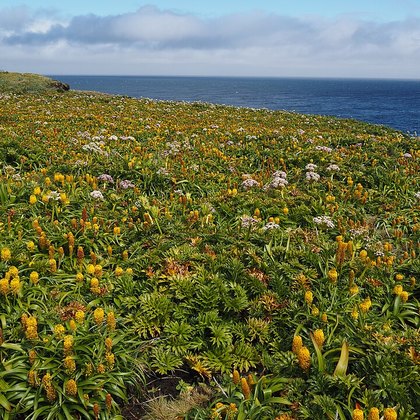
Open ocean from the subtropical convergence deep into subantarctic water, with a strong pull towards the shelf and slope edges where fishing takes place. It seizes squid and fish at the surface but also dives, to a few metres, which is what gets it into trouble with longlines. In the breeding season it digs long burrows in peat among tussock grass and under herbfield on subantarctic islands, usually on flat or gently sloping ground where the soil is deep enough.
Where the bird is most often found, arranged by main group and formation.


Range and movements
Within the map window it breeds on New Zealand's subantarctic islands: the Antipodes, the Auckland Islands — with Disappointment Island the chief site — and Campbell. Outside the window the largest colonies are on South Georgia, with an estimated two million pairs, and on Kerguelen with 175,000 to 226,000 pairs; worldwide there are some seven million adults. At sea it is common in the winter half of the year in the waters around New Zealand and along the southern coast of Australia, from Western Australia through the Great Australian Bight to Tasmania and New South Wales, where it is often the commonest large dark petrel behind a fishing boat.
- Resident
- Breeding (summer)
- Winter
- dark = core range, pale = thinly spread
Where and when to look
Pelagics out of Wollongong, Port Fairy, Eaglehawk Neck or Kaikoura produce it almost reliably in the winter months; it comes close to the boat and hangs around the chum, so there is time. Use it well: photograph the bill square-on from the side and look only at the tip. No dark nail means this species; a dark nail sends you on to Westland Petrel or Black Petrel. The white chin spot is pleasant when present, but it is not an identification mark.
Conservation
Vulnerable (VU), despite a world population running into the millions. The reason is bycatch: it is the seabird killed most often in southern longline and trawl fisheries, because it takes bait underwater and hangs tirelessly behind ships. Colony figures follow: at Bird Island off South Georgia numbers have fallen by 28 per cent, and at Prydz Bay by 86 per cent. To that add feral pigs and cats on Auckland Island, which take eggs and chicks from the burrows. Measures that work — streamer lines, setting longlines at night and weighted lines — are known but are not applied everywhere.
Scientific name
Procellaria aequinoctialis | Linnaeus, 1758
Linnaeus described the species in 1758 in the tenth edition of Systema Naturae as Procellaria aequinoctialis; because the genus has not changed since, author and year carry no parentheses. The genus Procellaria is formed on Latin procella, 'storm'. aequinoctialis means 'of the equinox' and was used by Linnaeus for animals he placed at the equator — a misjudgement here, since the bird belongs to the southern oceans. The type locality is the Cape of Good Hope, though the specimen itself probably came from South Georgia.