All species › Tubenoses › Petrels, shearwaters and diving petrels › Grey Petrel
Grey Petrel | Procellaria cinerea
Bruine stormvogel | Fardela gris
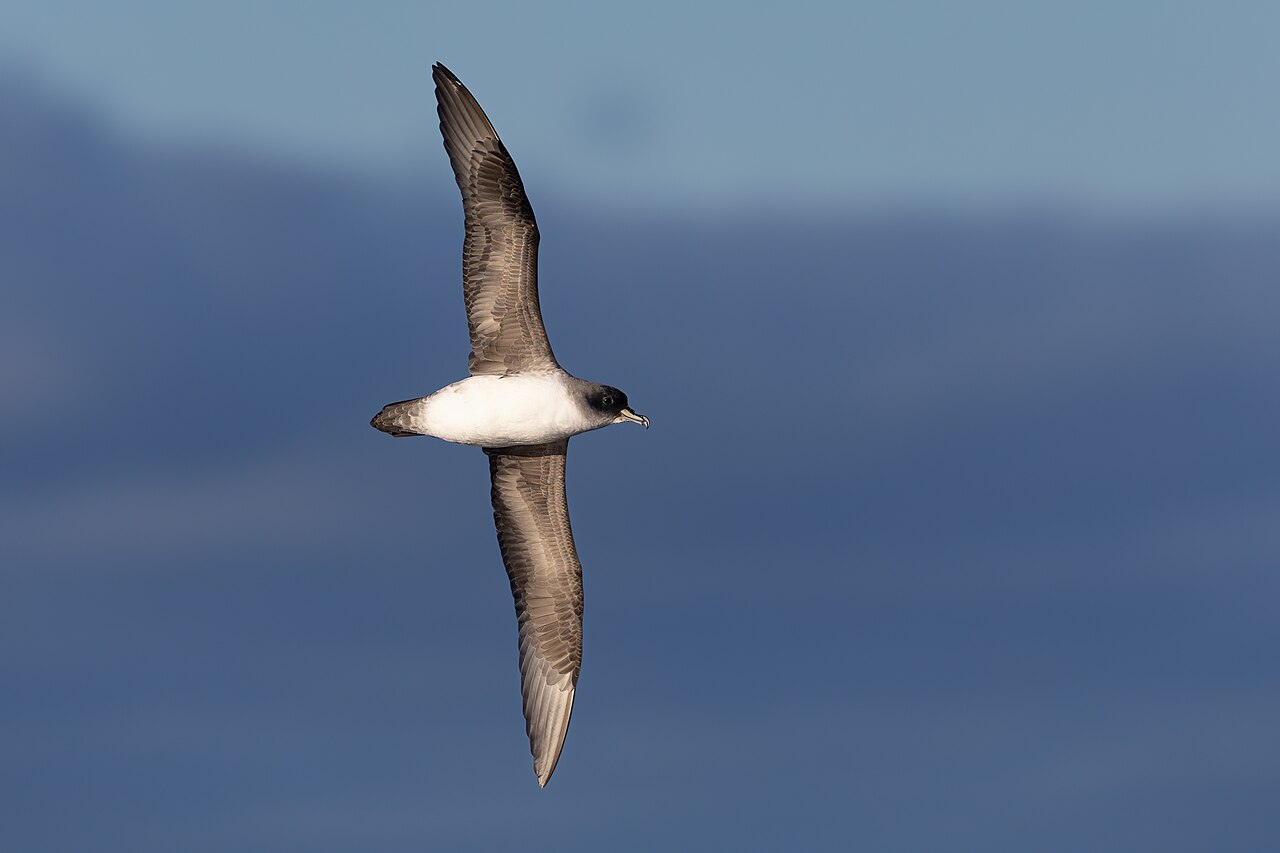
The Grey Petrel is the one of the four big Procellaria petrels that is white below: ash grey on head, back and wings, clean white from breast to belly, and with a dark underwing that sharpens that white still further. It is also the only member of the genus that breeds in the southern autumn and winter, so its chick grows up in the season when most seabirds are long back at sea. Its Dutch guide name means 'brown petrel', which suits the plumage badly, for brown it is nowhere.
Voice
At sea it is all but silent; only in a scrum for scraps behind a trawler does a hoarse rasp escape. The real voice belongs to the colony, where three calls are described: a low sustained moan between partners at the burrow, a loud rattling series of quacking notes — quack-quack-quack-quack — that runs across the slope around dawn and dusk and serves to attract a mate, and a bleat given in alarm or in a quarrel over a burrow.
No freely licensed recording has been found for this species yet; what to listen for is described below.
Identification
A solid petrel of 48 cm and about a kilogram, with long, fairly narrow wings and a stout, blocky head. Upperparts ash grey, with slightly darker grey wings and tail; the grey hood runs below the eye and merges gradually on the neck into the white of breast and belly. The underwing is dark and so stands out against those white underparts — dark underwing plus white belly is a rare combination in these waters and settles the bird at once. The bill is heavy and green-yellow to flesh coloured, with black between the horny plates and on the nostril tubes. Legs grey-pink, darker on the outside, with yellowish webs. The flight is low and purposeful, stiff beats alternating with long glides.
Confusion species
The three other Procellaria in this region — White-chinned Petrel (Procellaria aequinoctialis), Westland Petrel (Procellaria westlandica) and Black Petrel (Procellaria parkinsoni) — are dark from head to tail; one look at the belly rules out all three. Harder is White-headed Petrel (Pterodroma lessonii), also grey above and white below: that bird has a white head with a dark eye mask, a short black bill and a high, swinging arcing flight, while the Grey Petrel has an all-grey hood, a large pale bill and a lower, stiffer flight. Sooty Shearwater (Ardenna grisea) is wholly dark with a silvery panel in the underwing — exactly the reverse pattern.
Habitat
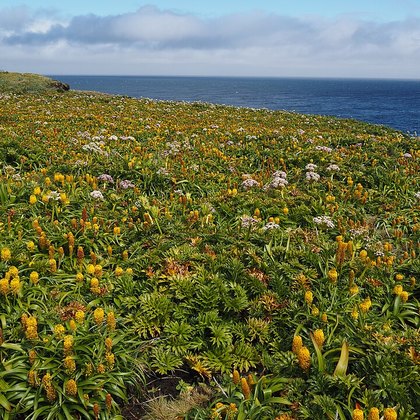
Open ocean between the subtropical convergence and subantarctic water, favouring the fronts where cold and warm water meet. It takes squid and fish at the surface and in shallow dives, and it is a notorious taker of carrion and fishery offal behind ships. To breed it digs burrows in peat under tussock grass and herbfield on the seaward slopes of subantarctic islands.
Where the bird is most often found, arranged by main group and formation.


Range and movements
Within the map window it breeds on Antipodes Island — with some 53,000 pairs by far the world stronghold — on Campbell Island, where fewer than a hundred pairs sit, and on Macquarie Island, where it is regaining ground after the removal of cats, rats and rabbits. At sea it ranges between roughly 32 and 58 degrees south: regular in the sea south of New Zealand, thinner northward, and off Australia mainly in Tasmanian, Victorian and New South Wales waters in the winter half of the year. From December to March a share of the birds crosses to the Humboldt Current off Peru.
- Winter
- dark = core range, pale = thinly spread
Where and when to look
Take a boat from Kaikoura, out of Bluff or Stewart Island, or from Eaglehawk Neck in Tasmania and Port Fairy in Victoria, preferably between May and September. Behind the chum, look for a petrel that banks and flashes its belly: grey above, white below, dark underwing. Photograph the bill, because the black between the horny plates and on the nostril tubes confirms the species afterwards even when the light was poor.
Conservation
Near Threatened (NT) globally; in New Zealand it is ranked At Risk – Naturally Uncommon. The heaviest pressure is at sea: because it dives and takes carrion readily, it strips bait from longlines underwater and drowns on the hook, and it is also lost in trawl nets and to warp strikes. Ashore the picture has cleared: Macquarie Island has been freed of cats, rats and rabbits, the last stage completed in 2014, and Antipodes Island was cleared of house mice in 2016, so both islands are now predator-free. Recovery is slow, for the bird lays one egg a year and does not breed until it is several years old.
Scientific name
Procellaria cinerea | Gmelin, 1789
Gmelin described the species in 1789 as Procellaria cinerea, and it has stayed in that genus, so author and year carry no parentheses. cinerea means 'ash coloured', from Latin cinis, and fits the upperparts exactly. The genus Procellaria was introduced by Linnaeus in 1758 and is formed on procella, 'storm'. The type locality was first given vaguely as a place within the Antarctic Circle and was later fixed on the New Zealand sea at 48 degrees south. The Maori name is kuia.