All species › Tubenoses › Petrels, shearwaters and diving petrels › Black Petrel
Black Petrel | Procellaria parkinsoni
Zwarte stormvogel | Petrel de parkinson
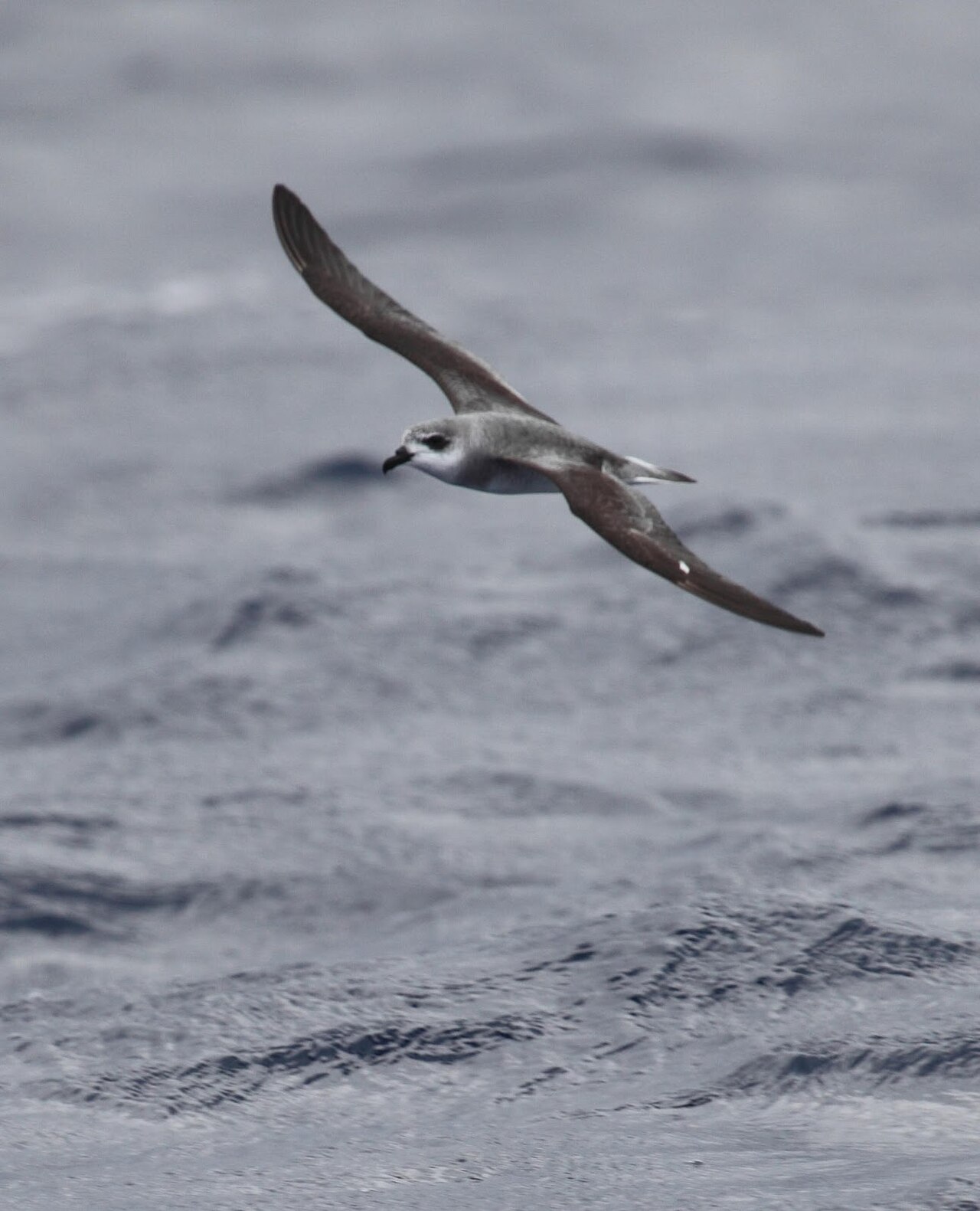
The Black Petrel, takoketai, is the smallest of the four large dark petrels of this region and the only one that belongs to the Hauraki Gulf: all black, with an ivory-yellow bill carrying a grey-black tip, breeding in burrows high on the forested ridges of two islands off Auckland. New Zealand ranks it as the seabird hit hardest by commercial fishing.
Voice
Usually silent at sea, though there is squealing in a scrum for scraps. The colony is noisy at night: birds passing overhead give a shrill, plaintive wik-wik-wik and from the burrows come moaning, quacking and rattling notes, with a drawn-out wail from pairs greeting each other at the entrance. The sound carries best on still nights between November and January, when laying begins.
No freely licensed recording has been found for this species yet; what to listen for is described below.
Identification
A medium-sized, wholly black petrel of 46 cm and about 700 g, with a span of some 115 cm; slighter in head and bill than its larger relatives and so more elegant in flight. The plumage is black to brownish black, underwing included, and legs and feet are black. The bill is yellowish ivory with black between the plates and a clearly grey-black nail at the tip. Some birds carry a few white feathers on the head or chin. The flight is easy, with fairly quick beats and long glides that turn into high arcs in wind.
Confusion species
Westland Petrel (Procellaria westlandica) is the larger twin: also black with a pale bill and dark tip, but 50 to 55 cm, heavier-headed and with a distinctly thicker bill, and its centre of range lies at Cook Strait and the West Coast rather than in northern waters. White-chinned Petrel (Procellaria aequinoctialis) is larger still and has a bill that stays pale right to the tip. Flesh-footed Shearwater (Ardenna carneipes) is the commonest mistake in northern New Zealand, being the same size and also all dark with a pale bill: look at the legs, flesh-pink in that species and black in Black Petrel, and at the bill, which in Ardenna carneipes is slimmer and pink with a dark tip. Flight helps too: the shearwater is narrower-winged and holds the wings straighter.
Habitat
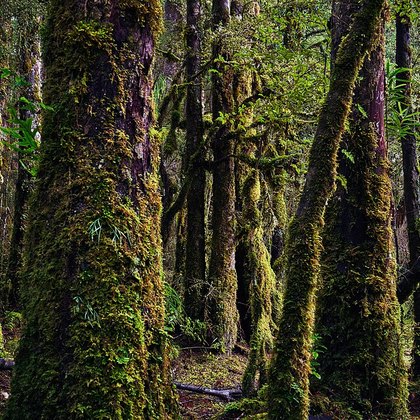
At sea the deep water of the outer Hauraki Gulf, the Bay of Plenty and the Tasman Sea, where it takes bioluminescent squid at the surface by night and in shallow dives, along with fish, salps and crustaceans, and offal behind ships. To breed it digs burrows half a metre to three metres deep, high on the forested ridges of Great Barrier and Little Barrier up to about 600 metres, under podocarps and kauri where the soil is deep enough.
Where the bird is most often found, arranged by main group and formation.

Range and movements
It now breeds in only two places on earth, both in the Hauraki Gulf: Great Barrier Island (Aotea) with about 5,000 pairs and Little Barrier Island (Hauturu) with about 600 pairs. It formerly bred on the mainland of both the North and South Islands; those colonies are gone. In the breeding season, October to July, it forages in the sea north-east of New Zealand and far into the Tasman Sea, where it is met on pelagics off New South Wales. Outside it, virtually the whole population crosses to the eastern tropical Pacific, off Ecuador, the Galapagos and Peru.
- Breeding (summer)
- dark = core range, pale = thinly spread
Where and when to look
A boat trip from Auckland to the outer Hauraki Gulf, or a pelagic out of Tutukaka or Whitianga between November and April, is the most reliable way; the Great Barrier ferry also produces birds. On any dark petrel, look first at the legs when the bird sits on the water or passes low — black means this species, pink means Flesh-footed Shearwater — and only then at the bill tip. From the shore it is scarce; this is a bird you must leave the harbour for.
Conservation
Vulnerable (VU) globally and Nationally Vulnerable in New Zealand, with numbers falling by at least 1.4 per cent a year. Bycatch is by far the largest problem: the species is reckoned the seabird worst affected by New Zealand commercial fishing, above all in the bottom longline fishery for snapper in the Hauraki Gulf and Bay of Plenty, and its foraging grounds overlap almost exactly with the fished area. Ashore, feral cats, pigs, rats and mustelids wiped out the mainland colonies; Little Barrier has since been cleared of rats and cats, while Great Barrier still holds cats and rats that take chicks from burrows. The species is slow: first breeding at five to seven years, one egg, and birds of over twenty-nine years have been recorded.
Scientific name
Procellaria parkinsoni | Gray, 1862
George Robert Gray described the species in 1862 in Ibis as Procellaria parkinsoni; because the genus has not changed since, author and year carry no parentheses. The epithet honours Sydney Parkinson, the young draughtsman who sailed with Cook on the Endeavour and died on the voyage home. The genus Procellaria goes back to Latin procella, 'storm'. The type locality is given simply as New Zealand. The usual Maori name is takoketai; the name taiko is also applied to this bird in New Zealand, as it is to Westland Petrel.