All species › Tubenoses › Petrels, shearwaters and diving petrels › Westland Petrel
Westland Petrel | Procellaria westlandica
Westlandstormvogel | Fardela de Nueva Zelanda
The Westland Petrel, taiko in Maori, is a large all-dark petrel that breeds nowhere in the world but in a strip of coastal hills on the West Coast of the South Island. All the colonies together cover about sixteen hectares — a patch of burrows under forest smaller than two kilometres square, from which the whole species comes. It breeds in midwinter, and it is one of very few New Zealand seabirds that still manage to do so on the mainland in numbers.
Voice
At sea it is silent, apart from hoarse squeals in a scrum behind a trawler. In the colony it is the opposite: quacking, nasal notes, a humming drone and a braying shout, mostly after dark as birds crash in through the trees. The din begins about three weeks before laying, in the courtship and mating period, and largely dies away afterwards.
No freely licensed recording has been found for this species yet; what to listen for is described below.
Identification
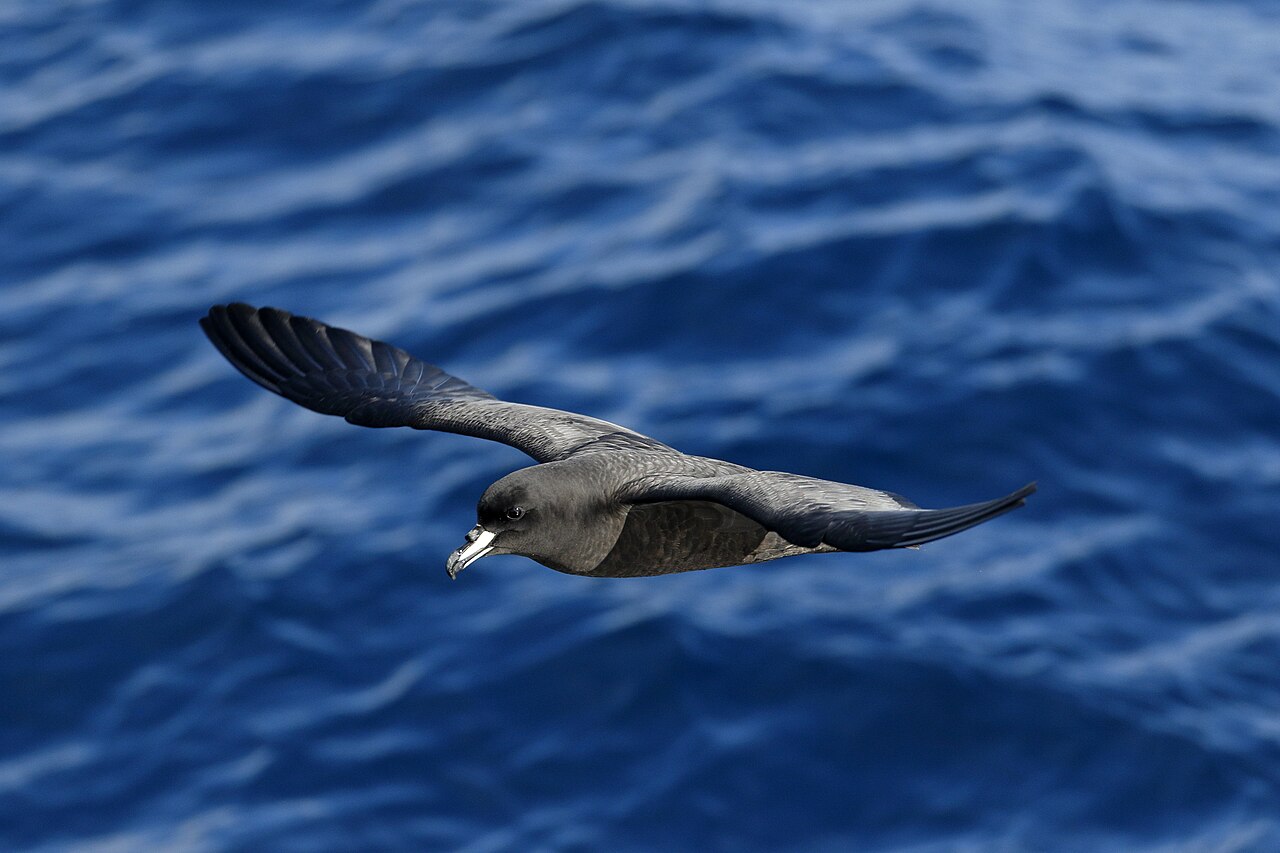
A heavy, broadly built petrel of 50 to 55 cm and 800 to 1600 g, thick-necked and large-headed, so that it looks bulkier than its measurements suggest. The plumage is uniform dark blackish brown, underwing included; legs and feet are black. The decisive mark is the bill: heavy and pale horn-yellow, with a clearly dark, almost black nail at the tip and black between the plates. The flight is slow and heavy, stiff beats with long high arcs in wind.
Confusion species
White-chinned Petrel (Procellaria aequinoctialis) is the hard one: as dark and slightly larger, but its pale horn bill lacks the dark tip, and it often — not always — shows a small white chin spot. A good photograph of the bill tip settles it. Black Petrel (Procellaria parkinsoni) also has a dark bill tip but is distinctly smaller (46 cm) and slighter in head and bill, and range helps strongly: it belongs to the Hauraki Gulf and northern waters, while the Westland Petrel holds the West Coast and Cook Strait. Flesh-footed Shearwater (Ardenna carneipes) is markedly smaller and slimmer, with flesh-coloured rather than black legs. Sooty Shearwater (Ardenna grisea) is smaller, narrower-winged and shows a silvery panel in the underwing.
Habitat
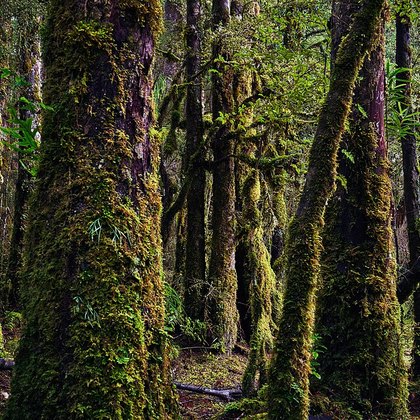
At sea the shelf and slope off the West Coast, where the canyons off Hokitika and Karamea drive food upward, and the open Tasman Sea beyond. To breed it comes ashore in lowland podocarp-broadleaf forest on the steep coastal hills a few kilometres inland, digging burrows among tree roots on slopes up to about 250 metres. That is unusual: most large petrels breed on treeless islands, this one under a canopy on the mainland.
Where the bird is most often found, arranged by main group and formation.

Range and movements
The entire breeding range lies between Barrytown and Punakaiki, north of Greymouth on the West Coast of the South Island — some 29 colonies of fifty to a thousand burrows each. At sea in winter it is the commonest large dark petrel of Cook Strait and the waters around the north of the South Island, and it follows the fishing fleet far out into the Tasman Sea and along south-eastern Australia. In the southern summer, outside the breeding season, the birds cross to South American waters and spend the season in the Humboldt Current off Chile and Peru.
- Resident
- dark = core range, pale = thinly spread
Where and when to look
From May to December a pelagic out of Kaikoura, or across Cook Strait from Wellington, is the surest chance; from the beach at Punakaiki the late-afternoon return of birds to the colony can be watched, one of the few places on earth where a large petrel comes in over the mainland in daylight. Watch for the bill tip as the bird banks, and note at the same time the heavy, short-necked impression: a Westland Petrel looks almost giant-petrel-like beside a shearwater.
Conservation
Endangered (EN), with about four thousand breeding pairs and a breeding range that is a pinprick on the map. At sea bycatch is the main problem: the birds follow trawlers and longliners and are killed on warps and hooks. Ashore, feral pigs, stoats, rats, cats, wandering dogs and at times weka take eggs and chicks, stock trample burrows, and storms and slips damage the forest floor the burrows sit in. Fledglings on their first flight are disoriented by street and road lighting and collide with power lines; they are then picked up and released. Mining and road works in the coastal hills remain a standing threat to so small an area.
Scientific name
Procellaria westlandica | Falla, 1946
Falla described the form in 1946, in the Records of the Canterbury Museum, as the subspecies Procellaria parkinsoni westlandica; it was later recognised as a full species. Because the genus did not change, author and year carry no parentheses. westlandica simply means 'of Westland', the district holding the only breeding ground, and the type locality is Barrytown, Westland. The genus Procellaria was introduced by Linnaeus in 1758, on procella, 'storm'. The Maori name taiko is used in New Zealand for Black Petrel and Magenta Petrel as well.