All species › Passerines › Cuckooshrikes › White-winged Triller
White-winged Triller | Lalage tricolor
Grijsstuittriller | Oruguero tricolor
In inland Australia the White-winged Triller is the sound of spring. As soon as the males arrive in September and October, an incessant, cheerful rattling trill hangs over woodland, mallee and acacia scrub, going on all day and sometimes through the night as well. The breeding male is then a strikingly pied bird with a grey rump; the female, and the male outside the breeding season, are by contrast an unremarkable brown-grey. The difference is so great that it is regularly taken for two species — but it is one and the same bird.

Voice
The name triller is well earned. The male produces a sustained, rapid, rolling rattle of clear notes — often rendered 'chiv-chiv-chiv-chiv' or 'joey-joey-joey' — that runs on unbroken for minutes and is repeated with remarkable persistence from a bare branch or in a fluttering song-flight with quivering wings. In spring this is often the most pervasive sound of all in dry Australian woodland, and on warm nights the birds simply carry on singing. Outside the breeding season they are largely silent, leaving a short hard 'chek' as a contact note. The female sings too, more softly and briefly than the male.
No freely licensed recording has been found for this species yet; what to listen for is described below.
Identification
A small, slim triller of about sixteen to eighteen centimetres with long, pointed wings. The plumage differs both between the sexes and between seasons, and with this species that is the main thing to know. The breeding male is glossy black on crown, nape, back, wings and tail, with clean white underparts and a broad white band across the wing coverts; between the black back and the black tail lies a clearly grey rump, the mark from which the Dutch name is taken. The female is entirely different: grey-brown above, dingy white below with faint streaking on the breast, with a pale eyebrow and a dark eye-stripe, and with brown wings in which the pale wing panel is much fainter. The male outside the breeding season resembles the female but keeps the blackish wings with their crisp white panel. So a 'female with black wings' seen in May is a male in winter plumage, not another species.
Confusion species
The main risk is the female against the female Varied Triller (Lalage leucomela). The latter is larger and longer-tailed, has clearly barred or streaked flanks rather than faint breast streaking, a warm buff undertail and a more sharply defined white eyebrow; moreover she sits in the rainforest, monsoon forest and mangrove of the northern and eastern coast, while the White-winged Triller is a bird of dry, open inland country. At a glance the breeding male can recall the Hooded Robin (Melanodryas cucullata), but that bird has a black hood running down onto the breast, an entirely different posture and no grey rump. The Willie Wagtail (Rhipidura leucophrys) is pied as well, but has a black throat and upper breast and fans its tail continually. In doubt, look for the grey rump of the breeding male and for the crisp white wing panel that flashes as a broad band in flight.
Habitat
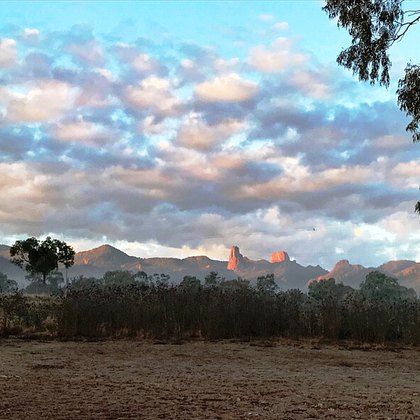
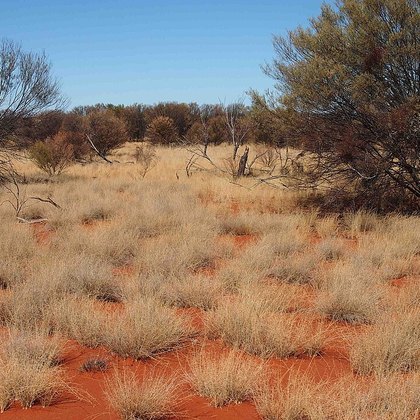
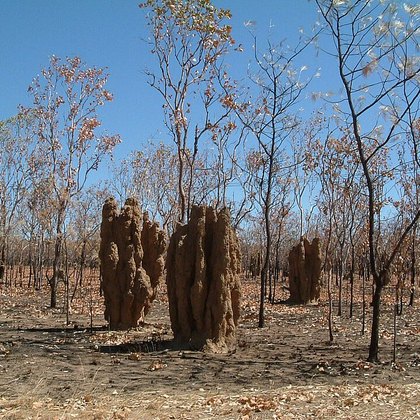
Open eucalypt forest and woodland, mallee, mulga and acacia shrubland, creek-line woodland and the tropical eucalypt savanna of the north, and beyond that all half-open farmland with scattered trees: roadside tree lines, remnant patches in pasture and homestead plantings. Closed rainforest is avoided. The food is almost entirely insects, especially caterpillars and beetles, gleaned from foliage or picked off the ground; the species forages lower than the large cuckooshrikes and regularly comes down to the soil. The nest is a strikingly small, shallow cup of grass stems and rootlets bound with cobweb into a horizontal fork, usually only a few metres up; both parents incubate and feed.
Where the bird is most often found, arranged by main group and formation.


Range and movements
Spread across almost the whole of Australia except Tasmania, and in addition over eastern New Guinea and the southern islands of Torres Strait. The species is markedly mobile: in the southern spring and summer the birds move south and inland to breed, and in autumn they shift to tropical northern Australia and beyond. Numbers also fluctuate strongly with rainfall — after good rains the species can appear inland in enormous numbers in districts where it has been absent for years. It does not occur in New Zealand.
- Resident
- Breeding (summer)
- dark = core range, pale = thinly spread
Where and when to look
Go to dry woodland or mallee in October or November and let the sound lead you: the sustained rattling trill is all but unmistakable and takes you to a male singing from an open, high perch. Then watch the bird fly, for that is when it is at its best: the broad white wing band and the grey rump show most clearly. If you see an unremarkable brownish bird in the same tree, assume it is the female and take time over the flanks and the eyebrow, so that you can make the comparison with Varied Triller for yourself. Note the season too: a pied triller in the far north in July is almost always a male in moult.
Conservation
Least Concern (LC), with an enormous range and a large if strongly fluctuating population. The species benefits from open, partly wooded landscapes and has consequently held on across much farmed country where other woodland birds have gone. It is not immune, though: where the scattered old trees and the shrub layer in pasture disappear entirely, so do the foraging and nesting opportunities, and as a ground forager the bird is exposed to predation by feral cats and foxes. The largest uncertainty is climate: because inland breeding numbers move directly with rainfall, a longer run of dry years automatically means a run of poor breeding seasons across a large part of the range.
Scientific name
Lalage tricolor | (Swainson, 1825)
William John Swainson described the species in 1825 as Ceblepyris tricolor, from an Australian bird whose type locality was later restricted to Sydney; author and year stand in parentheses because the species now sits in Lalage. The epithet tricolor is Latin for 'three-coloured' and refers to the breeding male: black, white and the grey of the rump. The genus name Lalage is of an altogether different order and describes nothing at all: Friedrich Boie took it in 1826 from a girl's name in the Odes of Horace, so it is purely literary naming. The three modern names each pick a different character of the same bird: the Dutch grijsstuittriller names the grey rump, the English White-winged Triller the white wing panel, and the Spanish oruguero tricolor follows the scientific name. The species has in the past been treated as conspecific with Lalage sueurii of Timor and Java; the two are now kept separate.