All species › Passerines › Whiteheads › Whitehead
Whitehead | Mohoua albicilla
Witkopmohoua | Mohoua cabeciblanco
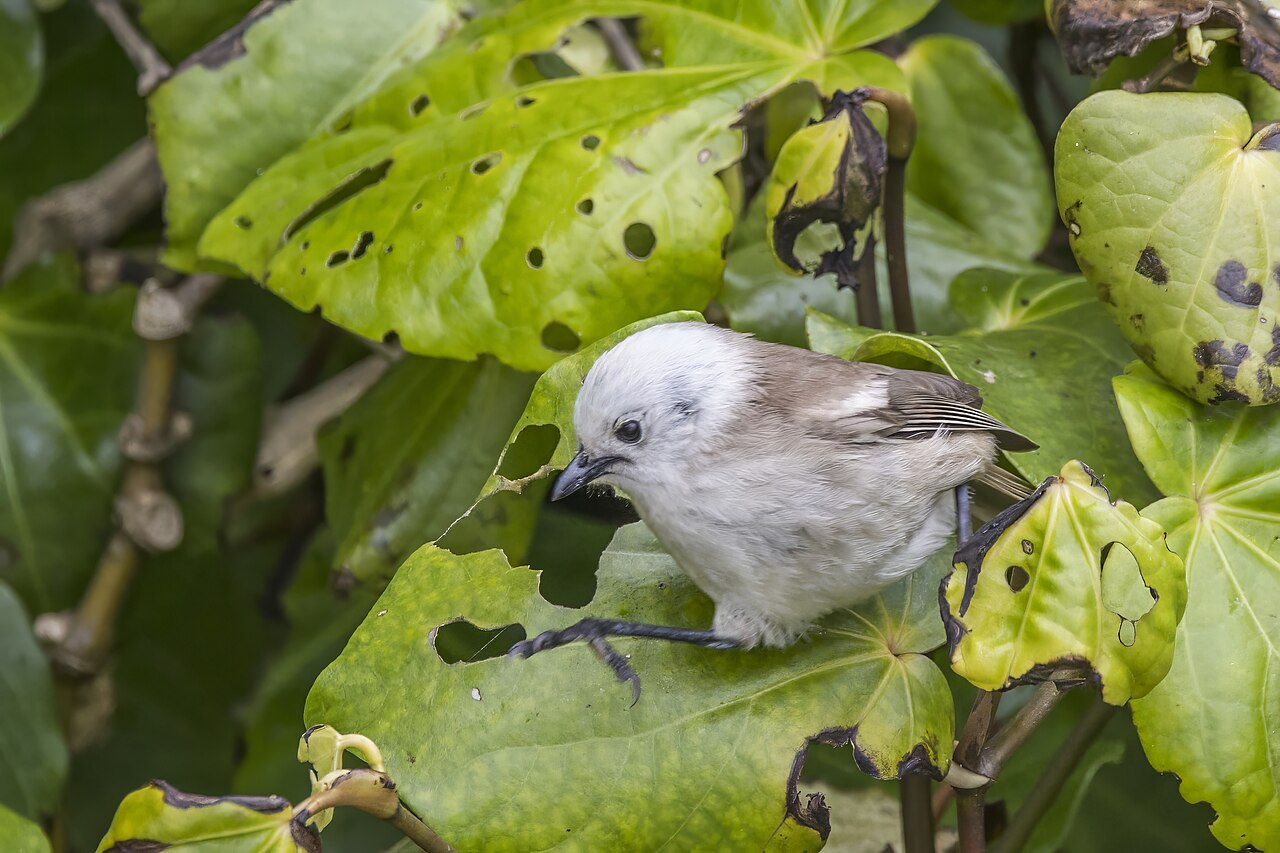
The Whitehead is a forest bird of New Zealand's North Island with a snow-white head and underparts, moving through the canopy in noisy parties. It belongs to a family of three species found in New Zealand and nowhere else. On the North Island it is the only host of the Long-tailed Cuckoo.
Voice
A sustained, canary-like twittering from the canopy, in which a series of viu viu viu runs into a rasping zir zir zir zir; that is how a party is recognised at a distance. Between it comes a constant soft cheeping by which the birds keep track of one another in the foliage. The species calls all year, including in winter, when the parties are largest. In summer the begging call of a young Long-tailed Cuckoo runs through it, far heavier and more wheezing than anything a Whitehead produces itself.
No freely licensed recording has been found for this species yet; what to listen for is described below.
Identification
Fifteen centimetres and fifteen to eighteen grams: compact, short-tailed and round-headed, with a thin black bill, black legs and a dark eye. The male has head, throat and underparts pure white, sharply set off against the grey-brown back, wings and tail. The female has the same pattern but with a brownish wash over crown and nape, so that the white looks less clean. Young birds are duller and browner on the head. The bird is restless, often hangs upside down from thin twigs and holds the tail slightly spread.
Confusion species
Yellowhead (Mohoua ochrocephala) has a yellow head and occurs only on the South Island; the two never meet. Pipipi (Mohoua novaeseelandiae) is brown with a streaked head and is likewise a South Island bird. On the North Island the Grey Warbler is the only confusion species: it is smaller, grey rather than white, and has a red iris. A dull young male can briefly look like a female; then watch how sharp the boundary between head and back is.
Habitat
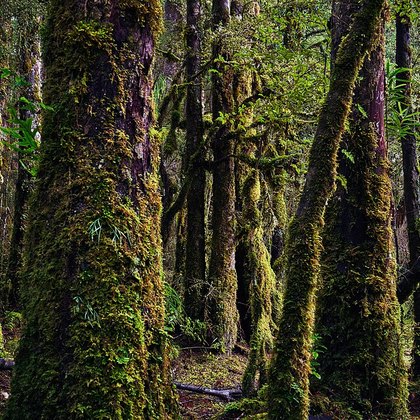
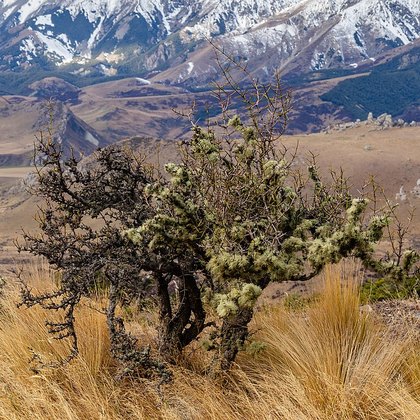
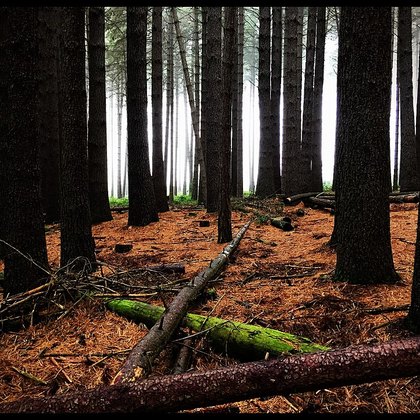
Tall native forest of the North Island — podocarp-broadleaf, beech and kauri — and dense shrubland on old cut-over country. Mature pine plantations are also occupied, provided there is an understorey. The birds work the whole canopy, from the lowest twigs to the crown, and are tied to no single tree. Open pasture is a barrier: the species flies poorly and rarely crosses bare ground, which makes fragmented forest useless to it.
Where the bird is most often found, arranged by main group and formation.


Range and movements
The North Island of New Zealand only, and there only south of a line from Pirongia through Hamilton to Te Aroha; north of that the species has gone. Naturally also on Little Barrier and Kapiti. In recent decades it has been successfully released on many islands and in fenced mainland sanctuaries, so that the range is growing again. It does not migrate; but in winter, in June and July, the parties grow larger and range further around the breeding territory.
- Resident
- Breeding (summer)
- dark = core range, pale = thinly spread
Where and when to look
Look for the sound and not the bird: a party gives itself away by sustained twittering from the canopy and is past in half a minute. Kapiti and Tiritiri Matangi are the surest places; it is also in the Waitakere Ranges and the Pureora forests. Anyone who in summer, from December to February, hears a heavy, wheezing begging call is looking at a young Long-tailed Cuckoo being fed by Whiteheads.
Conservation
Not threatened, and the range is growing through releases, but the species has gone from the north of the North Island and returns there only where predators are controlled. Rats, stoats and possums take nests; the female incubates alone and is vulnerable while doing so. Where a sanctuary is fenced and cleared of predators, density rises steeply within a few years.
Scientific name
Mohoua albicilla | (Lesson, 1830)
René Primevère Lesson described the bird in 1830 as Fringilla albicilla, among the finches; because the species was later moved to another genus, author and year stand in parentheses. The same Lesson introduced the genus Mohoua in 1835, taken from the Māori name for the Yellowhead. albicilla is compounded of Latin albus ('white') and the ending -cilla, carried over into bird names from Motacilla. The type locality is the Bay of Islands on the North Island — a district where the species no longer occurs.