All species › Pigeons and doves › Doves and pigeons › Wonga Pigeon
Wonga Pigeon | Leucosarcia melanoleuca
Wongaduif | Paloma wonga
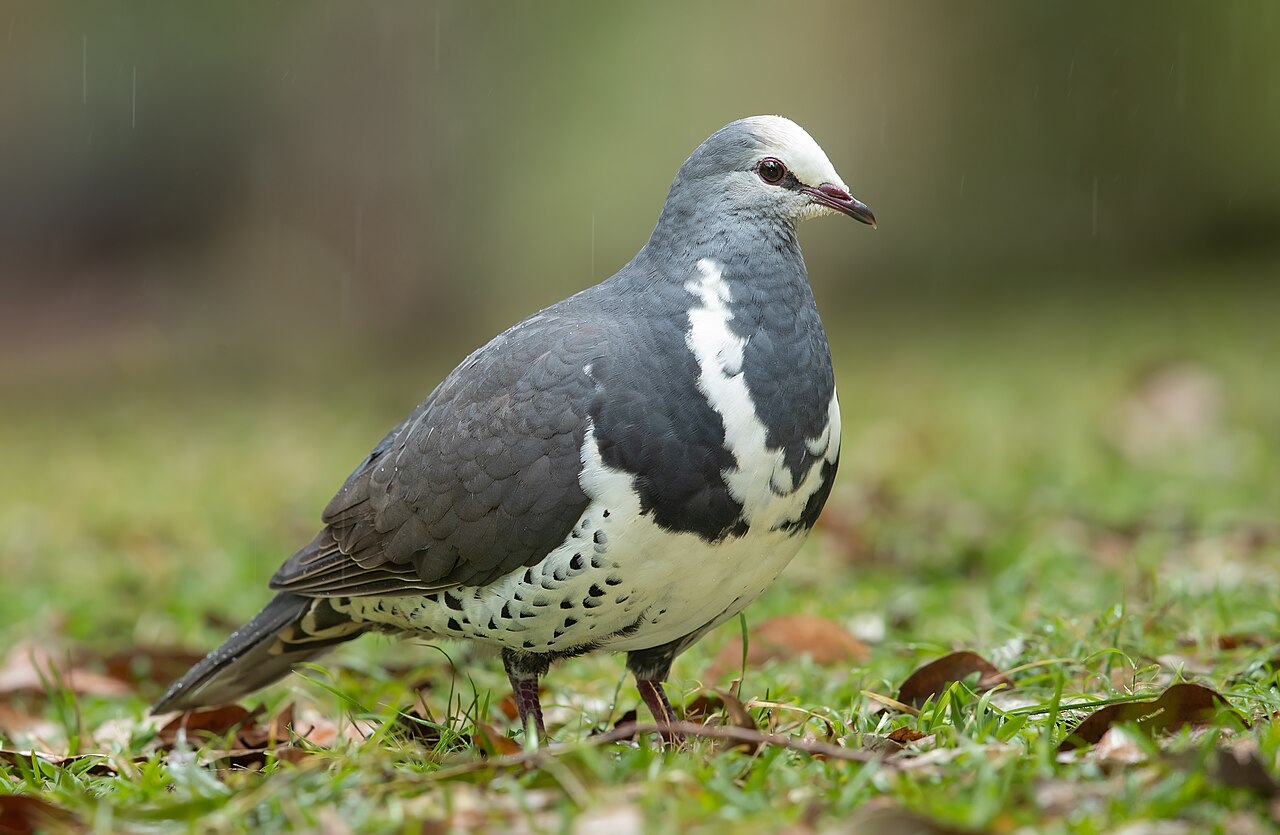
The Wonga Pigeon is the heaviest forest-floor pigeon of eastern Australia: a large, rounded bird with a small head, short broad wings and a long tail, blue-grey above and white below with a sharp white V on the breast. Usually you hear it first — an endlessly repeated, thudding woop-woop — and only then see it walking along the edge of a picnic area or a forest track.
Voice
A loud, high and utterly monotonous woop, repeated at roughly one-second intervals without end: a single bird can keep it up for hours and the sound carries up to two kilometres, until it seems almost a property of the forest itself. In display the male bows deeply and delivers a soft trilling coo. Take-off is a hard clattering roar from the short wings.
No freely licensed recording has been found for this species yet; what to listen for is described below.
Identification
A large, heavy pigeon of nearly forty centimetres, soft blue-grey above and white below, with a pale face and a broad, crisply drawn white V across the breast. The flanks and belly are strewn with dark grey crescents and wedge-shaped spots — a pattern that reads as fine speckling at range. The eye is dark red-brown with a pink orbital ring; bill, legs and feet are deep pink to red. Young birds are browner above with a vague, unfinished V. On the ground it walks slowly and deliberately, tail carried slightly up.
Confusion species
The size, the white V and the white crescent-marked underside are unique in this region, so real confusion is slight. Squatter Pigeon (Geophaps scripta) also carries a striking black-and-white face pattern but is smaller, brown above, with bare blue skin round the eye, and favours open woodland rather than rainforest. Topknot Pigeon (Lopholaimus antarcticus) is grey too but keeps to the high canopy and has a double crest. On the forest floor it shares ground with the far smaller, green-backed Pacific Emerald Dove (Chalcophaps longirostris), which only a brief flushing glimpse could confuse it with.
Habitat
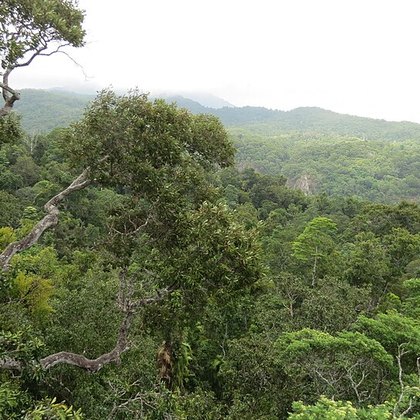
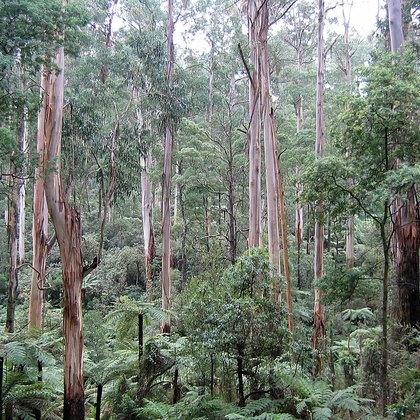
Dense subtropical and warm-temperate rainforest and wet eucalypt forest, favouring places where a closed canopy sits over an open, litter-rich floor. It makes conspicuous use of the edges and clearings people have cut into it: picnic areas, walking tracks, small car parks, roadsides and gardens with a feeding table. Nesting is in tall trees, feeding entirely on the ground.
Where the bird is most often found, arranged by main group and formation.


Range and movements
Endemic to eastern Australia, from south-eastern into central Queensland and south along the coast and coastal ranges to Gippsland in Victoria. Historically the range reached further north, to near Cairns, and further south, into the Dandenongs near Melbourne; both edges have retreated. Outside this eastern strip it occurs nowhere, neither in Tasmania nor in New Zealand.
- Resident
- dark = core range, pale = thinly spread
Where and when to look
Look for it where forest meets something open: a picnic ground in an east-coast national park at first light or towards dusk is the classic spot. Watch the ground for its regular walking routes, which stay visible as narrow bare lines worn through the litter, and settle down quietly there to wait. Name it by ear: one monotonous woop a second for minutes on end is no other bird.
Conservation
Least Concern (LC), but with a history less settled than that status suggests. Clearing of coastal forest has shortened the range at both ends, and in the 1940s the species was shot on a large scale as a supposed crop pest. Foxes and feral cats remain a steady pressure on a pigeon that does nearly everything on the ground. Since protection and the recovery of forest reserves numbers have risen again in many places.
Scientific name
Leucosarcia melanoleuca | (Latham, 1801)
John Latham described the bird in 1801; the genus Leucosarcia was introduced by John Gould in 1843 and is built from Greek leukos 'white' and sarx 'flesh' — after the pale meat, for the species was valued as game in the nineteenth century. The epithet melanoleuca means 'black and white'. Latham also gave the bird the name picata in the same year, and it was long known as Leucosarcia picata; melanoleuca is the name now in use. The English and Dutch names go back to the Indigenous word wonga-wonga from the languages of the New South Wales coast.