All species › Passerines › Australasian robins › Yellow-legged Flyrobin
Yellow-legged Flyrobin | Kempiella griseoceps
Gele vliegenvanger | Petroica patigualda
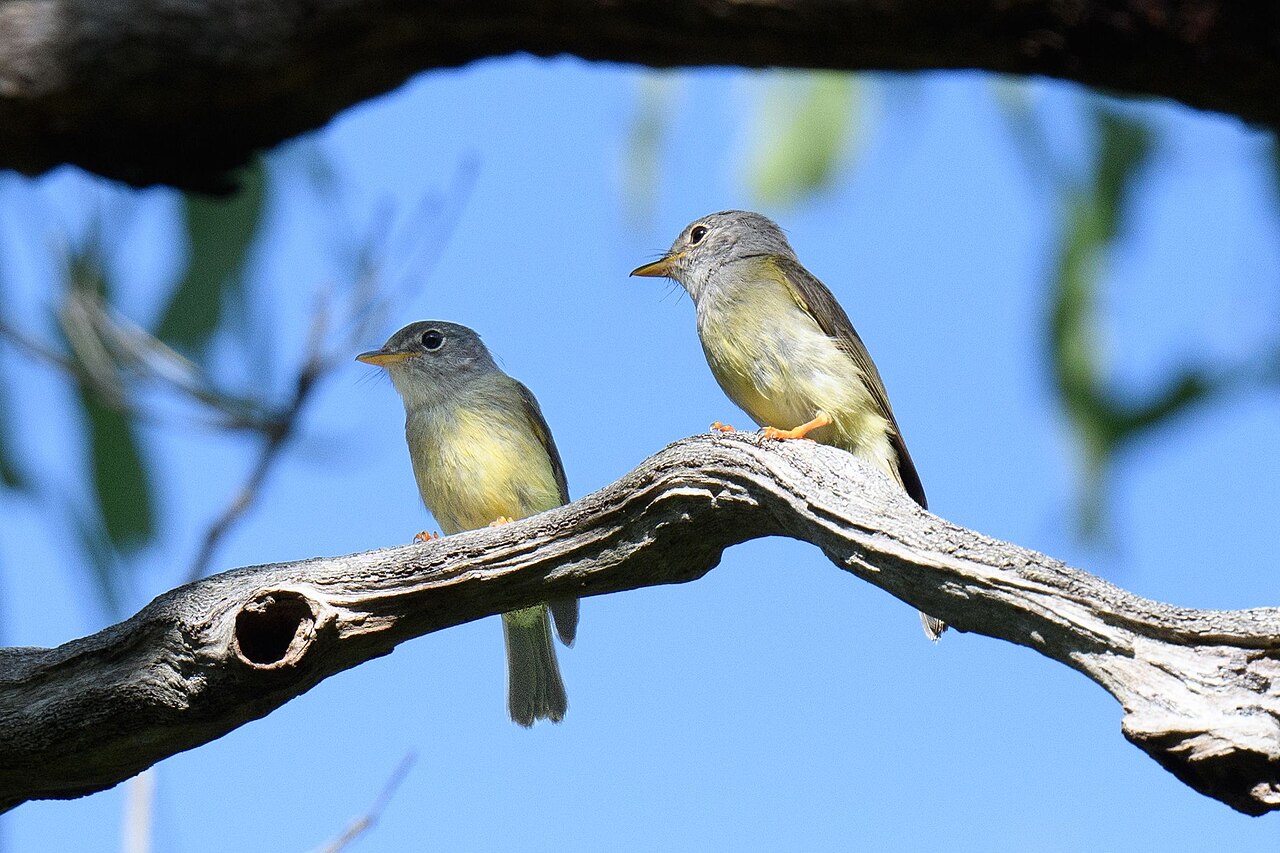
The Yellow-legged Flyrobin is the smallest member of the family in Australia: a bird of barely twelve centimetres and a little over ten grams, olive-green above, pale yellow below, with a grey cap and — the character the English name points at — conspicuously pale yellow legs. It belongs to a small, almost solitary genus and in Australia lives only in the rainforest of the northern Cape York Peninsula, where it stays high in the canopy and is easily overlooked.
Voice
A very high, thin, rapid series of tenuous notes, often falling slightly and ending in a trill — it sounds more like an insect than a bird and hardly registers in the general noise of rainforest. Alongside it short, sharp tsip notes between bouts of feeding. Once you know the series you hear it surprisingly often in the right forest; if you do not know it, you never hear it at all.
No freely licensed recording has been found for this species yet; what to listen for is described below.
Identification
Eleven to twelve centimetres and about ten grams, with a short bill broad at the base and a short tail. Crown and side of the head are grey, the back and wings olive-green, the throat whitish and the rest of the underparts pale lemon yellow, strongest on the belly. The legs and toes are pale yellow-pink and stand out against the dark branch; that is the best character. The sexes are alike; young birds are browner and faintly mottled.
Confusion species
The same Cape York rainforest holds Eopsaltria leucops, about as small and likewise olive above and yellow below, but with an unmistakable white face mask and dark legs. Microeca flavigaster is the hardest: also small, also yellow below, but it has no grey cap contrasting with an olive back, its legs are dark, and it sits in open woodland, along forest edges and near mangrove rather than inside closed rainforest. Kempiella flavovirescens, the nearest relative, occurs only in New Guinea. The Gerygone species are smaller still, with a slender pointed bill and white tail spots, and they hang at the leaf tips instead of sallying from a branch.
Habitat
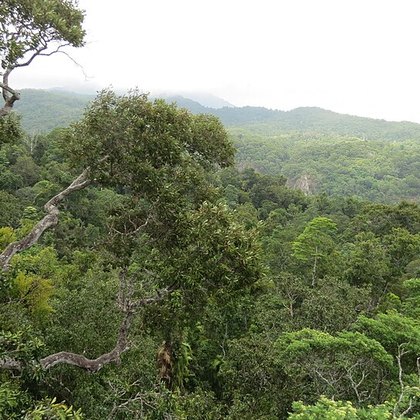
The middle and upper canopy of tropical lowland rainforest, and to a lesser degree its edge and adjoining monsoon forest and vine thicket. In Australia that confines it to the rainforest blocks of northern Cape York, around the Iron Range and the McIlwraith Range; in New Guinea it ranges from the lowlands to about fifteen hundred metres. It forages actively and restlessly, picking insects from leaf and twig and hanging briefly in the air to do so. The tiny cup nest of plant fibre and cobweb is finished with lichen and set on a bare horizontal branch.
Where the bird is most often found, arranged by main group and formation.

Range and movements
The bulk of the range lies in New Guinea, where the species is widespread. Within the area of this guide it is a bird of the northern Cape York Peninsula alone, in a handful of rainforest blocks in the far north-east. That is a small, remote area visited by few birders, and the number of Australian records stays modest as a result. It is sedentary and does not leave closed forest; nothing is known of wandering beyond the range.
- Resident
- dark = core range, pale = thinly spread
Where and when to look
Go to the rainforest near the Iron Range and look up — this is one of the few robins you will not find at eye level. Find a forest edge or a clearing that lets you see into the canopy, and watch the movement: a small, restless green-and-yellow bird hanging briefly in the air at a leaf tip. When it then settles for a moment on a bare branch, look at the legs. Pale yellow legs on a ten-gram bird in Australian rainforest mean this species.
Conservation
Least Concern (LC). In New Guinea the species is widespread and numerous, and the Red List category rests on that. For the Australian population the same reservation applies as for the other rainforest birds of Cape York: it is a small range in a few forest blocks, and anything that damages that forest — cyclones, fire along the forest edges, in the longer term a drying climate — reaches the whole Australian population at once. Most of that range lies within protected areas.
Scientific name
Kempiella griseoceps | (De Vis, 1894)
De Vis described the bird in 1894 as Microeca griseoceps, from a specimen taken on the mountain Maneao in south-eastern New Guinea; because it was later placed in another genus, author and year stand in parentheses. griseoceps is Latin for grey-headed, from griseus (grey) and the ending -ceps (head). The genus Kempiella is named for Robin Kemp, who collected in New Guinea and on Cape York in the early twentieth century; older works still carry the species under Microeca. The Dutch name, which translates simply as 'yellow flycatcher', is strikingly general for a species whose leg colour is the character — the English name does name it.