All species › Passerines › Australasian robins › Hooded Robin
Hooded Robin | Melanodryas cucullata
Zwartkopvliegenvanger | Petroica encapuchada
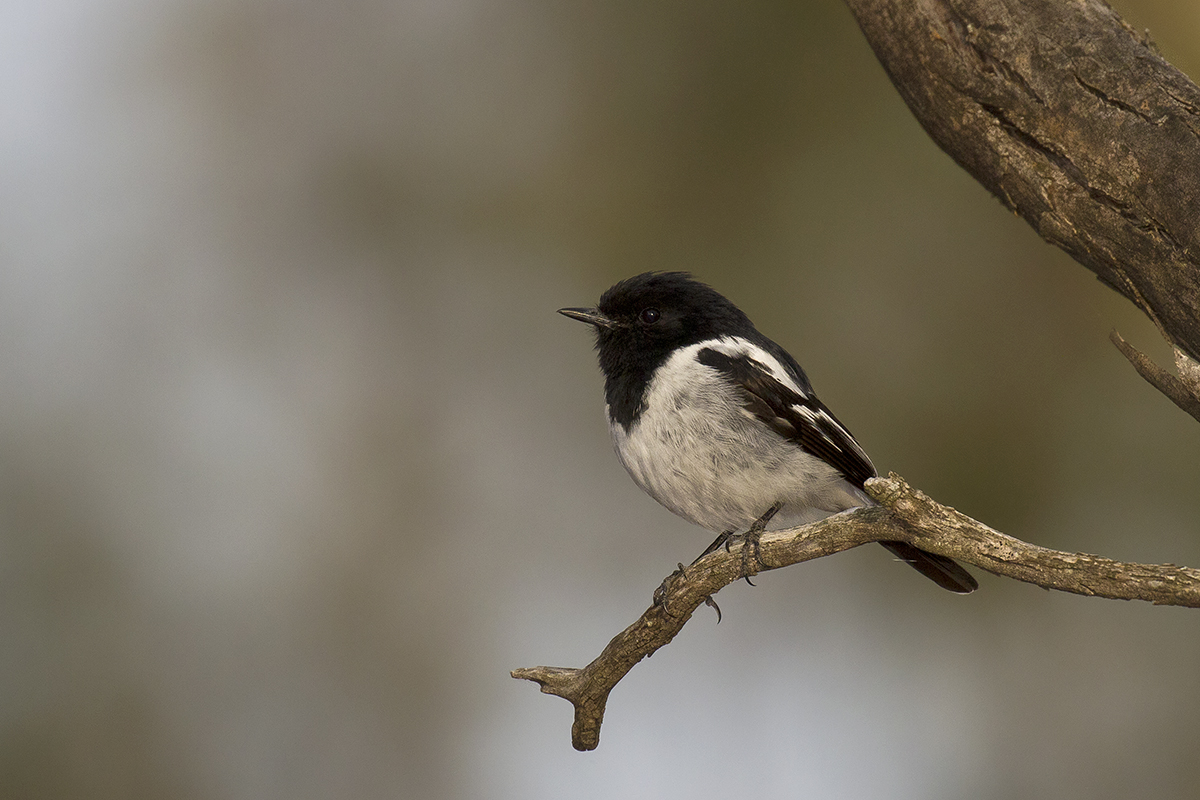
The Hooded Robin is Australia's only black-and-white robin: a quiet, shy bird of sixteen centimetres that looks down at the ground from a low dead branch or a fallen log, and then drops. It is mapped across almost the entire mainland and is yet common almost nowhere — in the south-east it has vanished from whole districts within half a human lifetime. Whoever finds one usually finds a pair on a patch of woodland where fallen timber and native grass have been left alone.
Voice
Soft and restrained: short low trills and now and then a series of clear piping whistles, mostly only in the first hour after sunrise. The song does not carry far and is quickly lost in windy woodland. Outside the early morning this is one of the most silent birds of the open forest; pairs keep contact with a few short dry ticks.
Recording: Greg McLachlan — CC BY-NC-SA 4.0 · Bowra Station, near Cunnamulla, Queensland, Australia · xeno-canto
Identification
A fairly large robin of fifteen to seventeen centimetres with a slender bill and a square-cut tail. The male is unmistakably pied: black head, throat and back running down over the breast like a hood, clean white underparts, black wings with a white shoulder bar and a white wing stripe, and white panels in the tail that show in flight. Bill, eye and legs are black. The female is a nondescript grey-brown with a pale grey throat, dark brown wings and the same white wing stripe. Juveniles are dark brown with cream speckling, but carry the pale wing and tail markings from an early age. The flight is short, fast and undulating, with plenty of white.
Confusion species
The male is the only black-and-white robin and cannot be missed; Pied and Black Honeyeaters are slimmer, have a decurved bill and are noisy and restless. The female is the problem. She is geographically separated from Dusky Robin (Melanodryas vittata), which occurs only on Tasmania, and Mangrove Robin (Melanodryas pulverulenta) is a greyer, shorter-tailed bird that stays in mangroves on the tropical north coast. The real risk is with female red Petroica robins and with Jacky Winter (Microeca fascinans): the Hooded Robin is clearly larger and heavier, has a grey breast and broad, sharply defined white markings on wing and tail, whereas Jacky Winter is smaller, lacks a wing bar and shows white outer tail feathers rather than white panels.
Habitat
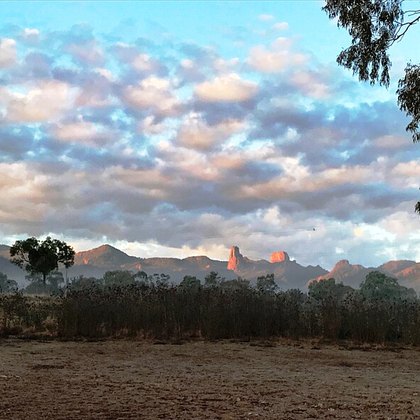
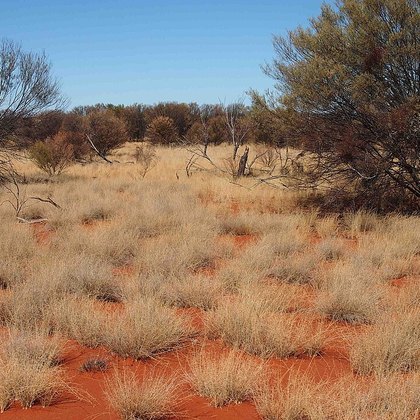
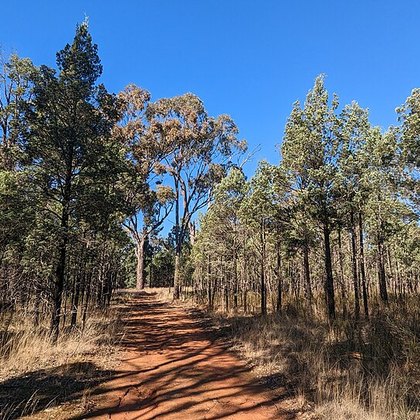
Lightly timbered woodland, mostly acacia or eucalypt, with a shrub layer that provides low lookout perches and an open native grass floor with bare patches between. What lies on the ground decides it: logs, fallen branches and deeper soils, which hold the small lizards and arthropods it lives on. Also in mulga (acacia scrub of the dry interior, dominated by Acacia aneura), in casuarina and callitris woodland and in mallee (low, multi-stemmed eucalypt scrub of dry southern Australia). Thick mats of exotic grass and bare scraped ground without cover are both useless to it.
Where the bird is most often found, arranged by main group and formation.

Range and movements
Almost the whole Australian mainland, but with large gaps: it is absent from Tasmania, from Cape York and the eastern Gulf of Carpentaria, from the Nullarbor and from around the Simpson Desert. The stronghold is south-eastern Australia between Adelaide and Brisbane. Four subspecies are recognised, of which the Tiwi form of Bathurst and Melville Islands stands apart. It is sedentary and lives in pairs or small family groups with helpers at the nest.
- Resident
- dark = core range, pale = thinly spread
Where and when to look
Stop at a patch of woodland where the fallen timber has been left lying and scan the lowest two metres: low dead branches, fence posts, fallen trunks. The bird sits still for a long time and moves only when it drops to the ground. Do not crowd a nest — both parents will then perform a distraction display, tumbling across the ground with one wing spread. And watch for Noisy Miners: where they have taken over a site, the Hooded Robin has usually already gone.
Conservation
Globally Least Concern (LC) — but that rating hides the situation in Australia itself. The Tiwi subspecies Melanodryas cucullata melvillensis has been listed as Critically Endangered and possibly extinct on the national EPBC list since 2018; the last verified record on Bathurst Island dates from 1992. The south-eastern nominate form was listed as Endangered in March 2023, on the basis of repeated surveys indicating a decline of more than fifty per cent in ten years. In Victoria the species is Vulnerable under the Flora and Fauna Guarantee Act, and likewise in New South Wales. The causes accumulate: large-scale clearing and fragmentation of woodland, altered fire regimes, displacement by the Noisy Miner, prolonged drought, and predation by feral cats on a bird that forages on the ground and nests low.
Scientific name
Melanodryas cucullata | (Latham, 1801)
John Latham described the species in 1801 as Muscicapa cucullata, among the flycatchers; Vigors and Horsfield later described it again as Grallina bicolor. After years in Petroica it now stands in Melanodryas, which is why author and year appear in parentheses. cucullata is Late Latin for 'hooded', after the male's black hood — the same idea as in the English and Dutch names. Melanodryas is from Greek melas, 'black', and dryas, 'wood-nymph'. In Australia it is also called Black Robin or Pied Robin; the first of those is confusing, as it belongs to the Black Robin (Petroica traversi) of the Chatham Islands.