All species › Woodpeckers and allies › Woodpeckers › Acorn Woodpecker
Acorn Woodpecker | Melanerpes formicivorus
Eikelspecht | Carpintero bellotero
The Acorn Woodpecker lives in tight-knit, resident groups that together store thousands of acorns in a single tree, each in its own bill-drilled hole — a granary tree that can remain in use for generations.
Voice
Very vocal: a repeated, harsh waka-waka-waka, often called by several birds at once.
Recording: Jonathon Jongsma — CC BY-SA 3.0 · McClellan Ranch Preserve, Santa Clara, California, United States · xeno-canto
Identification
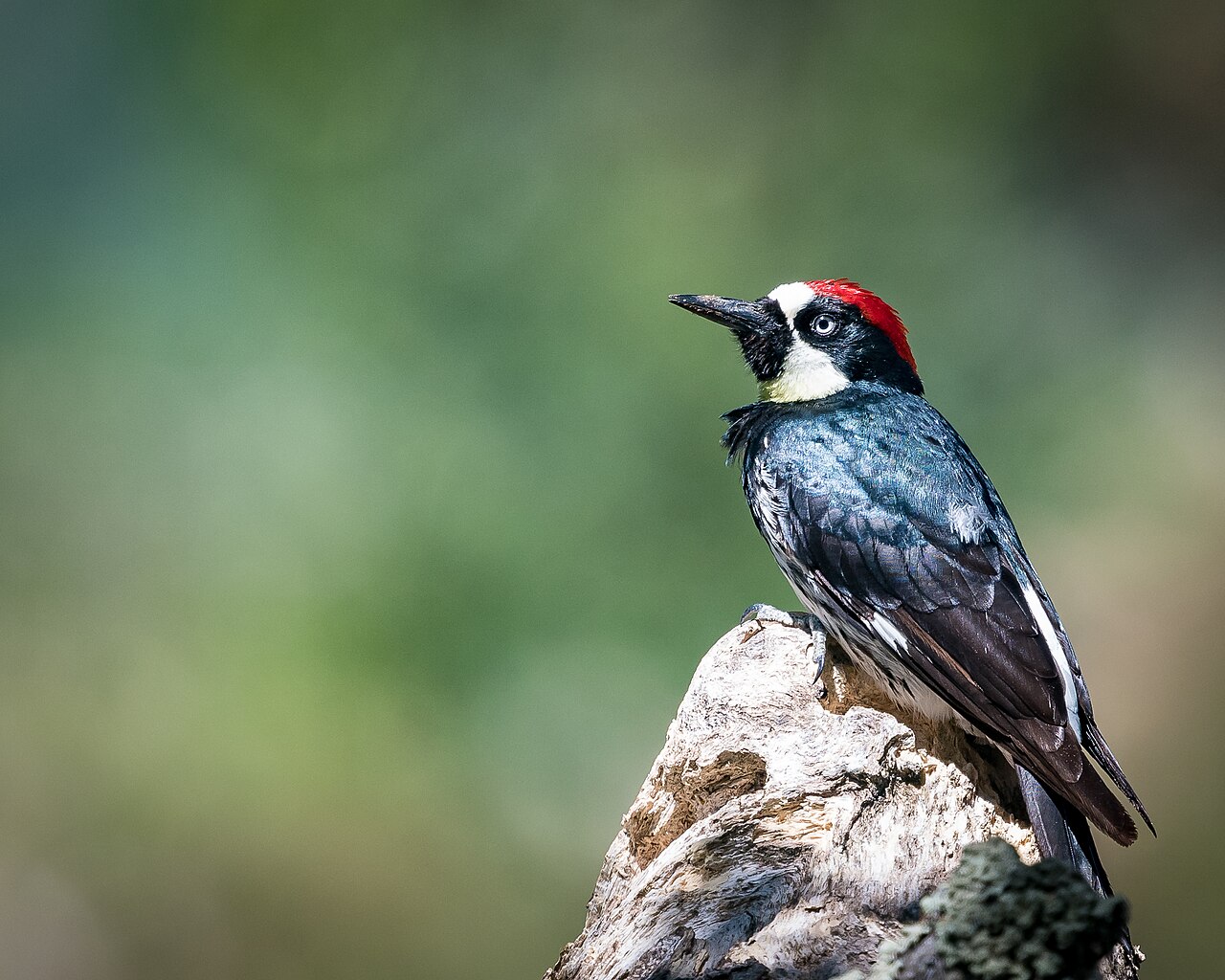
A clownish face with white eyes, a black back, a white forehead and throat, and a red crown that in the female is separated from the forehead by a black band. White on the wings and rump stands out in flight.
Confusion species
The striking face pattern makes confusion with other woodpeckers unlikely; only the head of the Golden-fronted and Gila Woodpeckers, both lacking the white eye and black-and-white face pattern, superficially resembles it.
Habitat
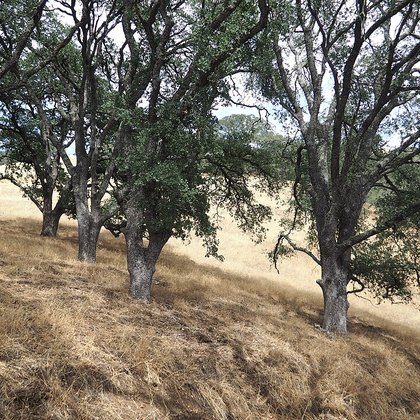
Oak woodland and mixed oak-pine forest, from savanna-like open oak country to denser forest in the mountains.
Where the bird is most often found, arranged by the USNVC — the vegetation classification of the United States and Canada — and CMECS for sea and coast.


Range and movements
Resident from south-western Oregon through all of California and the south-western United States, south through Mexico and Central America to Colombia.
- Resident
- Breeding (summer)
- Winter
- Passage
- dark = core range, pale = thinly spread
Where and when to look
Look for 'granary trees' with hundreds to thousands of small holes, each holding an acorn — often the same dead tree or pole used by one family group for years.
Conservation
Not threatened; the species depends heavily on old oaks with enough space for storage, and loss of oak woodland is a local risk for its cooperatively breeding groups.
Scientific name
Melanerpes formicivorus | (Swainson, 1827)
Originally described by Swainson in 1827 as Picus formicivorus; since moved to Melanerpes, author and year stand in parentheses. Formicivorus is Latin for 'ant-eating', though the diet consists mostly of acorns and insects.