All species › Passerines › Finches, euphonias and allies › ʻAkohekohe
ʻAkohekohe | Palmeria dolei
ʻAkohekohe | ʻAkohekohe
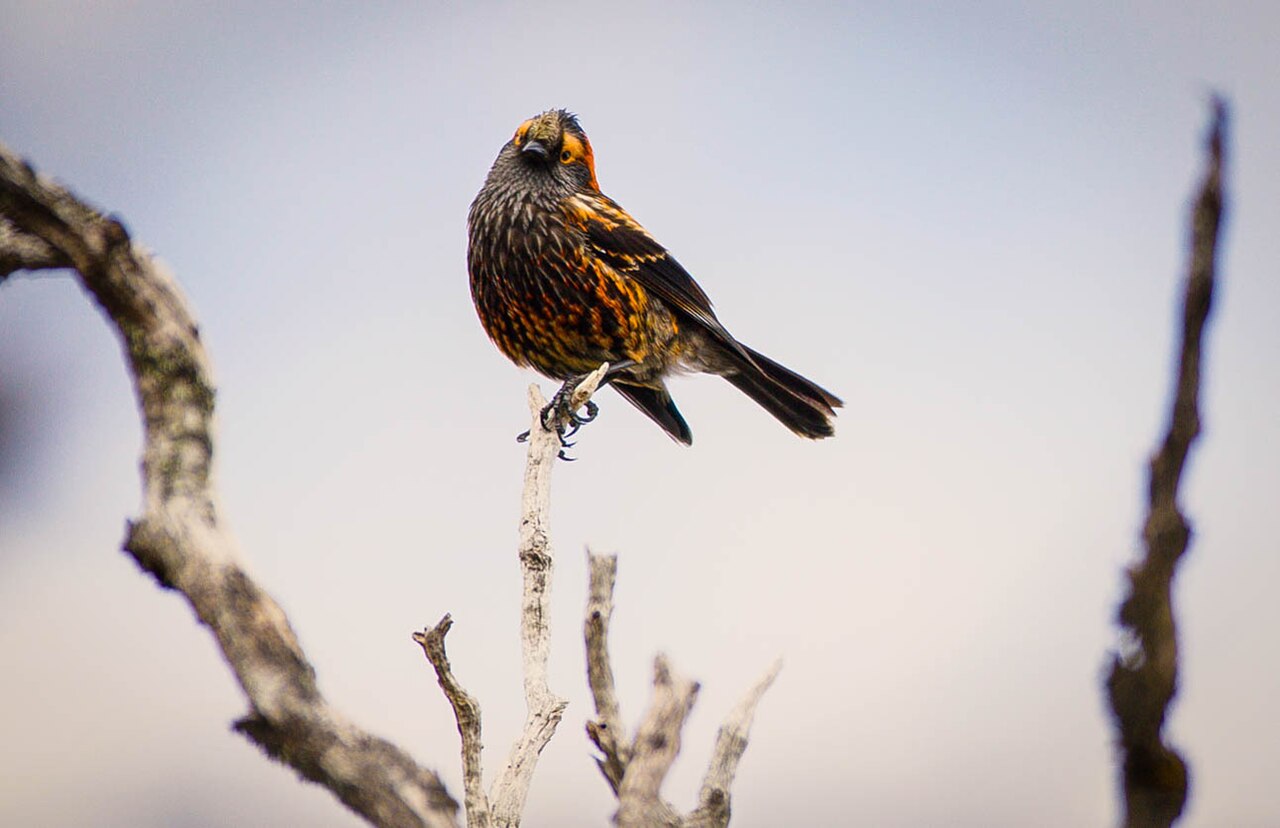
The ʻAkohekohe is the largest surviving Hawaiian honeycreeper and is told by the upright white crest on its forehead. It now occurs only in wet montane forest on the windward side of Haleakala on Maui; on Molokaʻi it has been gone since the early twentieth century.
Voice
The repertoire consists of short, hard notes often repeated in pairs, a descending trill given at roughly five-second intervals, and a low chuckling delivered from within the branches. Hoarse, guttural sequences also occur but are rarely heard. The calls carry far through the wet forest and usually betray the bird before it is seen.
Recording: Brooks Rownd — CC BY-NC-SA 3.0 · TNC Waikamoi Preserve, Maui County, Hawaii, United States · xeno-canto
Identification
A heavy, dark honeycreeper with glossy black plumage closely set with whitish-grey and orange feather tips over body and wings, so that at distance the bird looks speckled. On the forehead stands a bristly, whitish-gold crest that points forward over the base of the bill; orange-red feathers surround the eye and mark the nape. The bill is black, short and slightly curved. Young birds are brownish-black and lack both the orange and the full crest.
Confusion species
The ʻApapane is common in the same forest but much smaller, plain crimson with white undertail and no crest. The ʻIʻiwi is vermilion with black wings and a long, curved salmon bill. At some distance the dark ʻAkohekohe can suggest an introduced Warbling White-eye or a starling; the white forehead crest and the speckled plumage rule those out.
Habitat
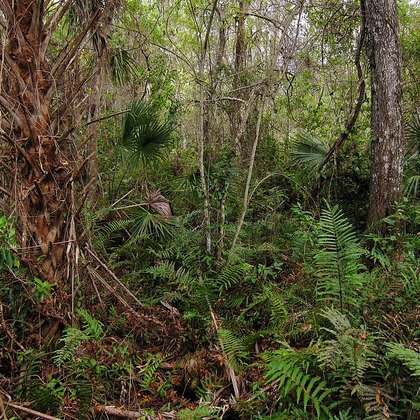
Wet and mesic montane forest of ohia lehua and koa (Acacia koa, a native Hawaiian tree) on the windward slope of Haleakala, between roughly 1300 and 2200 metres; breeding is almost confined to above 1700 metres. It feeds mainly on nectar from ohia flowers and defends flowering crowns against other nectar feeders. Lower forest, where mosquitoes are active year round, is avoided.
Where the bird is most often found, arranged by the USNVC — the vegetation classification of the United States and Canada — and CMECS for sea and coast.

Range and movements
The entire range is now a band of wet forest on eastern Maui, split into two cores on either side of the Koolau Gap and including the Waikamoi Preserve and Hanawi Natural Area Reserve. The species formerly occurred on Molokaʻi as well, where the last record dates from about 1907. The area occupied today is a fraction of the historical one and is still shifting upslope.
- Resident
Where and when to look
The best chance is a flowering ohia crown along the Hosmer Grove and Waikamoi trails in Haleakala National Park, early in the morning when the birds are busy at the blossom. Look for a heavy dark bird driving other nectar feeders off; the white forehead catches the light against the dark canopy even when the rest of the plumage reads as black.
Conservation
The species is listed as Critically Endangered (CR). Estimates from the start of this century reached nearly four thousand birds; later counts are considerably lower and show a continuing decline. The main cause is avian malaria, carried by the introduced mosquito Culex quinquefasciatus, which is penetrating ever higher into the forest as the climate warms and is shrinking the last malaria-free zone. Damage to the forest by pigs and goats and predation by rats add to this. On Maui, trials are under way releasing male mosquitoes carrying an incompatible Wolbachia strain in order to suppress the mosquito population.
Scientific name
Palmeria dolei | (Wilson, 1891)
Scott Barchard Wilson described the species in 1891 as Himatione dolei; because it was later placed in a genus of its own, author and year stand in parentheses. The genus Palmeria is named for Henry C. Palmer, the collector who worked in the Hawaiian Islands for Walter Rothschild. The species name dolei honours Sanford Ballard Dole, a jurist in Hawaii and later president of the Republic of Hawaii. The Hawaiian name ʻakohekohe is imitative and refers to the call. The specimen described came from Maui.