All species › Passerines › Finches, euphonias and allies › Nihoa Finch
Nihoa Finch | Telespiza ultima
Nihoavink | Palila de Nihoa
The Nihoa Finch is a heavy-billed honeycreeper found only on Nihoa, a steep rock island of sixty-three hectares in the northwestern Hawaiian chain. That is among the smallest ranges of any bird in the world: the entire world population fits into an area smaller than an average village.
Voice
The song resembles that of the Laysan Finch: a warbling series of whistled and rolling notes, different from bird to bird, delivered from a boulder or a grass tussock. The call is a short, hard chep, which carries far on the bare island because nothing muffles it. Males sing mainly early in the breeding season at the rock crevice where they hold a nest site.
Recording: Eric VanderWerf — CC BY-NC-SA 3.0 · Nihoa Island, Hawaii, United States · xeno-canto
Identification
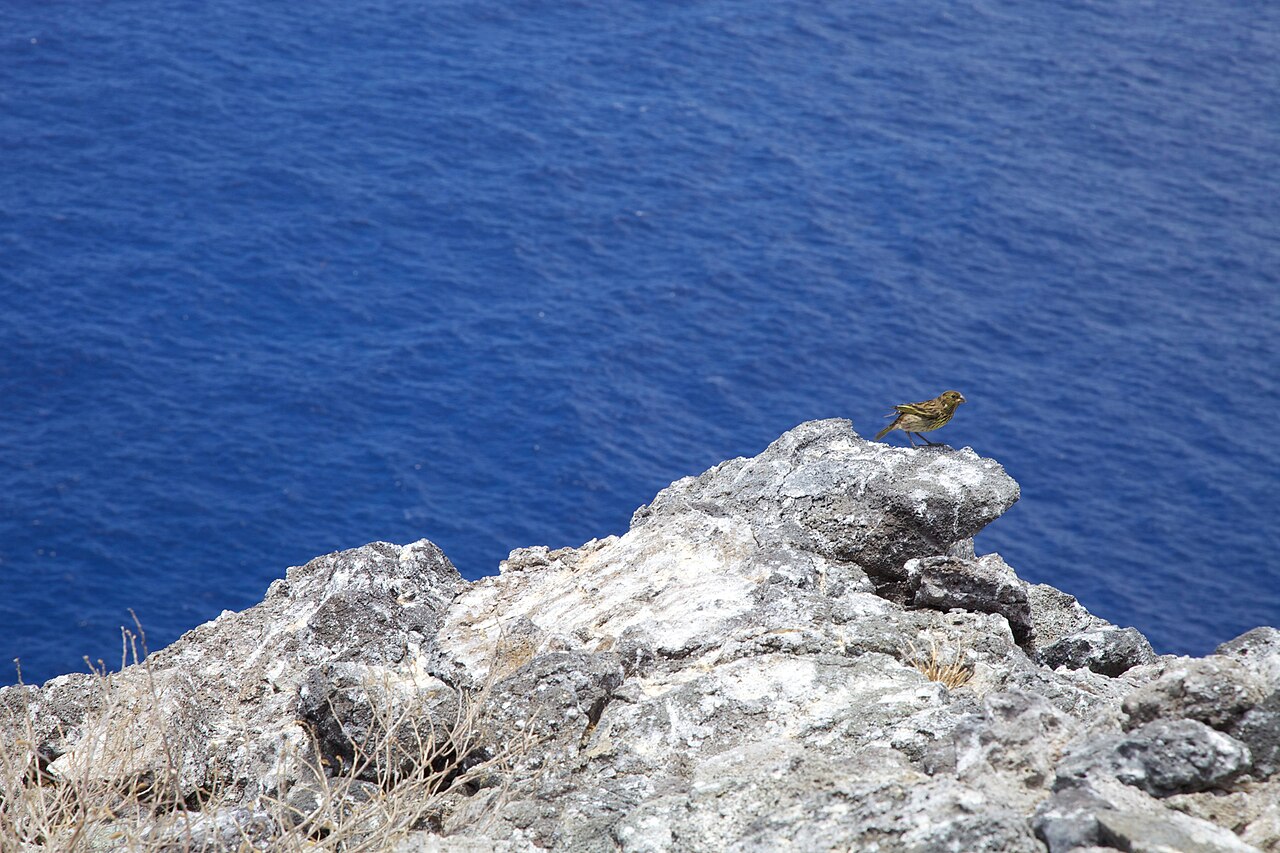
The male has a yellow head, throat and breast; the female is duller yellow and more heavily streaked, and in both the back is brown with black streaking. The bill is heavy and conical but proportionally smaller than in Laysan Finch; the legs are black and the feet large. Juveniles are largely streaked and brown. It walks and hops over the ground among boulders and low vegetation, clambers in the leaves of the loulu fan palm and probes in seabird burrows.
Confusion species
Only Laysan Finch is genuinely similar; it is larger, heavier-billed and more uniformly yellow below without streaking. The two share no island, so in practice locality decides: on Nihoa every finch is a Nihoa Finch. The only other passerine on the island is the Nihoa Millerbird, which is far smaller with a thin, slightly curved bill.
Habitat
All vegetated parts of Nihoa, from the coastal rocks to the summits at over two hundred and fifty metres, with herbaceous cover of aheahea, popolo and ilima among others, tussock grass and stands of loulu fan palms; bare ground and rock are used as well. Birds gather at the few freshwater seeps. Nesting is in crevices and cavities in the rock faces, from about thirty to two hundred and fifty metres above the sea.
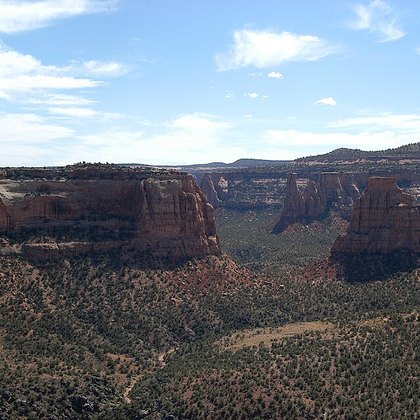
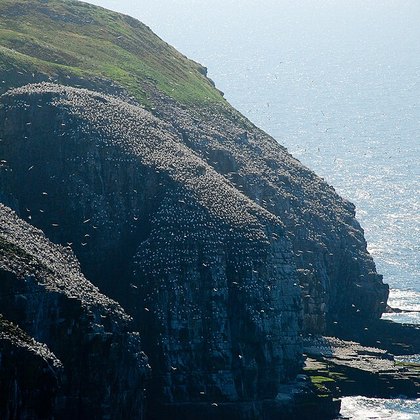
Where the bird is most often found, arranged by the USNVC — the vegetation classification of the United States and Canada — and CMECS for sea and coast.

Range and movements
Endemic to Nihoa; the entire range is one island of sixty-three hectares. Subfossil finds of related finches on the main islands show the genus was once far more widespread. In 1967 an attempt was made to found a second population at French Frigate Shoals to spread the risk, but that establishment did not hold. There is no migration; the birds do not leave the island.
- Passage
- dark = core range, pale = thinly spread
Where and when to look
Nihoa lies in the Papahanaumokuakea Marine National Monument and is reachable only by permit and by boat, with landing dependent on the surf, so sightings are effectively limited to the research trips made every few years. Anyone aboard sees the species all over the slopes; separating male from female goes fastest on the amount of streaking on breast and flank.
Conservation
Counts between 1967 and 2011 ranged from 945 to 4,647 birds, with a 2012 estimate of about 4,475 and a margin of some nine hundred; the swing follows rainfall and seed supply. The Red List treats the species as Critically Endangered (CR), not for a decline but for the single, small site: one invasion of rats from a stranded boat, one fire or one severe drought can strike the whole species. Alien plants, irruptions of the introduced grasshopper Schistocerca nitens that strips the vegetation, and in the longer term a changing climate add to it. The island is uninhabited and closed; quarantine on landing is the main ongoing measure.
Scientific name
Telespiza ultima | Bryan, 1917
William Alanson Bryan described the species in 1917; because it has remained in the original genus, author and year carry no parentheses. Telespiza comes from Greek tele 'far off' and spiza 'finch', after the remote islands. The species name ultima is Latin for 'the last, the farthest' and is usually taken as a reference to the remoteness of Nihoa and to the lateness of its discovery, when most Hawaiian birds had already been described. The specimen described came from Nihoa.