All species › Passerines › Tyrant flycatchers and allies › Alder Flycatcher
Alder Flycatcher | Empidonax alnorum
Elzenfeetiran | Mosquero Alisero
The Alder Flycatcher breeds in wet alder and willow thickets from Alaska to Newfoundland and south into the northeastern United States. Until 1973 it was treated with Willow Flycatcher as a single species, Traill's Flycatcher; the two were split on song and habitat, not on appearance, and can barely be separated even in the hand.
Voice
The song is a buzzy three-syllable phrase usually rendered fee-BEE-o or free-beer, with the stress on the middle syllable and a falling end; the bird throws its head back and jerks its tail as it delivers it. The call is a dry, short pip or kep, flat in pitch. In territorial disputes it gives a zwee-oo, a wee-oo and a rattling kitter. It sings through the day, including in the middle of the day and on migration.
Recording: Benjamin Drillat — CC BY-NC-SA 4.0 · Anchorage, Anchorage Municipality, Alaska, United States · xeno-canto
Identification
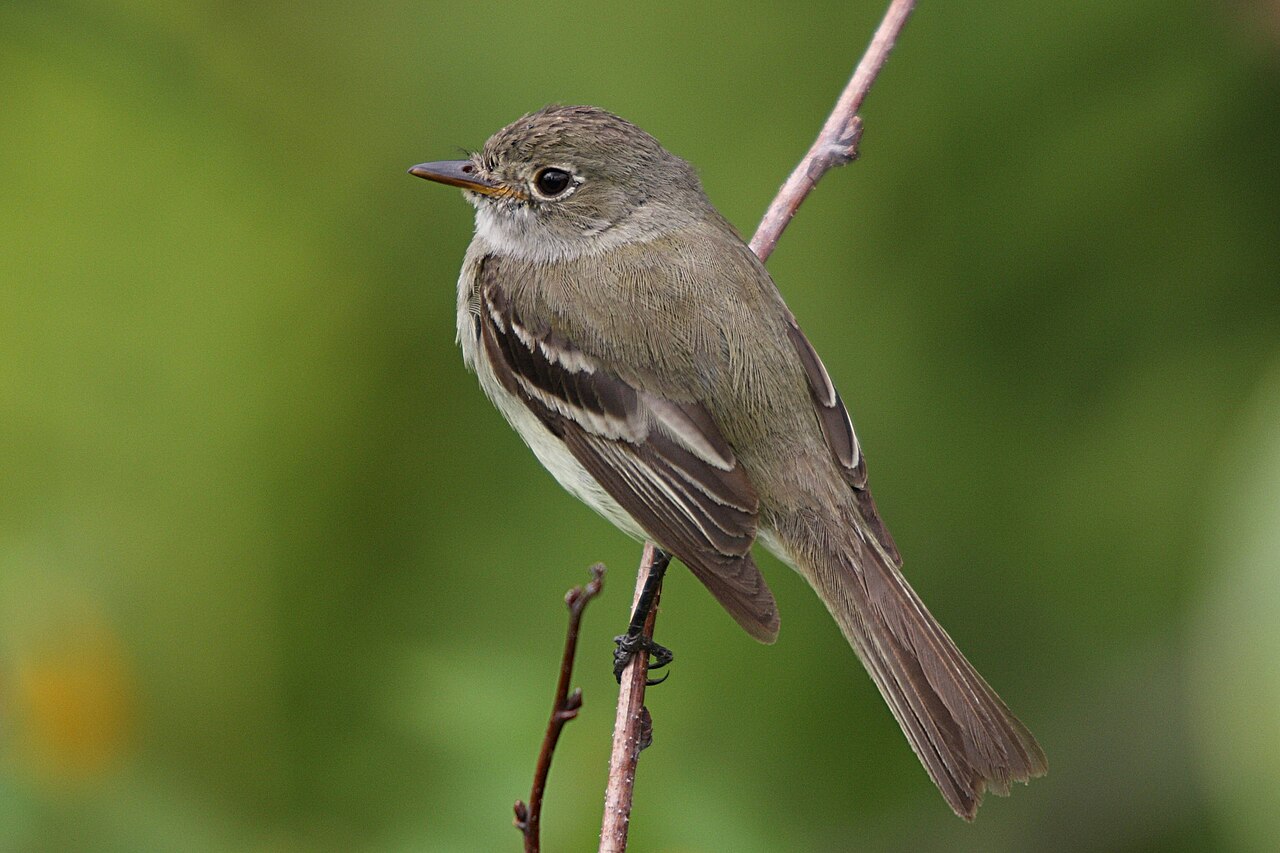
Brownish olive above, whitish below with a grey breast band and a white throat, two white wingbars, and an eyering that is faint and often barely visible — in this species and Willow Flycatcher the eyering is the least developed of the whole group. The lower mandible is pale orange, sometimes with a dark tip. The posture is upright, the head rounded. All of these marks overlap with other Empidonax; in the field only voice gives a closed identification, and silent birds of the Alder/Willow pair are routinely logged by surveyors as 'Traill's Flycatcher'.
Confusion species
Against Willow Flycatcher, the most similar pair: Alder sings a buzzy three-syllable fee-BEE-o stressed in the middle, Willow a sneezy two-syllable FITZ-bew stressed in front; the call is pip against a fuller, wetter whit. Habitat helps: alder thicket in wet, cold, northern ground and at altitude, against willow scrub in warmer, lower, more southern stream valleys; where both occur Alder usually takes the wetter, denser part. Against Acadian Flycatcher: a soft peet call, an explosive peet-sa song, and a position inside closed deciduous forest. Against Yellow-bellied Flycatcher: yellow throat, a descending burry che-BUNK and a rising whistled per-WEE. Against Western Flycatcher: a thin rising pseet or two-parted pit-PEET, a teardrop eyering, a yellow throat and a western range.
Habitat
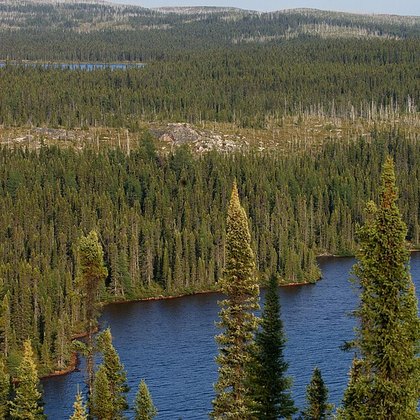
Wet, dense thickets of young alder, willow, birch and maple, usually three to eight years old, in abandoned beaver ponds, marshy meadows, bog edges and stream valleys up to about 1300 metres. Small openings and damp ground are constant elements. On migration it also uses drier forest and field edges up to 2500 metres. In winter it occupies scrub and woodland edge near water below about 1100 metres.
Where the bird is most often found, arranged by the USNVC — the vegetation classification of the United States and Canada — and CMECS for sea and coast.





Range and movements
Breeds from central Alaska and Yukon east through boreal Canada to Newfoundland, south to Minnesota, Wisconsin, Michigan, New York and New England, and along the Appalachians to West Virginia. It is among the latest migrants: arrival on the breeding grounds is often not until late May or early June, departure in August. Migration runs through the eastern United States, eastern Mexico and Central America to a wintering range in western South America, from Colombia to Bolivia.
- Breeding (summer)
- Passage
- dark = core range, pale = thinly spread
Where and when to look
Look for it in June in a wet alder thicket or an old beaver pond and wait for the song: a bird that looks like nothing in particular but says fee-BEE-o is settled. Outside the song period the species is essentially unidentifiable; log silent birds as Traill's Flycatcher.
Conservation
Partners in Flight puts the world population at about 120 million birds, making it one of the most numerous songbirds of boreal North America. The United States share is roughly stable, but in Canada numbers fell by about 44 per cent between 1966 and 2014; at that rate the population would halve again by 2082. The decline fits the wider pattern of falling numbers among aerial insectivores. The species is on the United States–Canada stewardship list.
Scientific name
Empidonax alnorum | Brewster, 1895
Brewster described the form in 1895 as the subspecies Empidonax traillii alnorum, from a specimen at Upton, Maine; after the 1973 split author and year stand without parentheses. Empidonax is from Greek empis 'gnat' and anax 'master'. The species name alnorum is Latin for 'of the alders', after the breeding habitat; the English and Dutch names say the same. The collective name Traill's Flycatcher, used for non-singing birds of this species pair, refers to the Scottish physician Thomas Stewart Traill.