All species › Passerines › Tyrant flycatchers and allies › Acadian Flycatcher
Acadian Flycatcher | Empidonax virescens
Beukenfeetiran | Mosquero Verdoso
The Acadian Flycatcher is the Empidonax of closed deciduous forest in the eastern United States: a green flycatcher of stream valleys and ravines that sits at mid level in the wood and picks insects from the undersides of leaves. Of the ten North American Empidonax it is the largest and the greenest, but here too the voice is the only identification that always holds.

Voice
The song is an explosive two-syllable outburst, peet-sa or ka-zeep, with the stress on the first syllable and an upward snap at the end; it is shorter and harder than the song of any other Empidonax. The bird sings mainly in the first hours of daylight from a dead branch halfway up the wood, repeating the phrase several times a minute for hours on end. The call is a soft, flat peet. There is also a rapid high ti-ti-ti-ti in excitement and a laughing series recalling the call of a Northern Flicker.
Recording: Mario Reyes Jr — CC BY-NC-SA 4.0 · Arburetum, Lexington, Fayette County, Kentucky, United States · xeno-canto
Identification
Olive-green above, white to pale yellow below, with two broad pale wingbars, a narrow but complete eyering and a large broad bill whose lower mandible is entirely orange. The head is angular with a peak at the rear of the crown, the tail is long, and the wingtip reaches far past the tail coverts — the longest primary projection in the group. Even so, the rule for all Empidonax applies: the colour differences between the species are smaller than the differences between a fresh and a worn bird of one species. Reliable identification rests on voice alone; a silent Empidonax in practice stays an Empidonax.
Confusion species
Against Alder Flycatcher: that species sings a buzzy three-syllable fee-BEE-o and calls a dry pip, against the explosive peet-sa and soft peet of Acadian; Alder sits knee-high in wet alder thickets, Acadian mid level inside closed forest. Against Willow Flycatcher: a sneezy two-syllable FITZ-bew with the stress in front and a full whit call, in open willow scrub, never in forest interior. Against Yellow-bellied Flycatcher: a yellow throat instead of a white one, a descending burry che-BUNK song and a rising whistled per-WEE call. Against Western Flycatcher: a thin rising pseet or two-parted pit-PEET, a teardrop-shaped eyering, and no occurrence east of the Great Plains. The supporting plumage marks for Acadian are the long primary projection and the wholly orange lower mandible.
Habitat
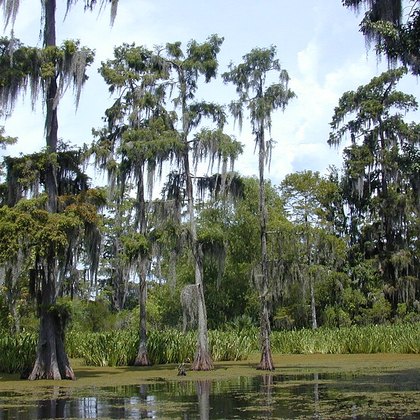
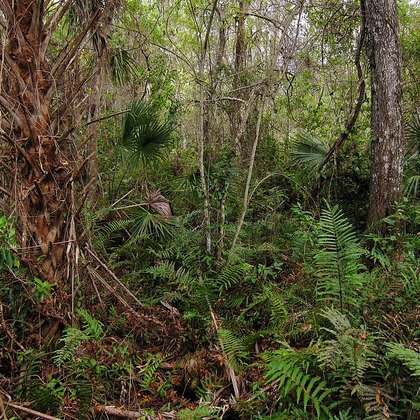
Mature, closed lowland deciduous forest, with a preference for stream valleys, ravines and swamp forest of beech, maple, sycamore and hemlock. It occupies the middle layer, below the canopy, where the understorey is open and the leaf cover dense. The species is sensitive to fragmentation and occurs more often in large forest blocks than in small woodlots. In winter it uses humid tropical forest and forest edge in the lowlands.
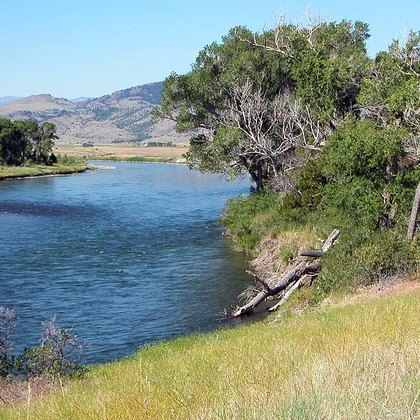
Where the bird is most often found, arranged by the USNVC — the vegetation classification of the United States and Canada — and CMECS for sea and coast.


Range and movements
A breeding bird of the eastern United States, from east Texas and east Kansas to the Atlantic coast, north to the southern Great Lakes, southern New England and extreme southwestern Ontario, south to the Gulf coast and northern Florida. It crosses the Gulf of Mexico and passes through eastern Mexico and Central America to winter from Nicaragua to Colombia, western Venezuela and Ecuador. The breeding range is occupied from late April to late August; migration is largely nocturnal.
- Breeding (summer)
- Winter
- Passage
- dark = core range, pale = thinly spread
Where and when to look
Look for it in May and June in the first hour after sunrise, in a ravine or along a forest stream inside a large block of woodland: the explosive peet-sa carries well and is repeated every ten to twenty seconds. Walk towards the sound and look up to dead side branches at eight to fifteen metres. Do not put a name on a silent bird.
Conservation
Partners in Flight puts the world population at about 5.2 million birds; the trend is stable overall, with decline in the south of the range. The main pressure is fragmentation of deciduous forest: in small woodlots parasitism by Brown-headed Cowbird rises and nesting success falls. Deforestation on the wintering grounds in Central America and northwestern South America works in the same direction. The species is used as an indicator of the condition of unbroken deciduous forest.
Scientific name
Empidonax virescens | (Vieillot, 1818)
Vieillot described the species in 1818 as Platyrhynchos virescens; because it was later moved to another genus, author and year stand in parentheses. The genus Empidonax was introduced in 1855 by Jean Cabanis, from Greek empis 'gnat' and anax 'master', thus 'master of gnats'. The species name virescens is Latin for 'becoming green', after the olive upperparts. The English name refers to Acadia in Nova Scotia, where the species does not occur; the specimen Vieillot described came from near Philadelphia. The Dutch name refers to beech, a characteristic tree of its breeding forest.