All species › Passerines › Tyrant flycatchers and allies › Willow Flycatcher
Willow Flycatcher | Empidonax traillii
Wilgenfeetiran | Mosquero Saucero
The Willow Flycatcher breeds in willow scrub along creeks, ponds and wet meadows, from the Atlantic coast to the Pacific and from southern Canada to the southwestern United States. It is the southern counterpart of the Alder Flycatcher, with which it was treated as one species until 1973; song separates the two, appearance does not.

Voice
The song is a sneezy two-syllable phrase, FITZ-bew, with the stress on the first part and a hoarse, pinched ending; the bird repeats it from a projecting twig above the scrub. The call is a dry, full whit, given outside the breeding season and on migration as well; in late summer and autumn that whit is often the only usable mark. A repeated creet is given in alarm near the nest.
Recording: Jonathon Jongsma — CC BY-SA 3.0 · Murphy-Hanrehan Park Reserve, Dakota, Minnesota, United States · xeno-canto
Identification
Brownish olive above, dingy white below with a faint yellow wash on the belly, a greyish breast band and a contrasting white throat; two whitish wingbars. The eyering is very thin or absent altogether — with Alder Flycatcher the weakest eyering in the group. The lower mandible is pale orange. The bill is proportionally broad, the head fairly flat. As in all Empidonax, appearance does not close the case: only song or call give a reliable identification, and silent birds of this species pair remain 'Traill's Flycatcher'.
Confusion species
Against Alder Flycatcher, the hardest pair: a two-syllable FITZ-bew stressed in front, against the buzzy three-syllable fee-BEE-o stressed in the middle; the call is a full, wet whit against a dry pip. Habitat adds a second line: Willow in warmer, lower and more southern willow scrub along creeks and in western mountain meadows, Alder in colder, northern alder swamps. Against Acadian Flycatcher: explosive peet-sa, soft peet, and closed deciduous forest instead of open scrub. Against Yellow-bellied Flycatcher: yellow throat against white, a descending burry che-BUNK and a rising whistled per-WEE, and conifer bog instead of willow scrub. Against Western Flycatcher, with which it overlaps in the west: a thin rising pseet or two-parted pit-PEET, a distinct teardrop eyering and yellow throat, and shaded mountain stream valleys instead of open scrub.
Habitat
Scrub of willow and other broadleaved shrubs beside standing or running water: stream valleys, marsh edges, wet meadows, silting ponds, and in the west mountain meadows and riparian belts. In the Pacific Northwest it also breeds in drier scrub on cutover ground. It winters in scrub, clearings and woodland edge near water in Central America. The nest sits low in a vertical fork, usually between half a metre and a metre and a half.
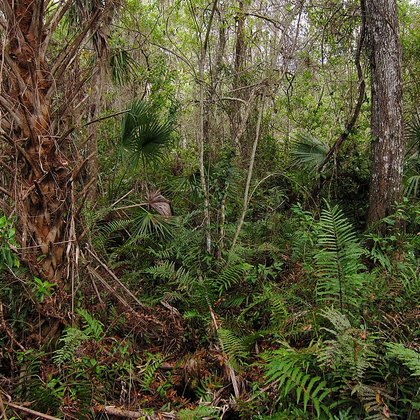
Where the bird is most often found, arranged by the USNVC — the vegetation classification of the United States and Canada — and CMECS for sea and coast.





Range and movements
Breeds from Nova Scotia and Maine west through southern Canada to British Columbia, and south through most of the United States to southern California, Arizona, New Mexico and west Texas; in the east south to the Appalachians of Virginia and North Carolina, but absent from the Deep South and Florida. Four subspecies are recognised, including extimus of the southwestern riparian woodlands. Migration covers roughly 1500 to 8000 kilometres; wintering runs from western Mexico through Central America, concentrated from Guatemala to Costa Rica, with small numbers to Ecuador.
- Breeding (summer)
- Winter
- Passage
- dark = core range, pale = thinly spread
Where and when to look
Look for it in June along a creek with willow scrub; it sings from the top of a bush and keeps going into the late morning. Wait for the sneezy FITZ-bew and ignore colour, eyering and bill. In August and September the dry whit is all there is to go on.
Conservation
Partners in Flight puts the world population at about 8.1 million birds; numbers fell by about 25 percent between 1966 and 2019. The southwestern subspecies extimus has been federally listed as endangered since 1995, with 300 to 500 breeding pairs at about 75 riparian sites at the time of listing; the causes are loss of riparian woodland, grazing and parasitism by Brown-headed Cowbird. Restoration of native riparian vegetation is the measure in use: about ninety percent of nests are found in native growth rather than in introduced saltcedar. Beavers contribute to maintaining suitable riparian scrub.
Scientific name
Empidonax traillii | (Audubon, 1828)
Audubon described the species in 1828 as Muscicapa traillii, from material in woods along the Arkansas River; because it was placed in Empidonax, author and year stand in parentheses. He named the bird after the Scottish physician and zoologist Thomas Stewart Traill. The genus Empidonax was introduced in 1855 by Jean Cabanis, from Greek empis 'gnat' and anax 'master'. The English, Dutch and Spanish names all refer to willow, the shrub in which the species usually nests.