All species › Passerines › New World warblers › American Redstart
American Redstart | Setophaga ruticilla
Amerikaanse roodstaart | Candelita norteña
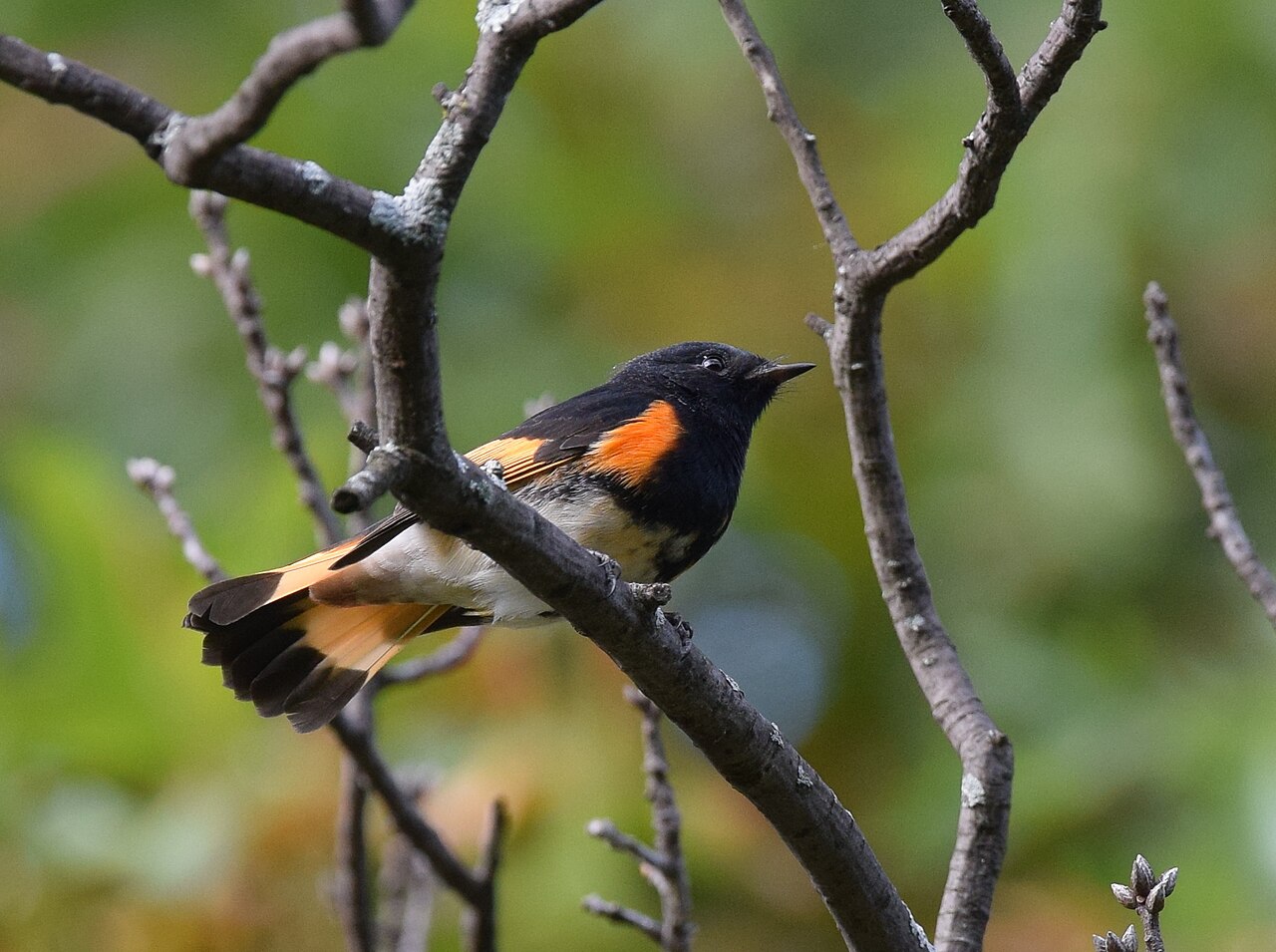
The American Redstart is a small warbler almost constantly in motion: with every hop it spreads tail and wings, flashing orange or yellow patches. The male is black and orange, the female grey-olive and yellow. The breeding range runs from Alaska to Newfoundland and south to the Gulf states.
Voice
The song is a high, thin series of four to eight see notes, often ending in a downward-slurred final note: see-see-see-seeoo. Each male holds several song types and alternates between them, which helps separate it from Yellow Warbler and Black-throated Green Warbler, which stay on one type. The call is a soft, clear chip, in flight a thin see. Through the morning its song is often the most persistent of any warbler in a mixed wood.
Recording: Scott Olmstead — CC BY-NC-SA 4.0 · Grafton Notch State Park, Oxford County, Maine, United States · xeno-canto
Identification
The adult male is glossy black with a white belly and orange patches at the base of the primaries, on the sides of the tail and on the flanks. The female is grey-olive above with a greyer head, white below, and has yellow patches in exactly the same places. First-year males resemble females, with black flecking on breast and head and sometimes an orange wash; they breed in that plumage. It often holds the tail half spread and fans it open and shut while foraging, flushing insects and taking them in the air; the broad bill with rictal bristles belongs to that hunting method.
Confusion species
Within the range of this guide little resembles the adult male. Painted Redstart (Myioborus pictus) of the mountain canyons of the Southwest is also black, but has a red belly, a large white wing patch and white outer tail feathers rather than orange. Females and young birds can suggest other yellow warblers, but the yellow patches at the base of the tail, visible the moment the tail is spread, and the spreading itself occur in no other species in this combination.
Habitat
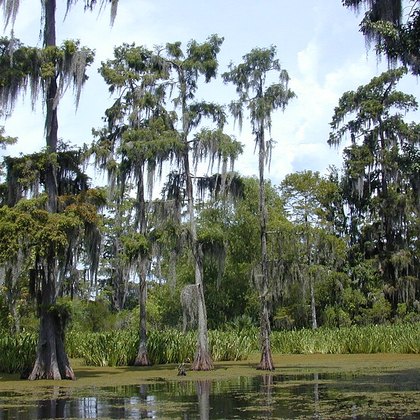
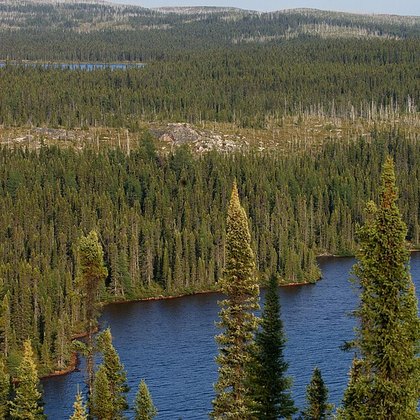
Moist second-growth deciduous and mixed woodland with a well-developed shrub layer, preferably in large forest tracts and near water: alder and willow thickets, streamside woodland, swamp forest and forest edge. Also in older parks and gardens with shrubbery. On the wintering grounds it uses mangrove, shade coffee and citrus plantings, wet lowland forest and secondary scrub; males there occupy the wetter sites on average.
Where the bird is most often found, arranged by the USNVC — the vegetation classification of the United States and Canada — and CMECS for sea and coast.




Range and movements
Breeds from southern Alaska and British Columbia across boreal Canada to Newfoundland, and in the United States from the northern Rockies and the Great Lakes eastward, south to Louisiana and through the Appalachians to Georgia. It winters from southern Florida and western Mexico through Central America and the Greater and Lesser Antilles to northern South America. In the east it is one of the most numerous migrants: in May and from mid-August onward it occurs in almost every woodlot along the flyways.
- Resident
- Breeding (summer)
- Winter
- Passage
- dark = core range, pale = thinly spread
Where and when to look
Watch the movement rather than the colour. Even at distance and against the light, the fanning open and shut of the tail is enough to name it, while the orange shows only in good light. The best period in the east is the first half of May and the second half of August; look in the shrub layer along a forest edge or a stream, not high in the canopy.
Conservation
Partners in Flight puts the global breeding population at about 42 million birds and the species scores 10 out of 20 on the Continental Concern Score. In the United States the Breeding Bird Survey gives a decline of about 1.1 per cent a year between 1966 and 2017, while numbers in Canada rose, so that the population as a whole held steady. Loss of second growth with a shrub layer on the breeding grounds and loss of forest on the wintering grounds are the main pressures; shade coffee plantations hold high winter densities.
Scientific name
Setophaga ruticilla | (Linnaeus, 1758)
Linnaeus described the species in 1758 as Motacilla ruticilla; because of the later change of genus, author and year stand in parentheses. The epithet ruticilla is New Latin, formed from rutilus 'reddish' and cilla 'tail' — the same formation that underlies the name of the Common Redstart of Europe, from which the Dutch name is taken, although the two species are not related. Setophaga is from Greek ses, genitive setos, 'moth' and phagos 'eating'. The type locality was given as 'America' and was later fixed on Virginia.