All species › Passerines › New World warblers › Kirtland's Warbler
Kirtland's Warbler | Setophaga kirtlandii
Kirtlands zanger | Reinita de Kirtland
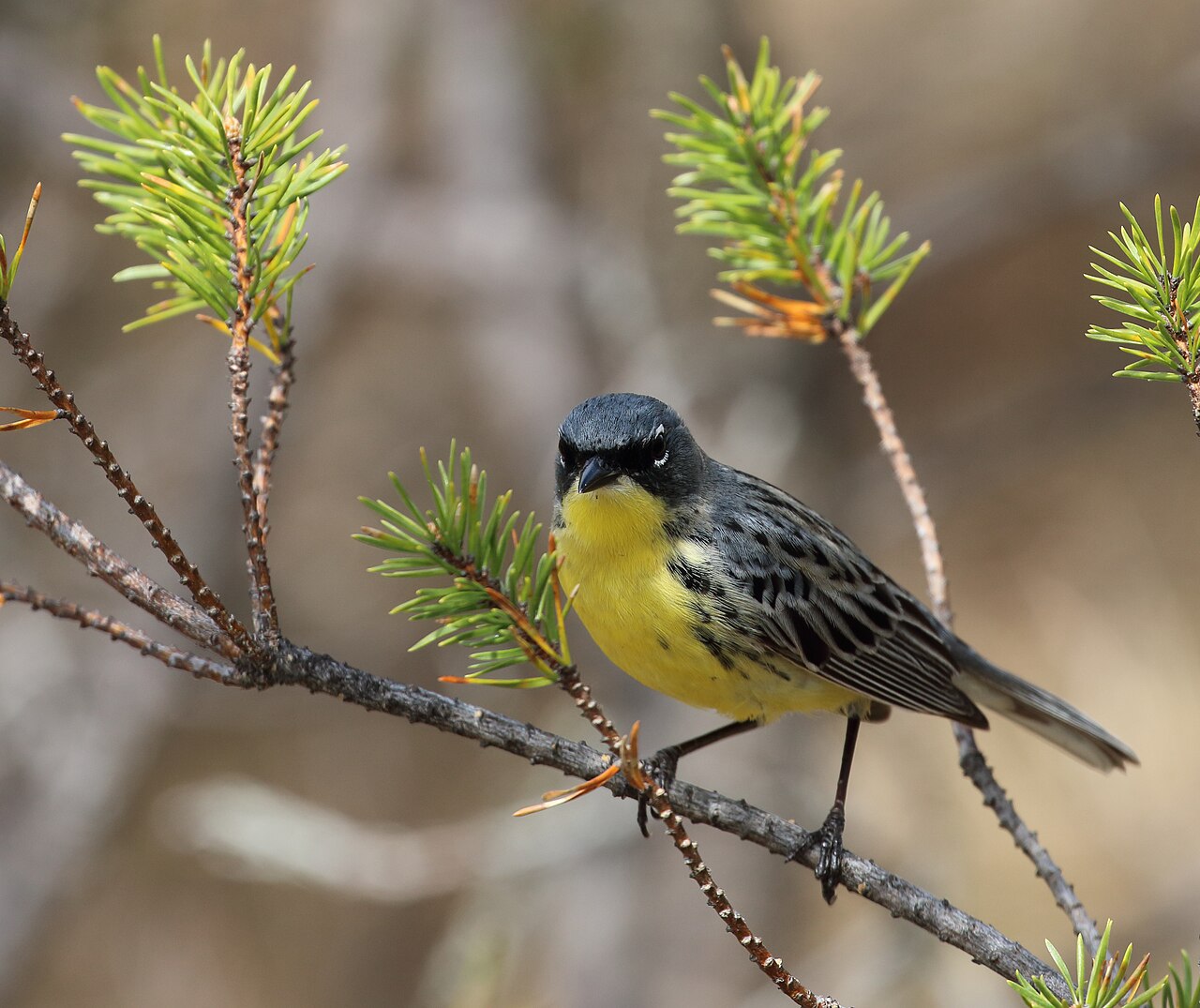
Kirtland's Warbler breeds almost entirely in extensive stands of young jack pine on poor sandy ground around the Great Lakes and winters in the low scrub of the Bahamas. It is one of the largest American warblers, blue-grey above and yellow below, with a tail that bobs almost continuously.
Voice
The song is low and full for a warbler: a series of three or four low chip notes followed by higher, louder closing notes, roughly chip-chip-chip-too-too-weet-weet, rising at the end. On still mornings it carries more than four hundred metres, further than most warblers of comparable size. The call is a low, dull chip. The male sings from a branch at the top of a young pine or an oak at the edge of the stand.
Recording: Sue Riffe — CC BY-NC-SA 4.0 · Curtis & Kobbs Rd, Michigan, United States · xeno-canto
Identification
Large for a warbler, with a long tail. The male is blue-grey above with black streaks on mantle and back, yellow below with black streaking along the flanks, and has a black lore and two short white arcs above and below the eye. The female is browner grey and more faintly streaked. Both sexes bob the tail constantly, a habit unusual among the northern members of this genus and evident at a distance. It forages low, often in the lower branches of young pines and on the ground beneath them.
Confusion species
Prairie Warbler also bobs its tail, but is clearly smaller, olive-green above with chestnut marks on the back, and has a black line through the eye and a second below the cheek. Magnolia Warbler has a white wingbar and a broad white band across the tail. Canada Warbler has a necklace of black streaks and an unstreaked grey back. The combination of a grey, black-streaked back, broken white eye arcs and persistent tail-bobbing is unambiguous.
Habitat
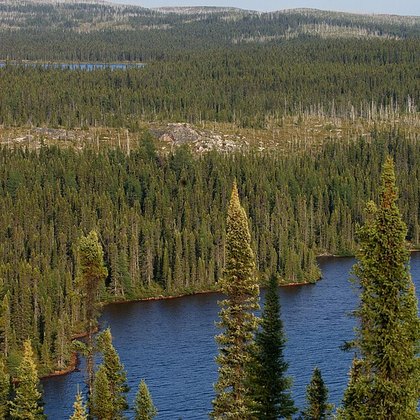
Unbroken stands of young jack pine roughly four to twenty-five years old and one and a half to six metres tall, on poor, free-draining sand, in blocks of at least sixty-five hectares, with open gaps between the pine clumps and live branches running down to the ground — the nest sits on the ground beneath them. Such stands arose naturally after fire; today they are planted in blocks. In winter it uses low, dry scrub and coppice (low, dense thicket on limestone, Caribbean and southern Florida) on the outer Bahamian islands, where it feeds largely on fruit.
Where the bird is most often found, arranged by the USNVC — the vegetation classification of the United States and Canada — and CMECS for sea and coast.



Range and movements
The breeding range lies almost entirely in the northern Lower Peninsula of Michigan, with smaller numbers in the Upper Peninsula, in Wisconsin and in Ontario. Wintering is nearly confined to the Bahamas, with small numbers in the Turks and Caicos. Migration runs in a narrow band through Ohio, southern Ontario and the Carolinas; records outside that band are scarce and are documented case by case.
- Breeding (summer)
- Winter
- Passage
- dark = core range, pale = thinly spread
Where and when to look
The season is late May to early July, in the managed jack-pine blocks near Grayling and Mio in Michigan. The breeding areas are then open only on a guided tour; outside them, stay on the road and scan the tops of the young pines. The song carries far, so drive slowly with the window down and step out as soon as you hear it.
Conservation
In 1974 only 167 singing males were counted. Two measures working together — cutting and replanting jack pine in blocks so that young stands are always available, and trapping Brown-headed Cowbirds, which were laying in the nests — raised numbers to over 2300 pairs by 2018. The species stayed above the recovery goal of a thousand pairs for seventeen consecutive years and was removed from the United States endangered species list in 2019. The IUCN keeps it as Near Threatened (NT): the population remains dependent on continuing management, since without new planting the existing stands grow out of the usable stage within a few decades.
Scientific name
Setophaga kirtlandii | (Baird, 1852)
Spencer Fullerton Baird described the species in 1852 as Sylvicola kirtlandii, after Jared Potter Kirtland, an Ohio physician and naturalist, on whose land near Cleveland the described specimen was taken; because of the later change of genus, author and year stand in parentheses. Setophaga is from Greek ses, genitive setos, 'moth' and phagos 'eating': 'moth eater'. The first nest was not found until 1903, more than fifty years after the description.