All species › Passerines › New World sparrows › American Tree Sparrow
American Tree Sparrow | Spizelloides arborea
Toendragors | Chingolo arbóreo
The American Tree Sparrow breeds at the treeline in Alaska and northern Canada and winters in the northern United States and southern Canada, where it forages in small flocks in weedy fields and along woodland edges. Across most of the guide area, then, it is present precisely in the coldest months.
Voice
The song is a sweet, high warble that descends in pitch and turns buzzy at the end: two or three clear whistled notes followed by a faster, rougher series. Males begin singing in late winter, before moving north. The common call is a clear, two-syllabled teel-wit, and a foraging flock keeps up a soft, tinkling tseet that at a distance sounds like small bells.
Recording: Valerie Heemstra — CC BY-NC-SA 4.0 · Nadeau Township (near Carney), Menominee County, Michigan, United States · xeno-canto
Identification
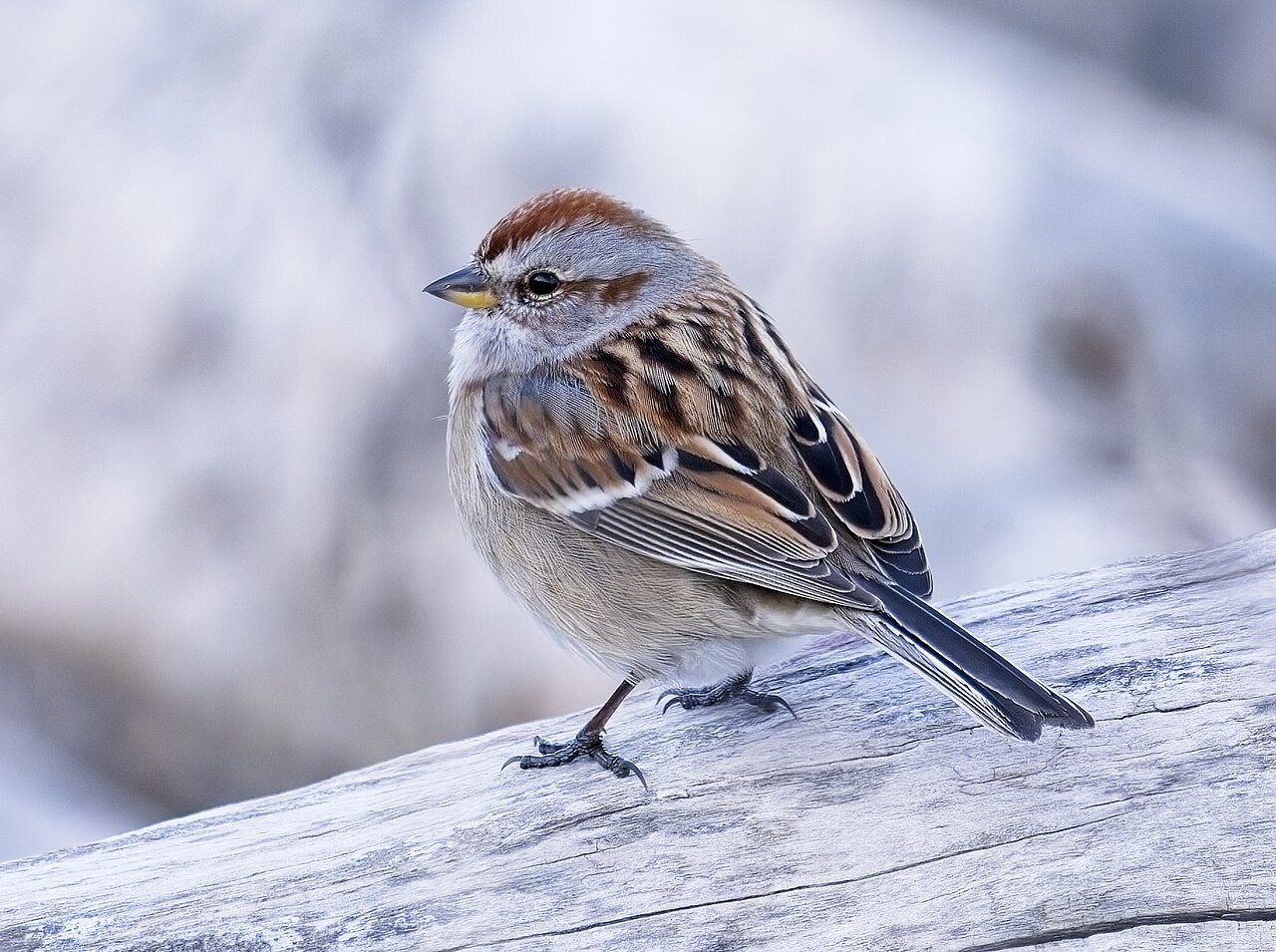
A sparrow with a rusty cap and a rusty eyeline on a grey head, a streaked brown back, one white wingbar and a long, thin tail. The underparts are plain grey with a dark smudge in the centre of the breast; the flanks are washed light buff. The bill is bicoloured: dark above, yellow below. In winter the bird looks plump because it fluffs its feathers. Male and female are alike.
Confusion species
Chipping Sparrow in nonbreeding plumage is the main confusion species: it has an all-dark bill, no breast spot, a grey rump, and a sharper dark eyeline running through the eye rather than behind it. Field Sparrow has an all-pink bill, a white eye-ring and no breast spot. Song Sparrow has a heavily streaked breast in which the spot is part of the streaking, not a separate dot on a plain ground. The bicoloured bill is the quickest mark in all postures.
Habitat
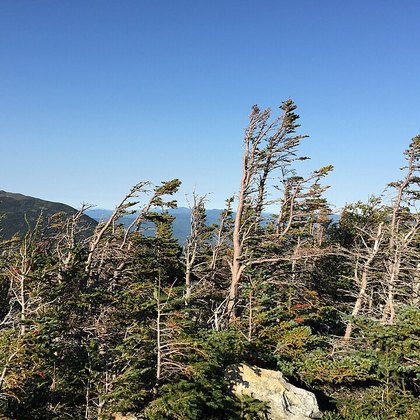
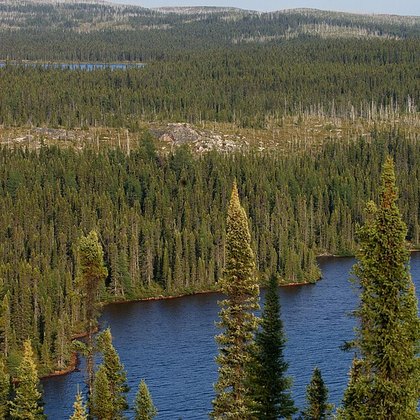
Breeds in the transition zone where northern forest gives way to tundra: thickets of alder, willow, birch and scattered spruce, often near bog and watercourses. In winter it seeks weedy fields, marsh edges, hedgerows and open woodland, and in settled areas gardens and backyards, where it comes to feeders for millet.
Where the bird is most often found, arranged by the USNVC — the vegetation classification of the United States and Canada — and CMECS for sea and coast.





Range and movements
The breeding range covers Alaska, Yukon, the Northwest Territories, Nunavut and the northern edge of the provinces as far as Labrador. The winter range lies wholly to the south of it: southern Canada and the northern half of the United States, roughly from Washington, Idaho and Montana east to New England and south to Kansas, Missouri, Kentucky and Virginia. It migrates late in autumn and early in spring; females on average winter somewhat further south than males.
- Resident
- Breeding (summer)
- Winter
- Passage
- dark = core range, pale = thinly spread
Where and when to look
In December and January look for a weedy field or a reed edge with seed heads standing above the snow, and listen for the flock's tinkling contact notes. Foraging birds beat grass seedheads sticking out of the snow with their wings to shake the seeds loose — an action that can be watched closely at short range.
Conservation
The species is listed as Least Concern (LC). The world population is estimated at about 26 million birds, and Partners in Flight scores the species 10 out of 20 on the Continental Concern Score, the lowest class of concern. Even so it is on the list of common birds in steep decline: numbers are falling steadily although the bird is still numerous. The pressures named are development in the northern breeding range and, locally, arsenic contamination in gold-mining country.
Scientific name
Spizelloides arborea | (Wilson, 1810)
Alexander Wilson described the species in 1810 as Fringilla arborea from a specimen taken in Pennsylvania; because it was later moved to another genus, author and year stand in parentheses. The species name arborea is Latin for 'of the trees' and was given for the resemblance to the Eurasian Tree Sparrow; the bird itself is not particularly arboreal and nests on the ground. The genus Spizelloides was introduced in 2014 by Slager and Klicka: the name means 'resembling Spizella', after genetic work showed the species stands well apart from the true Spizella sparrows. The Dutch name refers to the breeding range rather than to trees.