All species › Passerines › New World sparrows › Fox Sparrow
Fox Sparrow | Passerella iliaca
Roodstaartgors | Chingolo zorruno
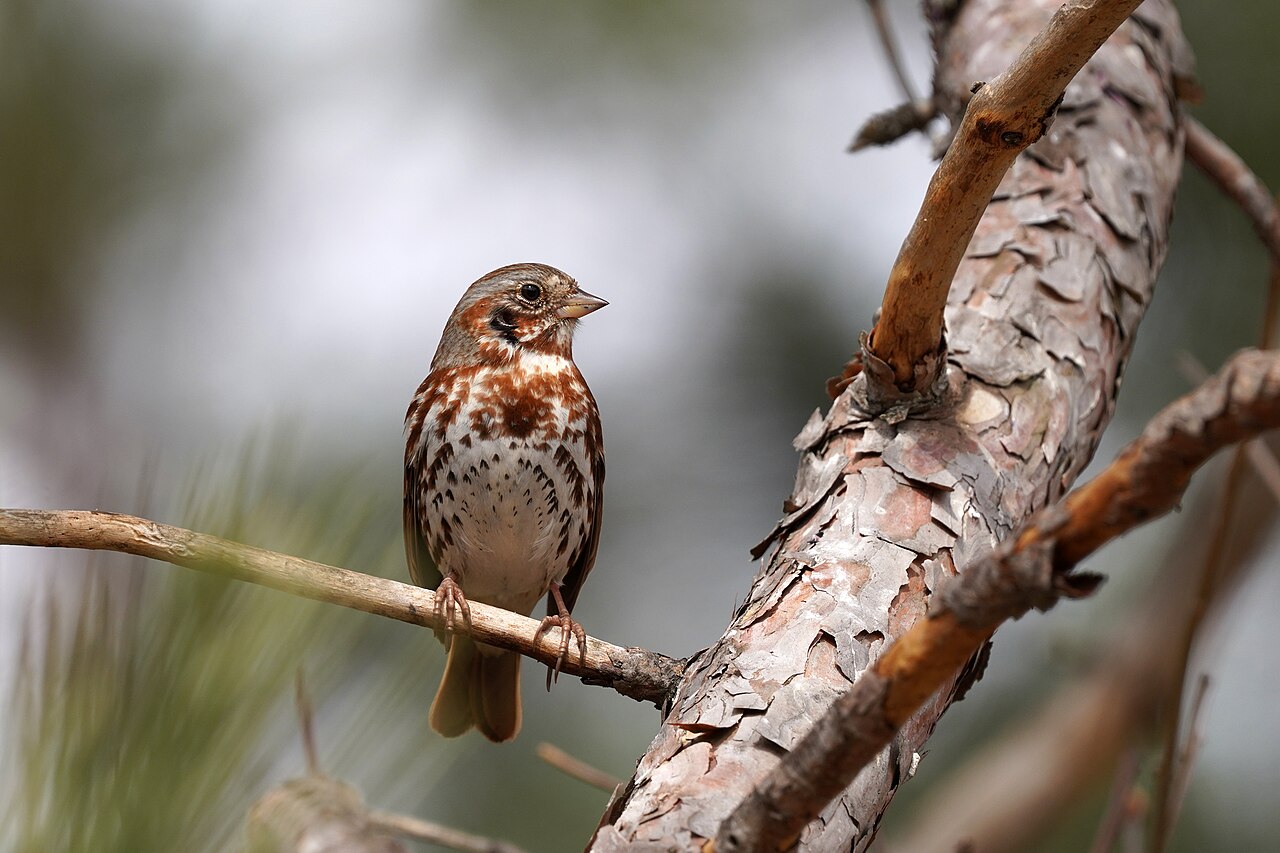
The Fox Sparrow is one of the largest and heaviest-built New World sparrows: a bulky, stout-billed ground bird with heavy triangular spotting on the breast. Four strongly differing groups go under the one name, from fox-red in the east through slate-grey in the Great Basin to dark brown along the Pacific coast.
Voice
The song is a sequence of about a dozen rich, whistled notes lasting two to three seconds, delivered from a concealed perch inside scrub. Eastern birds have one or two song types per male, western birds three or four, and western songs sound thinner and burrier. The contact call is a sharp smack that differs in tone between the groups, alongside a thin sip and a low chu-chu. Females sometimes give a shorter, quieter version of the male's song.
Recording: Valerie Heemstra — CC BY-NC-SA 4.0 · Cedarville Township (near Cedar River), Menominee County, Michigan, United States · xeno-canto
Identification
A heavy sparrow with a rounded head, a short thick bill and a fairly long tail that is often redder than the back. The underparts carry coarse, inverted-V spots that run together into one large blotch at the centre of the breast. The Red group is rusty on tail and wings with grey on head and nape; the Slate-colored group has an even grey head and back with rufous wings; the Thick-billed group resembles it but has a markedly heavy, blunt bill; the Sooty group of the Pacific coast is almost uniformly dark brown with dull brown spotting. The bill ranges from yellowish to dark grey.
Confusion species
Song Sparrow is the species it is most often confused with, but is clearly smaller and slimmer, with fine brown streaking instead of coarse spots and a striped head with a dark malar stripe and pale supercilium — the Fox Sparrow's head is nearly unmarked. California Towhee is larger and longer-tailed, plain brown and unspotted below. American Tree Sparrow has a rufous crown and an unspotted breast with a single central dot. Watch the foraging too: the Fox Sparrow rakes the litter with both feet at once, hopping forward and back.
Habitat
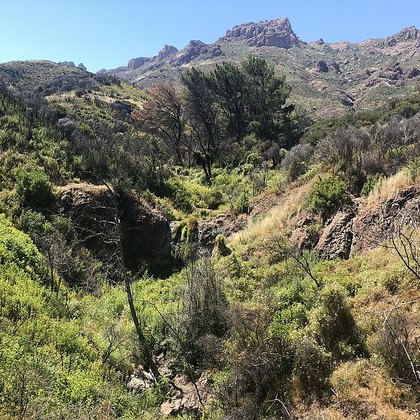
Breeds in dense low scrub: willow and alder thickets along taiga streams, dwarf birch flats at treeline, and in the west chaparral (dense, hard-leaved scrub of California's Mediterranean climate) and brushy high-elevation fields up to above 3000 metres. Outside the breeding season it uses dense undergrowth, woodland edges, bramble thickets and sheltered town gardens, where it rakes through the spilled seed beneath feeders. It avoids open bare ground and stays within a hop of cover.
Where the bird is most often found, arranged by the USNVC — the vegetation classification of the United States and Canada — and CMECS for sea and coast.





Range and movements
The breeding range runs from western Alaska and the Aleutians through boreal Canada to Newfoundland, and south along the western mountains into the Sierra Nevada and the Rockies of Colorado. Along the Pacific coast of British Columbia, Washington, Oregon and California the species is present year-round, as birds from the north replace local breeders that have moved south. The winter range falls into two blocks: a Pacific strip from southwestern British Columbia to Baja California, and an eastern block from the Ohio Valley to the Gulf Coast and Florida. In northern Mexico it occurs in small numbers in Baja California, Sonora and Chihuahua.
- Resident
- Breeding (summer)
- Winter
- Passage
- dark = core range, pale = thinly spread
Where and when to look
In winter, listen for the foraging itself: the loud rhythmic scratching in dry leaves under a dense shrub gives it away before you see it. The best chance in the east is a feeder with shrubbery beside it, between late October and April. Note the colour of back, tail and bill at every sighting — the four groups are separable in the field and may one day be treated as separate species.
Conservation
Partners in Flight puts the world population at about 35 million birds; numbers have been stable since 1966 and the species is listed as Least Concern (LC). Whether it is one species or several is not yet settled. The groups are unevenly placed: the Thick-billed form of the Sierra Nevada and some coastal forms of southern Alaska have small ranges and are tracked separately. Large-scale clearing of scrub and building along the Pacific coast affect the wintering grounds above all.
Scientific name
Passerella iliaca | (Merrem, 1786)
Merrem described the species in 1786 as Fringilla iliaca; because it was later moved to another genus, author and year stand in parentheses. The genus Passerella was introduced in 1837 by William Swainson as a diminutive of Latin passer 'sparrow'. The species name iliaca is from Latin ilia 'flanks', after the markings on the sides. The English name Fox Sparrow and the Spanish chingolo zorruno both refer to the fox-red of the eastern form; the Dutch name singles out the reddish tail. The type locality was later restricted to Quebec.