All species › Swifts › Hummingbirds › Anna's Hummingbird
Anna's Hummingbird | Calypte anna
Anna's kolibrie | Colibrí de Anna
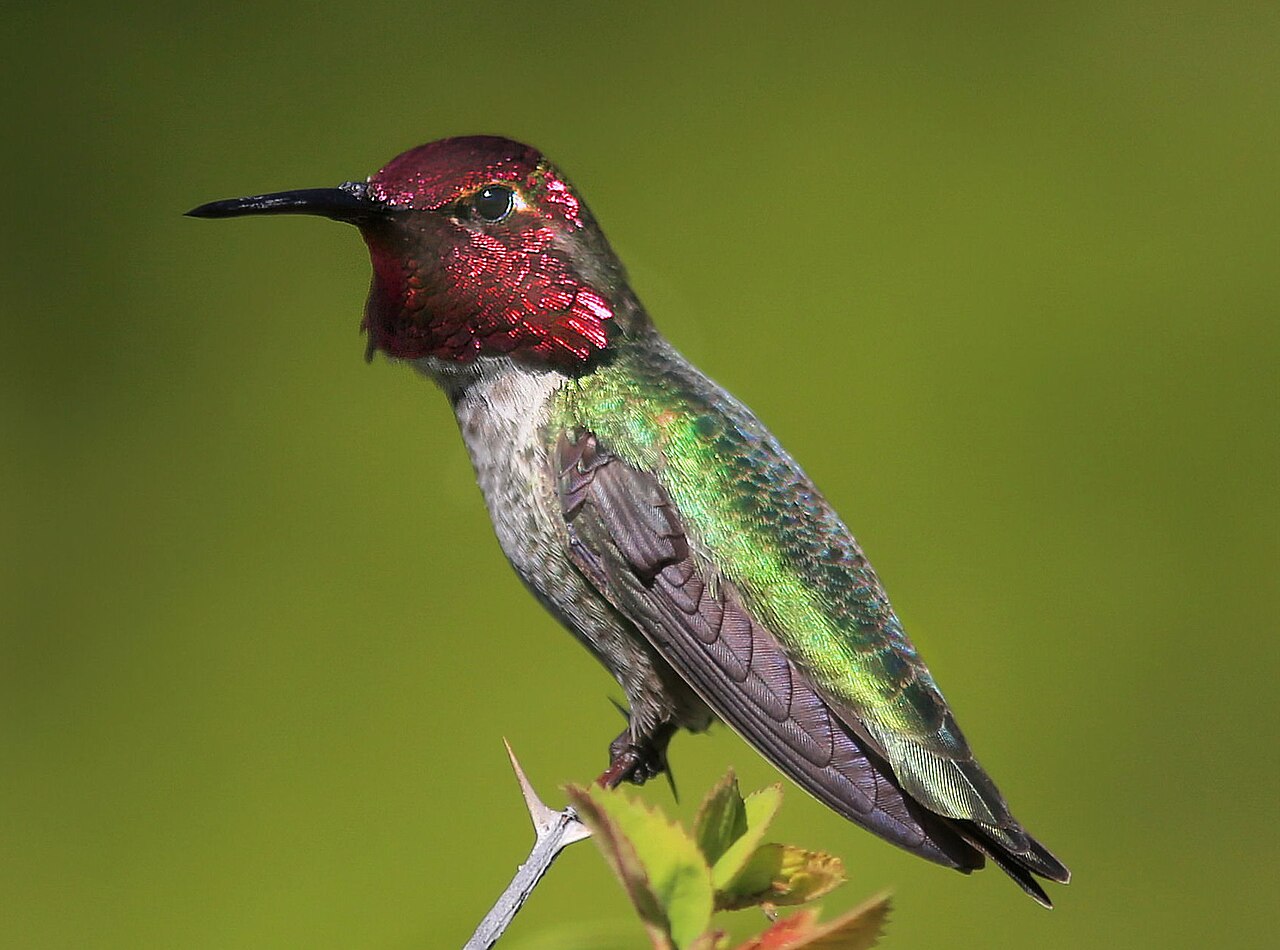
Anna's Hummingbird is the only hummingbird in North America in which not just the throat but the whole crown glows rose-red. It is also the only one that stays all year in the northwest, as far as British Columbia, and that may begin nesting there in December.
Click a thumbnail to switch the photo above.
Voice
It is the most vocal hummingbird on the continent: from a bare twig the male sings a scratchy, buzzing song of ten seconds or more, with clear whistles and emphatic chip notes among the buzzes. Song of this kind is unusual in hummingbirds and makes the bird findable by ear. The call is a series of short, sharp chip notes that run together into a twitter when the bird is excited. At the end of the display dive comes a brief explosive squeak; high-speed video has shown that it does not come from the throat but from air rushing past the modified outer tail feathers.
Recording: Greg Irving — CC BY-NC-SA 4.0 · Dungeness Recreation Area, Clallam County, Washington, United States · xeno-canto
Identification
The male has both crown and throat covered in rose-red iridescent feathers that run out into points at the sides of the neck; otherwise he is green above and greyish green below, without any rufous. That sheen is an interference colour from the structure of the feather and not a pigment: without direct light the head looks dull brown or grey-black. The female is green with grey underparts and usually shows a small patch of red spangles in the centre of the throat — the only female hummingbird in the West with such a patch. For a hummingbird the build is sturdy, with a short straight bill and a fairly broad tail.
Confusion species
Costa's Hummingbird is smaller and shorter-tailed and has a violet-purple crown and throat with far longer points along the neck. The male Broad-tailed Hummingbird does have a rose-red throat, but a green crown, rufous edges to the tail and a loud, sustained wing trill in flight. Female Black-chinned Hummingbirds are smaller and slimmer, with an unmarked pale throat and a longer bill. When the throat patch is missing, judge size and posture: Anna's looks heavier and perches more calmly than the other western species.
Habitat
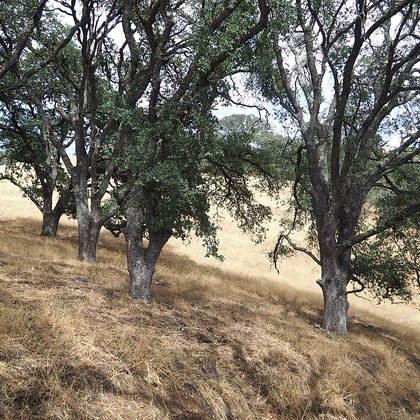
Gardens, parks, street plantings and eucalyptus groves as much as chaparral (dense, hard-leaved scrub of California's Mediterranean climate), coastal scrub, open oak savanna and riverside woods. Of all North American hummingbirds it is the most thoroughly bound up with settled country: planted flowers and feeders give it food even in midwinter. It avoids closed conifer forest and high mountains, though after breeding it moves up onto the lower slopes. Where nights fall below freezing it lowers its body temperature and metabolism — it goes into torpor (a state of lowered metabolism, a kind of overnight hibernation) — and returns to the feeder at first light.
Where the bird is most often found, arranged by the USNVC — the vegetation classification of the United States and Canada — and CMECS for sea and coast.




Range and movements
Resident along the Pacific coast and the adjoining interior, from southern British Columbia to northwestern Baja California and east to Arizona. Around 1900 the range lay almost wholly within California and Baja California; from the 1930s the species spread north to Vancouver, Washington and Oregon, and now to southeastern Alaska, where small numbers winter. Planted exotic shrubs and trees, eucalyptus among them, and feeders kept filled year-round made that possible. In the interior southwest it appears mainly outside the breeding season.
- Resident
- Breeding (summer)
- Winter
- Passage
- dark = core range, pale = thinly spread
Where and when to look
Look for it in winter and early spring: it nests from December into March, when no other hummingbird is present in the northwest; a singing male then often perches on a bare twig above a garden. Stand ten metres off and wait until he turns towards the sun; only from that angle do crown and throat light up together.
Conservation
Numerous and strongly increased: breeding bird surveys show a rise of more than two per cent per year between 1966 and 2019, and the population is estimated at about 9.6 million birds. The species is not threatened (LC) and clearly benefits from gardens and feeders. The best-documented threat is the domestic cat, which takes birds mainly at low-flowering garden plants; in addition, northern winterers come to depend on feeders kept filled and free of ice through frost.
Scientific name
Calypte anna | (Lesson, 1829)
René Lesson described the species in 1829 as Ornismya Anna; because it was later moved to another genus, author and year stand in parentheses. The genus Calypte was introduced in 1856 by John Gould; the name goes back to Greek kalyptre, 'veil' or 'head-dress', a reference to the coloured crown. The species name honours Anna Masséna, Duchess of Rivoli, wife of the collector in whose cabinet the specimen ended up. The specimen described came from California, namely from San Francisco.